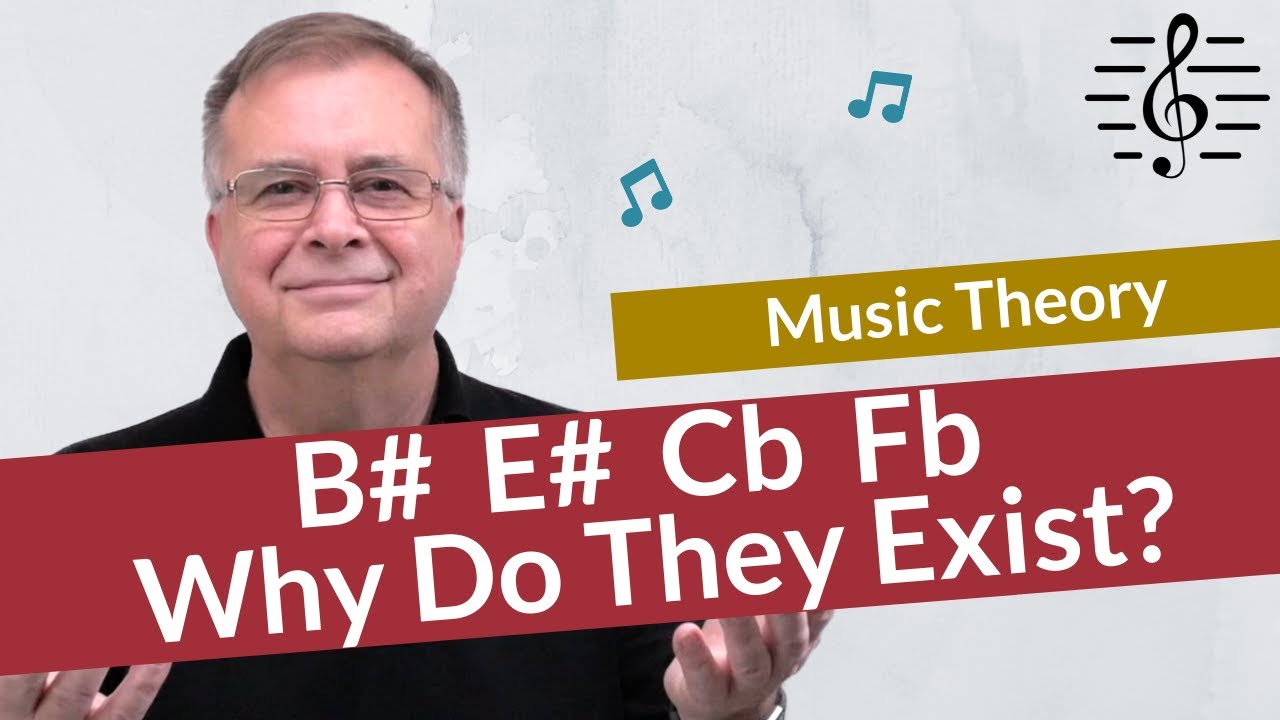
Why the Notes E# B# Cb and Fb Really Do Exist - Music Theory
video description
Date: 2022-03-28
Related videos



Comments and reviews: 10
Amaroth
It's hilarious to see this long explanation why musicians like to keep it ABCDEFG while sitting in a country using German system where B is called H because... reasons :D. Honestly, I can sort of understand what is the idea behing this system, however, it seems to me incredibly overengineered and redundant. I just don't see how is piling all of this on top of everything helpful. Why do we use 7 letters instead of using 12 and being simply done with it. Yes, we'd have to remember which letters are being skipped in a given scale, however, we'd avoid this mental gymnastics of -E is in fact also F flat or E double sharp...-. Just tell me I am supposed to play E, I know what string, fret or position it is on my instrument of choice, do not bring up to 5 different names for it just because it's neat to say in order. We do not actually play the music saying ABCDEFG in the end, we are to play the notes. Or the true reason is still utterly escaping me. You explained how it works, but not really why that is actually a good or practical idea to anyone but someone who is trying to remember a scale. Anyone playing a string instrument has to do by working with 12 positions and frets instead of redundant 7+5 keys already anyway.
Still, thank you for a very good video, it is much appreciated, but it did not answer the real question I personally have.
reply
Steven
I think this is the wrong question. The question isn't why are there missing flat and sharps. The question is why are there octaves? The spacing in between two notes that are the same (A4 and A5 for example) is dictated by a 1:2 ratio in frequency. Then you divide that into 12 parts (in an equally tempered scale). So, why don't we just name them notes A-L and repeat on the 13th note with A again? The octave with the white keys on the piano makes sense for the C major scale, but not for any other scale where you have to hit flat/sharp notes in order to sound good. The spacing between the simple letter octave notes is not evenly spaced in terms of frequency. That's why some are a whole tone apart, and some are spaced by a semitone.
reply
john
While most white sharps and flats do not have keys in the Circle of 5th-s (in which they are theoretical keys or impossible keys with double-sharps and double-flats), Cb actually does have a key listed in the circle and is allowed to be used in practice as it does not contain any double-flats or double-sharps (in this case being the key of Cb Major, which goes as Cb, Db, Eb, Fb, Gb, Ab, Bb, Cb). Don-t expect this to be the same with the key of Cb Minor though, as there are double-flats in the key signature and is thus not listed in the Circle of 5th-s.
However, most musicians prefer to use B Major as it only has 5 sharps as opposed to Cb Major-s 7 flats, even though Cb Major is not a theoretical key.
reply
Flutterby
Me again! Thank you so much for sharing your knowledge! I am seriously considering taking up further courses with you when I'm ready to commit.... Just a quick question on this one if you please - Am I right in thinking that the double flats and double sharps are used as eharmonics in order to always have each letter of the alphabet in any scale? If that makes sense.... So as you may have had F you'd then have Gb and if you needed another G the doubles would be used? I'm struggling to ask the question let alone know the answer, I really hope I'm making sense with what I'm trying really hard to ask - I will try again if it's too confusing! I would love your brain!!! Thank you so much Gareth -
reply
Ruby666
sometime G# minor using Ab minor too when in harmonic and melodic minor
because G# harmonic minor will have double sharp but on Ab harmonic minor will using natural sign
which making Ab minor in harmonic and melodic minor sometime easier to read
7 flat with natural will easier than 5 sharp with double sharp
but if I am arranger in natural minor (without modulating) i go G# minor 100% but in harmonic or melodic minor i may consider Ab depending how it modulating
btw I think you should wrote -G# harmonic minor- instead -G# minor- because
some people can confuse when see -G# minor- word it will think -G# natural minor- instead -G# harmonic minor-
reply
SuperJeremiah333
Not sure why everybody likes it, but to me it's complete rubbish!
The basic assumption that there's such a key as Gb is the problem - there's no such key, it's F# and F# minor.
But even if you prefer to say Gb, there's no need to confuse everybody by being enslaved to the idea that you can only have one of each letter of the alphabet in a key or scale - the # or b sign after the letter is perfectly fine to distinguish it, and they almost always indicate a note that's between 2 notes with single letter names, so why confuse the issue?
As far as I'm concerned this is creating an imaginary problem, and then solving it by creating a real one!
reply
Wheatley
It seems like the key phrase here is -because I want one of each letter- - which I would take to mean that it's a convention of written notation rather than a real difference in the frequency of the note. It is thus a question of communication or interpretation (theory) rather than practical effect or physical reality (existence). If so, it seems like it is not correct to say that they -exist- so much as they are convenient ways of thinking of music to make reading it easier and possibly to make certain musical reasoning easier.
reply
Ashraf
I am grateful to you Gareth because you encouraged me sometime ago to write the scores for my documentaries. When I asked for your pro guidance to evaluate the music which I wrote, I found your comments and guidance very useful. Few weeks ago I uploaded an extended trailer for my upcoming documentary and people were asking me who wrote the music for you? they liked it very much. Sound effects and score. You are a great person. Thank you for your wonderful music tutorials.
reply
Robert
Off the point a bit but what, on the piano at least, determines the choice between using the G flat and F sharp keys signatures? I can see it for an instrument like the harp where the flats are a bit different in tone than the sharps because the strings are at a different tightness and sound a bit different, but on the piano?
reply
Mike
Great lesson Gareth. I do have a question. Bach-s fugue is in G#minor. However it isn-t specified whether it-s natural, harmonic, or melodic. Is this something a musician has to figure out on his own by looking at the notes? Since the 7th note of the scale is raised a semi-tone, would Bach-s piece be considered harmonic minor?
reply
Add a review, comment
Other channel videos