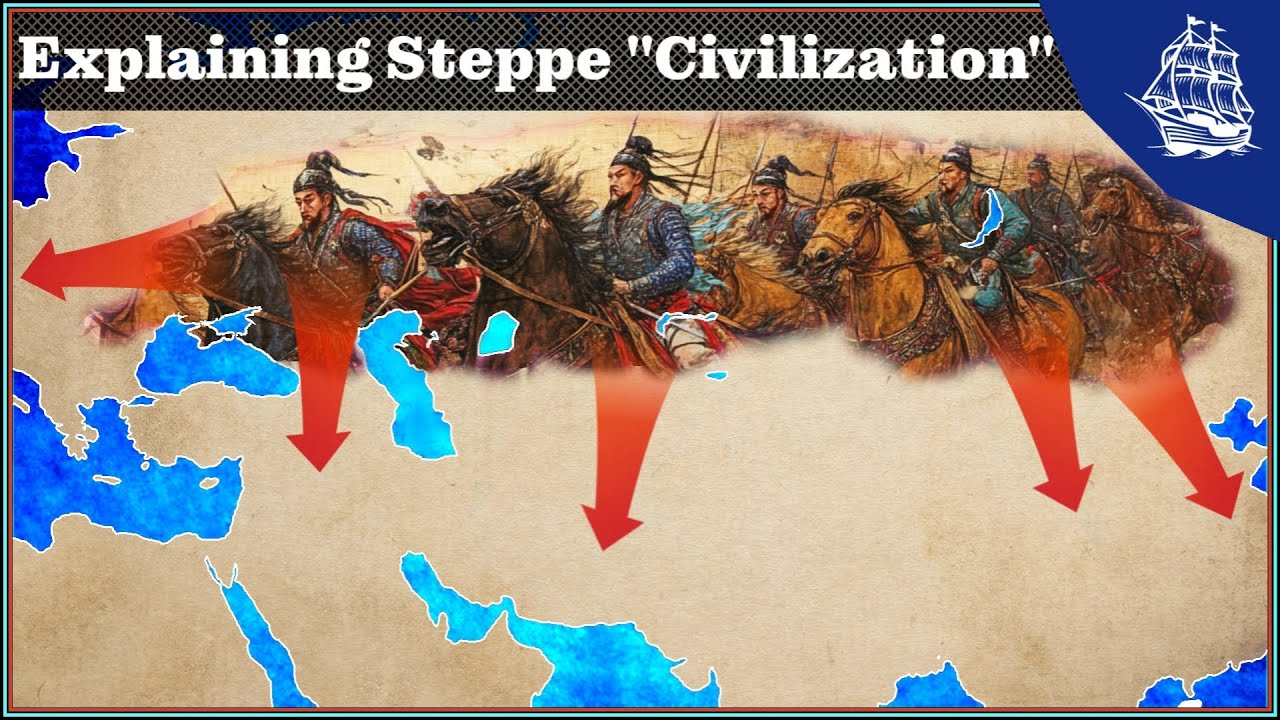
Explaining Steppe Anti-Civilization
video description
Date: 2025-03-05
Related videos




Comments and reviews: 20
choysakanto6792
Westoid civilizationists always like to shat on the Mongols as uncivilized savages when:
1. They have a culture and social system of their own, which still persists today.
2. They literally built cities entirely on their own. The imperial capital city of Karakorum was built entirely with Mongol hands. Same goes to Sarai which went on to become the largest and most populous city in the entire Europe until the collapse of the Golden Horde.
3. Their savagery isn't any different elsewhere. European kingdoms themselves despite professing Christianity would later go on to commit the largest genocide in the entire history of the world.
And it isn't without a cause. For long periods of time in the past, Mongolia and Central Asia in general used to be repeatedly conquered and controlled by oppressive Chinese military governors extracting heavy tribute from the already poor steppe locals, it's especially exemplified during the Han and Tang dynasties, and the fact that the Jin had this penchant of abducting huge groups of steppe folk to make them serve as chattel slaves is literally one of the major reasons why Genghis went to war in the first place.
And the sack and burning of Khwarezm is hardly warranted. Genghis literally sent, like, more than 10 trade missions composed of 300 camels laden with precious goods and escorted by thousands of merchants in an attempt to establish a trade agreement with the Khwarezmian empire, and coming from an already dirt poor polity like Mongolia which is currently busy with its war against the Chinese empires, getting them killed literally pissed the Mongols off who had finally run out of patience. If this was any Western power, they would rather retaliate immediately, case on point the Opium Wars and their early forays to late Tokugawa era Japan.
Occidentalism should just stop.
reply
Westoid civilizationists always like to shat on the Mongols as uncivilized savages when:
1. They have a culture and social system of their own, which still persists today.
2. They literally built cities entirely on their own. The imperial capital city of Karakorum was built entirely with Mongol hands. Same goes to Sarai which went on to become the largest and most populous city in the entire Europe until the collapse of the Golden Horde.
3. Their savagery isn't any different elsewhere. European kingdoms themselves despite professing Christianity would later go on to commit the largest genocide in the entire history of the world.
And it isn't without a cause. For long periods of time in the past, Mongolia and Central Asia in general used to be repeatedly conquered and controlled by oppressive Chinese military governors extracting heavy tribute from the already poor steppe locals, it's especially exemplified during the Han and Tang dynasties, and the fact that the Jin had this penchant of abducting huge groups of steppe folk to make them serve as chattel slaves is literally one of the major reasons why Genghis went to war in the first place.
And the sack and burning of Khwarezm is hardly warranted. Genghis literally sent, like, more than 10 trade missions composed of 300 camels laden with precious goods and escorted by thousands of merchants in an attempt to establish a trade agreement with the Khwarezmian empire, and coming from an already dirt poor polity like Mongolia which is currently busy with its war against the Chinese empires, getting them killed literally pissed the Mongols off who had finally run out of patience. If this was any Western power, they would rather retaliate immediately, case on point the Opium Wars and their early forays to late Tokugawa era Japan.
Occidentalism should just stop.
reply
cmd31220
I think what this is is the outermost version of the urban vs rural societal conflict that we see within civilizations. The Steppe, whether it be mongolia or the Turks or American Indians or American cowboys, always exist between established urban civilizations. They are the untamed wild between the walls of cities, and because there is so much open land they develop a much more hyper-individualistic, personal culture because they literally have no one else to help. If the Tribe can't solve the problem themselves, the problem doesn't get solved. In contrast the urbanized civilizations that surround the steppes is forced to develop interpersonal politics and civilization because people have no where else to go. The primary problems are no longer man vs nature, but man vs man. As a result the urban approach to conflict is some version of talking it out and/or dealing with it in the courts. The rural approach, on the other hand, is very often some version of pistols at high noon.
On an inter-civilizational level, this results in a back and forth where the rural steppe peoples come in and slaughter everyone because that's just how they resolve conflict and because they CAN. And then the urban civilizations either band together to kick out the invaders or evolve and improve to the point where they can defeat the invaders themselves. Then they dominate for a time, steadily becoming weaker, decadent, and dependent on international trade over military power until the barbarians roll in and conquer again. And that is the cycle that drives the big 4 you describe at the beginning of the video. The urban hegemon decays, is destroyed by the steppe who eventually is forced to retreat and those it leaves behind adopt a civilizational model, new hegemons emerge and conquer until they in turn decay.
reply
I think what this is is the outermost version of the urban vs rural societal conflict that we see within civilizations. The Steppe, whether it be mongolia or the Turks or American Indians or American cowboys, always exist between established urban civilizations. They are the untamed wild between the walls of cities, and because there is so much open land they develop a much more hyper-individualistic, personal culture because they literally have no one else to help. If the Tribe can't solve the problem themselves, the problem doesn't get solved. In contrast the urbanized civilizations that surround the steppes is forced to develop interpersonal politics and civilization because people have no where else to go. The primary problems are no longer man vs nature, but man vs man. As a result the urban approach to conflict is some version of talking it out and/or dealing with it in the courts. The rural approach, on the other hand, is very often some version of pistols at high noon.
On an inter-civilizational level, this results in a back and forth where the rural steppe peoples come in and slaughter everyone because that's just how they resolve conflict and because they CAN. And then the urban civilizations either band together to kick out the invaders or evolve and improve to the point where they can defeat the invaders themselves. Then they dominate for a time, steadily becoming weaker, decadent, and dependent on international trade over military power until the barbarians roll in and conquer again. And that is the cycle that drives the big 4 you describe at the beginning of the video. The urban hegemon decays, is destroyed by the steppe who eventually is forced to retreat and those it leaves behind adopt a civilizational model, new hegemons emerge and conquer until they in turn decay.
reply
mauser98kar
You've analyzed socio-psychological aspect of the steppe, but I think you've missed another crucial - if boring - part.
Logistics. Steppe societies were insanely mobile by their eras. They were nomads, most of them knew how to ride, they moved extensively in search of new spots for their herds, which made them uniquely adapted to move often and long. And the steppe was flat and open, allowing unimpeded movement across hundreds and even thousands of kilometers.
Which means force projection. How hard it is to form a coalition of German tribes living in the woods opposed to nomadic tribes living in the open steppes How big and cohesive the corresponding coalitions would be In the steppes, powerful conqueror could always reach his enemies, which, as long as he held power, made prospect of rising against him suicidal. This without a doubt promoted cohesion and loyalty, and the open nature of the steppes made amassing troops easier.
Which in turn meant that once nomads got their shit together, there almost was no stopping them. For the time that took settlers to amass thousand men, nomads would bring ten thousands, who would strike, slaughter and stride towards the next target before settlers could react. Which turned many of nomadic conquests into snowballs, during which settled countries just couldn't react in time, losing armies to cohesive assaults quicker than they could replenish them.
This is purely physical side of the medal. But I would assume it is what both made the steppe culture the way it is and made its invasions so unstoppable.
reply
You've analyzed socio-psychological aspect of the steppe, but I think you've missed another crucial - if boring - part.
Logistics. Steppe societies were insanely mobile by their eras. They were nomads, most of them knew how to ride, they moved extensively in search of new spots for their herds, which made them uniquely adapted to move often and long. And the steppe was flat and open, allowing unimpeded movement across hundreds and even thousands of kilometers.
Which means force projection. How hard it is to form a coalition of German tribes living in the woods opposed to nomadic tribes living in the open steppes How big and cohesive the corresponding coalitions would be In the steppes, powerful conqueror could always reach his enemies, which, as long as he held power, made prospect of rising against him suicidal. This without a doubt promoted cohesion and loyalty, and the open nature of the steppes made amassing troops easier.
Which in turn meant that once nomads got their shit together, there almost was no stopping them. For the time that took settlers to amass thousand men, nomads would bring ten thousands, who would strike, slaughter and stride towards the next target before settlers could react. Which turned many of nomadic conquests into snowballs, during which settled countries just couldn't react in time, losing armies to cohesive assaults quicker than they could replenish them.
This is purely physical side of the medal. But I would assume it is what both made the steppe culture the way it is and made its invasions so unstoppable.
reply
frankieboy3657
a book I have read that is worth its weight in gold.
because it explains the journey and fall of great and strong cultures through food and diet.
india as an example a country that first ate raw milk and red meat (in ayuverdic text literally says that if you are low in sperm you should drink blood from a cow)
but eventually due to overpopulation king prithu made them vegetarian.
india was then easily taken over by the protein, raw milk fed afghans, and mongols
same goes for rome, a tribe became state and a state an empire they lost their tribal ways.
They got used to the rich non local cuisine with herbs and spices. they hired germanic soldiers to fight for them and the germanic mercenaries could see that rome was getting weaker so they started to trivialize Rome.
to take back their germanic territories.
All rich societies fall into decadence and are won / taken over by raw meat, raw milk eating drinking nomad / peoples before the industrial revolution.
After the industrial revolution the settled people had an advantage over the nomads, because they could now just shoot cannons and bullets at them.
mongols. afghans in central Asia or germans in europe. all warrior cultures have one thing in common.
the book is called the disease of kings by Varis Ahmad there is a lot of knowledge in it.
even some esoteric knowledge that I should not tell now because you know.
its forbidden to talk about its about the losers of ww2.
I advise everyone to get the book
Disease of kings by varis Ahmad.
reply
a book I have read that is worth its weight in gold.
because it explains the journey and fall of great and strong cultures through food and diet.
india as an example a country that first ate raw milk and red meat (in ayuverdic text literally says that if you are low in sperm you should drink blood from a cow)
but eventually due to overpopulation king prithu made them vegetarian.
india was then easily taken over by the protein, raw milk fed afghans, and mongols
same goes for rome, a tribe became state and a state an empire they lost their tribal ways.
They got used to the rich non local cuisine with herbs and spices. they hired germanic soldiers to fight for them and the germanic mercenaries could see that rome was getting weaker so they started to trivialize Rome.
to take back their germanic territories.
All rich societies fall into decadence and are won / taken over by raw meat, raw milk eating drinking nomad / peoples before the industrial revolution.
After the industrial revolution the settled people had an advantage over the nomads, because they could now just shoot cannons and bullets at them.
mongols. afghans in central Asia or germans in europe. all warrior cultures have one thing in common.
the book is called the disease of kings by Varis Ahmad there is a lot of knowledge in it.
even some esoteric knowledge that I should not tell now because you know.
its forbidden to talk about its about the losers of ww2.
I advise everyone to get the book
Disease of kings by varis Ahmad.
reply
AdamTube12345
Hey Rudyard, massive fan of your work. Crazy the amount of people who take time and energy out of their lives to criticize you, not for your quality of work or merit, but for abuse you received as a child (vids only been up 15 hours at time of comment. I hope you are aware of the massive positive impact your videos have and this positivity overshadows the negative reactions by the hordes of simps/NPCs/I stand with the current thing. I have had many girls at the gym, ladies at work ect, tell me how much they enjoy talking to me because they find me interesting, intelligent, smart ect especially compared to other guys they know and I have you to thank. Your videos not only give me plenty of interesting perspectives and info to discuss with others in a wide variety of conversations, but what's been so massively important is the ability to understand individuals and peoples in a manner that gives me a hugely unfair advantage in many different areas.
Thanks heaps Rudyard!
PS. ATTENTION ALL SIMPS ==> Rudyards videos have helped me to date and hook-up with many many good looking and really lovely females. I mean not like you SIMPS are going to satisfy them so you should be thanking Rudyard and me for keeping the ladies pleasured and satisfied seeing as you INCELS arent.
reply
Hey Rudyard, massive fan of your work. Crazy the amount of people who take time and energy out of their lives to criticize you, not for your quality of work or merit, but for abuse you received as a child (vids only been up 15 hours at time of comment. I hope you are aware of the massive positive impact your videos have and this positivity overshadows the negative reactions by the hordes of simps/NPCs/I stand with the current thing. I have had many girls at the gym, ladies at work ect, tell me how much they enjoy talking to me because they find me interesting, intelligent, smart ect especially compared to other guys they know and I have you to thank. Your videos not only give me plenty of interesting perspectives and info to discuss with others in a wide variety of conversations, but what's been so massively important is the ability to understand individuals and peoples in a manner that gives me a hugely unfair advantage in many different areas.
Thanks heaps Rudyard!
PS. ATTENTION ALL SIMPS ==> Rudyards videos have helped me to date and hook-up with many many good looking and really lovely females. I mean not like you SIMPS are going to satisfy them so you should be thanking Rudyard and me for keeping the ladies pleasured and satisfied seeing as you INCELS arent.
reply
bohohohohoyt
Al-Mu'tasim's elite corps of Turkish slave-soldiers in the 830s was a subject of great controversy. Many citizens of Baghdad especially members of the military-com- plained bitterly about it. To others, though, the advantages were clear, as court-favored essayist al-Jahiz explained:
The Turk will hit from his saddle an animal, a bird, a target, a man, a couching animal, a marker post or a bird of prey stooping on its quarry. His horse may be exhausted from being galloped and reined in, wheeled to right and left, and mounted and dismounted: but he himself goes on shooting, loosing ten arrows before [his enemy] has let fly one. . Especially formidable is his trick of using his lasso to throw a horse and unseat its rider, all at full gallop. [The Turks] train their horsemen to carry two or even three bows, and spare bowstrings in proportion. Thus in the hour of battle the Turk has on him everything needful for himself, his weapon and the care of his steed. As for their ability to stand trotting, sustained galloping, long rides and cross-country journeys, it is truly extraordinary. If the [Turk's] daily life were to be reckoned up in detail, he would be found to spend more time in the saddle than on the ground.
reply
Al-Mu'tasim's elite corps of Turkish slave-soldiers in the 830s was a subject of great controversy. Many citizens of Baghdad especially members of the military-com- plained bitterly about it. To others, though, the advantages were clear, as court-favored essayist al-Jahiz explained:
The Turk will hit from his saddle an animal, a bird, a target, a man, a couching animal, a marker post or a bird of prey stooping on its quarry. His horse may be exhausted from being galloped and reined in, wheeled to right and left, and mounted and dismounted: but he himself goes on shooting, loosing ten arrows before [his enemy] has let fly one. . Especially formidable is his trick of using his lasso to throw a horse and unseat its rider, all at full gallop. [The Turks] train their horsemen to carry two or even three bows, and spare bowstrings in proportion. Thus in the hour of battle the Turk has on him everything needful for himself, his weapon and the care of his steed. As for their ability to stand trotting, sustained galloping, long rides and cross-country journeys, it is truly extraordinary. If the [Turk's] daily life were to be reckoned up in detail, he would be found to spend more time in the saddle than on the ground.
reply
okonomiakiki9819
With a modern DNA analysis, it's quite fascinating to track all historical records and compare with recent lab findings. Y-chromosome indeed determines a migration of a male individual and whoever had that nomadic-warrior-herder lifestyle dominated the steppe. You can see it by R1a/b and recent Turkic expansions. Riding a horse and firing 360 degree from a composite bow was quite imba until muskets came.
Altai mountains was a cradle of R-haplo civilizations (Andronovo-Sintashta-Pazyryk, they have been connected well with sedentary (BMAC) civilizations and provided most of the bronze age materials (tin, copper, especially near Ural mountains (Arkaim megafactory. Nomadic groups were quite efficient in mining, since if a deposit is gone you just move to another place.
So I highly doubt that barbaric spawn statement, the region is just underinvestigated.
reply
With a modern DNA analysis, it's quite fascinating to track all historical records and compare with recent lab findings. Y-chromosome indeed determines a migration of a male individual and whoever had that nomadic-warrior-herder lifestyle dominated the steppe. You can see it by R1a/b and recent Turkic expansions. Riding a horse and firing 360 degree from a composite bow was quite imba until muskets came.
Altai mountains was a cradle of R-haplo civilizations (Andronovo-Sintashta-Pazyryk, they have been connected well with sedentary (BMAC) civilizations and provided most of the bronze age materials (tin, copper, especially near Ural mountains (Arkaim megafactory. Nomadic groups were quite efficient in mining, since if a deposit is gone you just move to another place.
So I highly doubt that barbaric spawn statement, the region is just underinvestigated.
reply
tobey_maguire_
It's injustice to call Greek and Indian philosophies a result of Aryan invasions. If this was true, others like Germanic, Celtic, Scythians and many more such people would have developed the same type of philosophies and science. But what they had Nothing!
Greece developed its science and philosophy due to geography, climate and contributions of steppe people (now Greeks) and their contact with Egypt and Mesopotamia.
India developed its science and philosophy due to geography, climate and the contributions of intelligent IVC people, warrior steppe people (Aryans) and other inhabitants of India.
Plus, the reason using Aryan word is incorrect, since it was only used by Indians and Iranians. So calling all Indo-Europeans as Aryans is like calling all Indo-Europeans as Americans.
Get over your Eurocentric bias.
reply
It's injustice to call Greek and Indian philosophies a result of Aryan invasions. If this was true, others like Germanic, Celtic, Scythians and many more such people would have developed the same type of philosophies and science. But what they had Nothing!
Greece developed its science and philosophy due to geography, climate and contributions of steppe people (now Greeks) and their contact with Egypt and Mesopotamia.
India developed its science and philosophy due to geography, climate and the contributions of intelligent IVC people, warrior steppe people (Aryans) and other inhabitants of India.
Plus, the reason using Aryan word is incorrect, since it was only used by Indians and Iranians. So calling all Indo-Europeans as Aryans is like calling all Indo-Europeans as Americans.
Get over your Eurocentric bias.
reply
whatifalthist
I have always felt drawn to the Steppe, being from the Canadian prairies and all. When I did the dna analysis on mytrueancestry & it appears that I have some Scythian & Hun admixture. Being closely related to the houses of Bathory, King Bela III & the house of Aba, John Hunyadi, and several burials from Eastern & central Europe, including a female skeleton found in Bavaria whose skull was bound in her infancy in the Hunnic manner. The notion that certain environments might act as incubators for barbaric or nomadic peoples seems pretty plausible as I have personally observed this being born & raised in Saskatchewan, where a stabbing is referred to as a Saskatoon Autograph or North Battleford Handshake.
reply
I have always felt drawn to the Steppe, being from the Canadian prairies and all. When I did the dna analysis on mytrueancestry & it appears that I have some Scythian & Hun admixture. Being closely related to the houses of Bathory, King Bela III & the house of Aba, John Hunyadi, and several burials from Eastern & central Europe, including a female skeleton found in Bavaria whose skull was bound in her infancy in the Hunnic manner. The notion that certain environments might act as incubators for barbaric or nomadic peoples seems pretty plausible as I have personally observed this being born & raised in Saskatchewan, where a stabbing is referred to as a Saskatoon Autograph or North Battleford Handshake.
reply
theoafman9068
Your description of the Aryans is grossly inaccurate. The Aryans were a people who descended from the Sintashta culture, which was a culture of late Indo-Europeans. Yamnaya, Andronovo, Sintashta and Aryan are all distinct cultures and / or peoples. The Aryans in particular descend from peoples of Sintashta east of the Urals, where they migrated to the BMAC (Bactra-Margiana Archeological Complex) and later split into Iranic and Indo-Aryan peoples.
To say all of Europe is Aryan is just hilariously wrong. The Indo-Europeans expanded into Europe well before one of their later offshoots migrated East into the Ural regions an then south into Bactria / Central Asia, and after modern Iran / North India.
reply
Your description of the Aryans is grossly inaccurate. The Aryans were a people who descended from the Sintashta culture, which was a culture of late Indo-Europeans. Yamnaya, Andronovo, Sintashta and Aryan are all distinct cultures and / or peoples. The Aryans in particular descend from peoples of Sintashta east of the Urals, where they migrated to the BMAC (Bactra-Margiana Archeological Complex) and later split into Iranic and Indo-Aryan peoples.
To say all of Europe is Aryan is just hilariously wrong. The Indo-Europeans expanded into Europe well before one of their later offshoots migrated East into the Ural regions an then south into Bactria / Central Asia, and after modern Iran / North India.
reply
claudiaxander
The Tarim mummies were not Indo-European migrants from the West, but rather descendants of indigenous people. To their great surprise, genetic researchers in 2021 found that the Tarim Basin mummies were not newcomers to the region at all, but rather appear to be direct descendants of a once widespread Pleistocene population that had largely disappeared by the end of the last Ice Age. This population, known as the Ancient North Eurasians (ANE, survives only fractionally in the genomes of present-day populations, with Indigenous populations in Siberia and the Americas having the highest known proportions, at about 40 percent.
reply
The Tarim mummies were not Indo-European migrants from the West, but rather descendants of indigenous people. To their great surprise, genetic researchers in 2021 found that the Tarim Basin mummies were not newcomers to the region at all, but rather appear to be direct descendants of a once widespread Pleistocene population that had largely disappeared by the end of the last Ice Age. This population, known as the Ancient North Eurasians (ANE, survives only fractionally in the genomes of present-day populations, with Indigenous populations in Siberia and the Americas having the highest known proportions, at about 40 percent.
reply
skylinefever
I like this Steppe culture video. I am just fed up with all these magic dirt salespeople acting as if people can just be reasoned out of their instincts and into the ideal cog in the machine.
Your comments of tolerating religion in a cynical way made me think of the Roman ruling class. They didn't argue whether religions were true or false, they argued that religions were useful. It seems some people are either discovering the Roman ruling class POV, or they have simply admitting to taking up that viewpoint in larger numbers.
reply
I like this Steppe culture video. I am just fed up with all these magic dirt salespeople acting as if people can just be reasoned out of their instincts and into the ideal cog in the machine.
Your comments of tolerating religion in a cynical way made me think of the Roman ruling class. They didn't argue whether religions were true or false, they argued that religions were useful. It seems some people are either discovering the Roman ruling class POV, or they have simply admitting to taking up that viewpoint in larger numbers.
reply
Lenny2012S
Nomadic states always included areas of agricultural production in the river basins who those warrior tribes protected from harm in exchange for their produce.
The bordering areas of sedentary societies and sedentary states were also included into the nomadic state's area of protection in exchange for their products.
This is not unlike states we usually call civilized. There were no grain produced inside medieval castle. Band of warriors from that castle took grain from nearby villages in exchange for protection.
reply
Nomadic states always included areas of agricultural production in the river basins who those warrior tribes protected from harm in exchange for their produce.
The bordering areas of sedentary societies and sedentary states were also included into the nomadic state's area of protection in exchange for their products.
This is not unlike states we usually call civilized. There were no grain produced inside medieval castle. Band of warriors from that castle took grain from nearby villages in exchange for protection.
reply
marcelma
Very interesting and sound presentation!
By the way, what you are describing here as steppe cultures or nomadic cultures are pretty much what in late Clare Graves' approach is the 3rd value system. It is not inherently connected to a nomatic life-style, but a nomadic life-style creates the typical existential challenges that can well be navigated by this system, so people wouldn't find much incentive to explore more complex systems (which require more energy to run. It might be worthwhile to have a look into his work.
reply
Very interesting and sound presentation!
By the way, what you are describing here as steppe cultures or nomadic cultures are pretty much what in late Clare Graves' approach is the 3rd value system. It is not inherently connected to a nomatic life-style, but a nomadic life-style creates the typical existential challenges that can well be navigated by this system, so people wouldn't find much incentive to explore more complex systems (which require more energy to run. It might be worthwhile to have a look into his work.
reply
Ivan-pr7ku
Nomads vs. farmers, the steppe vs. the city, the roaming riders vs. settled workforce is probably the oldest class struggle in history. No wonder communist regimes went most harshly to exploit the independent entrepreneurs in the country side, i. e. the kulaks, forcing rural collectivization at gun point to feed the industrial urbanization. The Age of Enlightenment was the inflection point where the settled culture began to tame its nomadic counterpart for good.
reply
Nomads vs. farmers, the steppe vs. the city, the roaming riders vs. settled workforce is probably the oldest class struggle in history. No wonder communist regimes went most harshly to exploit the independent entrepreneurs in the country side, i. e. the kulaks, forcing rural collectivization at gun point to feed the industrial urbanization. The Age of Enlightenment was the inflection point where the settled culture began to tame its nomadic counterpart for good.
reply
whatifalthist
I have held a certain historical theory that the earliest Indo-European family language speakers split early between the ones on the north side of the Caucasian mountains who domesticated the horse and spread their use and those on the south side of the Caucasian mountains who cultivated the first grapes and built the first ships. And human cultures today are either horse people or vine people cultural phenotypes.
reply
I have held a certain historical theory that the earliest Indo-European family language speakers split early between the ones on the north side of the Caucasian mountains who domesticated the horse and spread their use and those on the south side of the Caucasian mountains who cultivated the first grapes and built the first ships. And human cultures today are either horse people or vine people cultural phenotypes.
reply
voswouter87
Low economic density means poverty > parents cannot spoil their children > those children develop conservative values.
While people who can build high economic density can spoil their children > who grow up with progressive values > often also in high population density > communism.
The high economic density builds civilization but also the self-destructive communism.
reply
Low economic density means poverty > parents cannot spoil their children > those children develop conservative values.
While people who can build high economic density can spoil their children > who grow up with progressive values > often also in high population density > communism.
The high economic density builds civilization but also the self-destructive communism.
reply
whatifalthist
Steppe conquerors liberated Europeans from Roman slavery. Also Mongols, Koreans and Japanese belong to steppe people. Much of the land called China today was ruled longer by Mongols and Koreans, than so called claim by communist Chinese who have burnt history books and jailed historians. The land described as China in this video lacks Asian history knowledge.
reply
Steppe conquerors liberated Europeans from Roman slavery. Also Mongols, Koreans and Japanese belong to steppe people. Much of the land called China today was ruled longer by Mongols and Koreans, than so called claim by communist Chinese who have burnt history books and jailed historians. The land described as China in this video lacks Asian history knowledge.
reply
whatifalthist
So much incorrect stuff right off the bat. I don't know where to start. I wonder what else you got wrong
1) Tarim Basin mummies are most related to Ancient Northeast Asians and the Ainu, not modern Europeans
2) Scythians were not European, they were an Iranic speaking bunch and most descriptions and paintings of them portray them as brownish or off-white
reply
So much incorrect stuff right off the bat. I don't know where to start. I wonder what else you got wrong
1) Tarim Basin mummies are most related to Ancient Northeast Asians and the Ainu, not modern Europeans
2) Scythians were not European, they were an Iranic speaking bunch and most descriptions and paintings of them portray them as brownish or off-white
reply
jamesedwards. 1069
I happen to have enjoyed your recent branching out from history, but as we can see you're not yet nearly done with history, so, keep going for it.
Also, as a side note, I much appreciate your mention of the game Civilization, it makes me feel like the hours I spent playing it were not a complete waste of time.
reply
I happen to have enjoyed your recent branching out from history, but as we can see you're not yet nearly done with history, so, keep going for it.
Also, as a side note, I much appreciate your mention of the game Civilization, it makes me feel like the hours I spent playing it were not a complete waste of time.
reply
Add a review, comment
Other channel videos