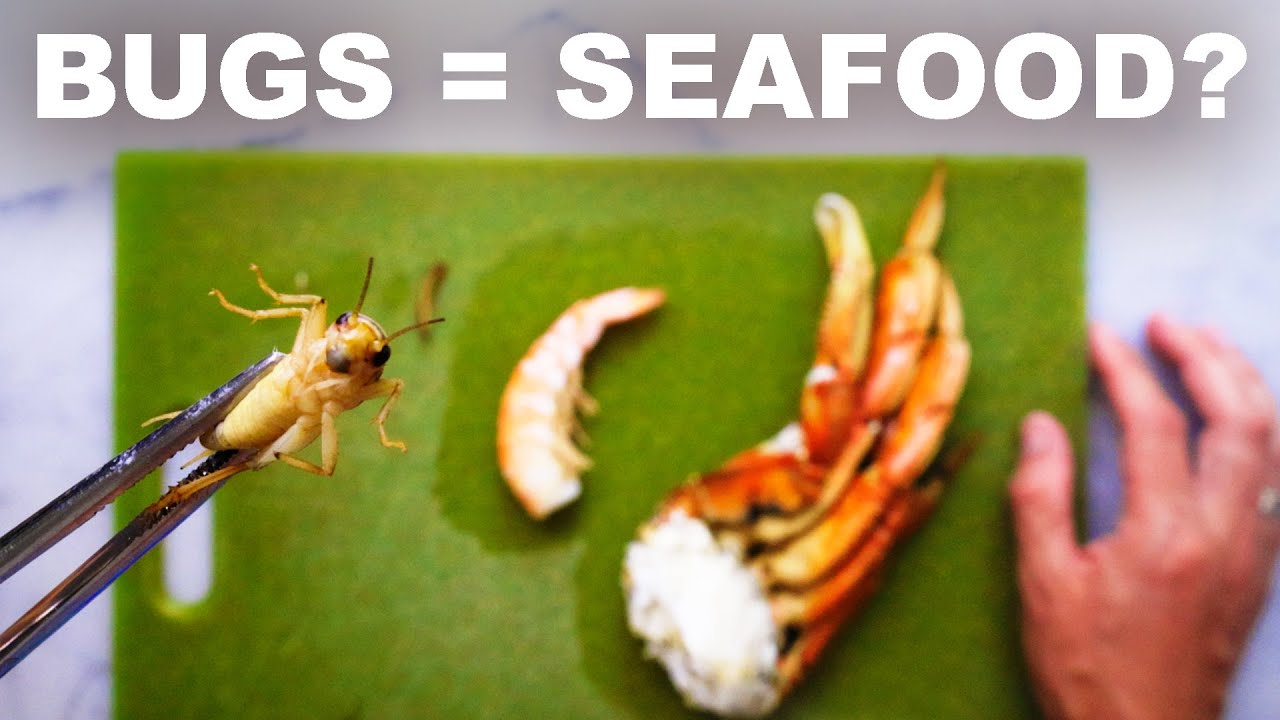
Why we love crustaceans and fear insects (which are crustaceans)
video description
Date: 2024-07-19
Related videos




Comments and reviews: 20
aragusea
Seafood used to be very taboo in colonial America, lobster used to be viewed very similarly to insects. Meanwhile, many Asian countries, such as Laos and Thailand, are very seafood forward in their cuisine, and they also occasionally eat insects. I think it's mainly down to two factors, food availability and generational conflict. People eat what is available. If there is a surplus of cows, beef related cuisine will be popular. If rice is available in surplus, rice will be a staple cuisine. If people travel to a new country and find there isn't a large excess of food, they'll eat whatever is available. That means seafood to the colonial people who are desperate, and already have boats and can make more boats easily. It was taboo, but it was a better source of food than insects. Insects would need to be farmed, while seafood can be caught in large amounts in a place we can't do anything else with. Combine this with the fact seafood was fed to prisoners, it eventually became a guilty pleasure, and broke the taboo with time. Same thing with a lot of African foods and slave foods that became very popular in those regions. While in Laos, they have larger insects due to the rainforest climates, combined with much smaller human populations, and on average much smaller people, which makes insects more viable. As these countries develop, their land will be converted into farmland, pesticides will become prevalent, and insects will decline from their cuisine, as more efficient food sources are made affordable, and insects become veiwed as unsafe to eat.
Tldr: people don't wanna farm bugs when they could farm cows or chickens. The sea is free real-estate that doesn't require upkeep, farmland is a serious investment that needs animals with lots of meat. The people who eat bugs are usually desperate, under developed, and often smaller in population and in average body size, and often live in climates with larger than average bugs.
reply
Seafood used to be very taboo in colonial America, lobster used to be viewed very similarly to insects. Meanwhile, many Asian countries, such as Laos and Thailand, are very seafood forward in their cuisine, and they also occasionally eat insects. I think it's mainly down to two factors, food availability and generational conflict. People eat what is available. If there is a surplus of cows, beef related cuisine will be popular. If rice is available in surplus, rice will be a staple cuisine. If people travel to a new country and find there isn't a large excess of food, they'll eat whatever is available. That means seafood to the colonial people who are desperate, and already have boats and can make more boats easily. It was taboo, but it was a better source of food than insects. Insects would need to be farmed, while seafood can be caught in large amounts in a place we can't do anything else with. Combine this with the fact seafood was fed to prisoners, it eventually became a guilty pleasure, and broke the taboo with time. Same thing with a lot of African foods and slave foods that became very popular in those regions. While in Laos, they have larger insects due to the rainforest climates, combined with much smaller human populations, and on average much smaller people, which makes insects more viable. As these countries develop, their land will be converted into farmland, pesticides will become prevalent, and insects will decline from their cuisine, as more efficient food sources are made affordable, and insects become veiwed as unsafe to eat.
Tldr: people don't wanna farm bugs when they could farm cows or chickens. The sea is free real-estate that doesn't require upkeep, farmland is a serious investment that needs animals with lots of meat. The people who eat bugs are usually desperate, under developed, and often smaller in population and in average body size, and often live in climates with larger than average bugs.
reply
Dragonited
The giganticism in dinosaurs has been found to not have been because of the oxygen levels, although it was about 30%. Insects, however, are defininitley dependent on the oxygen levels since the cells in insects take out oxygen and reduce the amount left the furter the air reaches into it's body and thus limit their size.
The dinosaurs' size was because of many factors. One of them were likely a fierce competition between herbivore and carnivore dinosaurs, and the largest dinosaurs were the ones that dominated the Cretaceous period like the Tyranosaurus Rex and various Titanusaurus species. The holow bones of dinosaurs like our modern birds were also a factor to help them be able to grow so large and just like birds theyalso likley had air sacks that allowed them to absorb oxygen during exhale as well. Their upright posture also helped, which, unlike modern reptiles that have a more spread out posture, would allow more support for a larger body. Large herbivores also had the ability to survive for longer without food and water when they wandered to find better areas for food during the dryer climate during the Cretaceous. The herbivores' increasing size then caused the carnivores to increase in size to be able to kill the larger Titanosurus.
There's one dinosaur or it wasen't an actuall dinosaur but a distant relative, but we generally see them as such, and that was the flying reptiles of the Pterosaurs that did benefit from higher oxygen levels since it allowed them the extra energy to be able to lift their bodies from the ground. They did, however, die out with the dinosaurs during the C/T boundary 65 million years ago and are not related to birds like dinosaurs are.
reply
The giganticism in dinosaurs has been found to not have been because of the oxygen levels, although it was about 30%. Insects, however, are defininitley dependent on the oxygen levels since the cells in insects take out oxygen and reduce the amount left the furter the air reaches into it's body and thus limit their size.
The dinosaurs' size was because of many factors. One of them were likely a fierce competition between herbivore and carnivore dinosaurs, and the largest dinosaurs were the ones that dominated the Cretaceous period like the Tyranosaurus Rex and various Titanusaurus species. The holow bones of dinosaurs like our modern birds were also a factor to help them be able to grow so large and just like birds theyalso likley had air sacks that allowed them to absorb oxygen during exhale as well. Their upright posture also helped, which, unlike modern reptiles that have a more spread out posture, would allow more support for a larger body. Large herbivores also had the ability to survive for longer without food and water when they wandered to find better areas for food during the dryer climate during the Cretaceous. The herbivores' increasing size then caused the carnivores to increase in size to be able to kill the larger Titanosurus.
There's one dinosaur or it wasen't an actuall dinosaur but a distant relative, but we generally see them as such, and that was the flying reptiles of the Pterosaurs that did benefit from higher oxygen levels since it allowed them the extra energy to be able to lift their bodies from the ground. They did, however, die out with the dinosaurs during the C/T boundary 65 million years ago and are not related to birds like dinosaurs are.
reply
AGryphonTamer
Using the definitions like that doesn't sit well with me. Two things with the same background are not the same. Eating a pile of ground flour, egg, and water isn't the same as eating pasta. Eating pasta isn't the same as eating cake or bread.
Then taxonomy is a tool for studying evolution. That can be useful for the kitchen, but should not be the deciding factor. Fish for example isn't a taxonomical term, and is used to define stuff well outside any single clade. Insects has both definitions. A taxonomical one, and the one people use.
Spiders, millipedes, centipedes, ticks, are all insects in book. But don't fit into the taxon insecta. None if those are in Pancrustacea either.
Springtails are also insects in my book, but aren't technically. They're in Pancrustacea too. And they're hexapods along with most things I'd call insects. But they're not insects.
reply
Using the definitions like that doesn't sit well with me. Two things with the same background are not the same. Eating a pile of ground flour, egg, and water isn't the same as eating pasta. Eating pasta isn't the same as eating cake or bread.
Then taxonomy is a tool for studying evolution. That can be useful for the kitchen, but should not be the deciding factor. Fish for example isn't a taxonomical term, and is used to define stuff well outside any single clade. Insects has both definitions. A taxonomical one, and the one people use.
Spiders, millipedes, centipedes, ticks, are all insects in book. But don't fit into the taxon insecta. None if those are in Pancrustacea either.
Springtails are also insects in my book, but aren't technically. They're in Pancrustacea too. And they're hexapods along with most things I'd call insects. But they're not insects.
reply
cubandarknez
Yeah weirdly drawn lines by the brain, but if I had to rationalize backwards I'd imagine it is a combination of things. Water environment vs land environment associations, where I feel like we have more concerns for dirty/Unhygienic conditions in land vs sea (even if not actually the case. Then it's the swarm thing Adam mentioned, normally I just don't picture sea based bugs as swarming me (though sea worms are creepy too, where as for land bugs that in combination with the hygiene concerns it immediately combines into the notion of being swarm by dirty things. Then for me personally, the way land bugs move draws much more attention than sea bugs. For one I live on land, so even if I am keeping sea bugs nearby, I know it is very unlikely to end up in my land area, whereas land bugs could crawl/hop/fly) from and to pretty much anywhere.
reply
Yeah weirdly drawn lines by the brain, but if I had to rationalize backwards I'd imagine it is a combination of things. Water environment vs land environment associations, where I feel like we have more concerns for dirty/Unhygienic conditions in land vs sea (even if not actually the case. Then it's the swarm thing Adam mentioned, normally I just don't picture sea based bugs as swarming me (though sea worms are creepy too, where as for land bugs that in combination with the hygiene concerns it immediately combines into the notion of being swarm by dirty things. Then for me personally, the way land bugs move draws much more attention than sea bugs. For one I live on land, so even if I am keeping sea bugs nearby, I know it is very unlikely to end up in my land area, whereas land bugs could crawl/hop/fly) from and to pretty much anywhere.
reply
raguelelnaqum
Its funny how so many human societies today abhor entomophagy when humans, being primates, literally evolved from entomophagous omnivores. Our bodies are literally built to process the proteins of arthropods better compared to those of other organisms outside of plants & fungi. It's theorized this may be why societies that heavily rely upon other sources of protein or hyperspecify on plant & fungal protein tend to suffer nutrient deficiencies (in the case of vegans and certain vegetarian diets) without supplements or cancer & other diseases (in the case of red meat & yellow fat consumption) when you compare human variations of these diets with that obligate herbivores & carnivores, and even certain facultative diet examples (as those animals usually are still eating proteins they can process without complications.
reply
Its funny how so many human societies today abhor entomophagy when humans, being primates, literally evolved from entomophagous omnivores. Our bodies are literally built to process the proteins of arthropods better compared to those of other organisms outside of plants & fungi. It's theorized this may be why societies that heavily rely upon other sources of protein or hyperspecify on plant & fungal protein tend to suffer nutrient deficiencies (in the case of vegans and certain vegetarian diets) without supplements or cancer & other diseases (in the case of red meat & yellow fat consumption) when you compare human variations of these diets with that obligate herbivores & carnivores, and even certain facultative diet examples (as those animals usually are still eating proteins they can process without complications.
reply
Kassidar
You are onto something with the we're freaked out by anything in large enough numbers that it can swarm us. A mouse is cute but a scatter of relieved mice is not. Still I wonder if the majority of whether someone is freaked out or not by land crustaceans is just a function of their disgust sensitivity. Lots of land bugs are either decomposes/scavengers. And many of the ones that aren't are venomous predators who, even though don't hunt us, defensively their venom poses physical danger to us.
Predators and decomposes. Fear and disgust. And isn't that exactly what people who don't like bugs react with when they meet a bug species they're not well familiar with.
reply
You are onto something with the we're freaked out by anything in large enough numbers that it can swarm us. A mouse is cute but a scatter of relieved mice is not. Still I wonder if the majority of whether someone is freaked out or not by land crustaceans is just a function of their disgust sensitivity. Lots of land bugs are either decomposes/scavengers. And many of the ones that aren't are venomous predators who, even though don't hunt us, defensively their venom poses physical danger to us.
Predators and decomposes. Fear and disgust. And isn't that exactly what people who don't like bugs react with when they meet a bug species they're not well familiar with.
reply
Salted_Fysh
Small correction on the beginning:
'Most' Humans is inaccurate as most humans don't live in the 'western' cultural sphere in which bugs are looked down upon as a food source. Most humans live in Africa, South America and the Asia part of Eurasia. Where eating bugs is considerably more normal.
So this is also very much a culture specific thing rather than a biological one. We are _taught_ to look at bugs as creepy crawlies.
reply
Small correction on the beginning:
'Most' Humans is inaccurate as most humans don't live in the 'western' cultural sphere in which bugs are looked down upon as a food source. Most humans live in Africa, South America and the Asia part of Eurasia. Where eating bugs is considerably more normal.
So this is also very much a culture specific thing rather than a biological one. We are _taught_ to look at bugs as creepy crawlies.
reply
michael5068
Why we love the meat of mamals, and fear humans (which are mamals)
I kid, but I mean on the surface level they are similar but digging down they are different. Rabbits and squirrels seem the same but squirrels belong to the order rodentia an rabbits to the order lagomorphia. Then you try them and rabbit tastes like turkey while squirrel tastes like deer. You can't compare the two just because they belong to the same phylum.
reply
Why we love the meat of mamals, and fear humans (which are mamals)
I kid, but I mean on the surface level they are similar but digging down they are different. Rabbits and squirrels seem the same but squirrels belong to the order rodentia an rabbits to the order lagomorphia. Then you try them and rabbit tastes like turkey while squirrel tastes like deer. You can't compare the two just because they belong to the same phylum.
reply
aviweiner1614
As someone who keeps kosher, and therefore have never eaten a crustacean, I have the same reaction to shrimp and other shellfish as I do to bugs, they both disgust me in the same way at least with the thought of eating them. I suspect you are actually fine with eating them because you grew up with thinking of them as food, as they really aren't very different from bugs for people have never eaten them.
reply
As someone who keeps kosher, and therefore have never eaten a crustacean, I have the same reaction to shrimp and other shellfish as I do to bugs, they both disgust me in the same way at least with the thought of eating them. I suspect you are actually fine with eating them because you grew up with thinking of them as food, as they really aren't very different from bugs for people have never eaten them.
reply
TheReliquarian
I think the mental hurdle is that crabs and crustaceans come from the ocean, and we associate open running water with freshness, whereas insects are considered unclean because they crawl on the ground and eat things that would make us sick like decaying flesh and animal droppings. Crustaceans often also eat those kinds of things, but they kinda get a pass because we usually don't see it going on.
reply
I think the mental hurdle is that crabs and crustaceans come from the ocean, and we associate open running water with freshness, whereas insects are considered unclean because they crawl on the ground and eat things that would make us sick like decaying flesh and animal droppings. Crustaceans often also eat those kinds of things, but they kinda get a pass because we usually don't see it going on.
reply
fren111
There is a theory that it is a genetic memory, Our ancestors were killed enough times that fear passed into genetics and became a reflex,
Just to give some context, in Madagascar lemurs are terrified of anything to fly above the treetops, because many years ago the island was full of eagles that were the predators, now extinct, lemurs still terrified, not one of them having ever seen an eagle
reply
There is a theory that it is a genetic memory, Our ancestors were killed enough times that fear passed into genetics and became a reflex,
Just to give some context, in Madagascar lemurs are terrified of anything to fly above the treetops, because many years ago the island was full of eagles that were the predators, now extinct, lemurs still terrified, not one of them having ever seen an eagle
reply
aragusea
Wow, you've fallen for the BS.
When you're eating the flesh of shrimp or lobster, you're not eating Chitin, but you are when you eat bugs.
Chitin leads to respiratory issues and eventually cancer as your body can't process it, and you can't process it out in any cooking method you can use.
Stop advocating for people to eat poison. Chitin is not remotely the same as cellulose.
reply
Wow, you've fallen for the BS.
When you're eating the flesh of shrimp or lobster, you're not eating Chitin, but you are when you eat bugs.
Chitin leads to respiratory issues and eventually cancer as your body can't process it, and you can't process it out in any cooking method you can use.
Stop advocating for people to eat poison. Chitin is not remotely the same as cellulose.
reply
ub3rfr3nzy94
Insects: Tiny legs with no meat, abdomens full of puss like organs. Smells bad.
Crustaceans: Large limbs and tails with lots of meat, organs arent pusslike and are much smaller in proportion to body. Doesnt smell like crap.
If scorpions had fat lobster tails, spiders had claws and crickets abdomens were meaty tails like a prawn and not full of goo we'd eat those too.
reply
Insects: Tiny legs with no meat, abdomens full of puss like organs. Smells bad.
Crustaceans: Large limbs and tails with lots of meat, organs arent pusslike and are much smaller in proportion to body. Doesnt smell like crap.
If scorpions had fat lobster tails, spiders had claws and crickets abdomens were meaty tails like a prawn and not full of goo we'd eat those too.
reply
aragusea
oxigen did not play such a big of a roll on giantism as previously thought, it helps a bit but the main factor on insect giantism was the lack of fully terrestrial predators, making them go nuts and fill in macropredatory niches, for a while. Also dinosaur giantism was due to bone pneumacity and air sacks along the body on saurischia(sauropods and theropods including birds)
reply
oxigen did not play such a big of a roll on giantism as previously thought, it helps a bit but the main factor on insect giantism was the lack of fully terrestrial predators, making them go nuts and fill in macropredatory niches, for a while. Also dinosaur giantism was due to bone pneumacity and air sacks along the body on saurischia(sauropods and theropods including birds)
reply
amitlevin8841
I think the issue why people a freaked out by bags I'm not buy seafood is because bags are either associated with disease or pestilence historically so we would have an innate disgust reaction to two bags specifically bags that live on the land whereas shrimp's or other Crustaceans the it's not the innate fear what disgust associated with pestilence and decay decaying
reply
I think the issue why people a freaked out by bags I'm not buy seafood is because bags are either associated with disease or pestilence historically so we would have an innate disgust reaction to two bags specifically bags that live on the land whereas shrimp's or other Crustaceans the it's not the innate fear what disgust associated with pestilence and decay decaying
reply
sadroses2
I eat kosher, so I have never tried shrimp or crab, and I can tell you that at least anecdotally, it's because I grew up without it being normalized. When I was in my teens I realized how shrimp look like pink bugs and couldn't get over how do people manage to eat them, because bugs. I doubt I could bring myself to try shrimp, even if they were declared kosher today.
reply
I eat kosher, so I have never tried shrimp or crab, and I can tell you that at least anecdotally, it's because I grew up without it being normalized. When I was in my teens I realized how shrimp look like pink bugs and couldn't get over how do people manage to eat them, because bugs. I doubt I could bring myself to try shrimp, even if they were declared kosher today.
reply
1998tkhri
I've always wondered why bugs are forbidden if you keep kosher, since, why would you need to make a rule forbidding something most people are repulsed by The connection to other crustaceans is an interesting continuation of the same prohibition, but of course, that leads to wondering why crustaceans are forbidden generally, and don't have any good answers there yet.
reply
I've always wondered why bugs are forbidden if you keep kosher, since, why would you need to make a rule forbidding something most people are repulsed by The connection to other crustaceans is an interesting continuation of the same prohibition, but of course, that leads to wondering why crustaceans are forbidden generally, and don't have any good answers there yet.
reply
hundvd_7
One of the most fascinating things is that there are a few videos of like this:
A million or so little brown things moving and kind of squirming in the sand.
Everyone's immediate reaction is visceral fear and disgust.
Camera zooms in, and reveals that they are not in fact spiders, but crabs.
Everyone immediately kinds it kinda cute.
reply
One of the most fascinating things is that there are a few videos of like this:
A million or so little brown things moving and kind of squirming in the sand.
Everyone's immediate reaction is visceral fear and disgust.
Camera zooms in, and reveals that they are not in fact spiders, but crabs.
Everyone immediately kinds it kinda cute.
reply
DefinitelyNotJody
one thing that contributes to my fear of insects is that they move so fast relative to their size. theyre like constantly on the verge of fnaf jumpscaring you. crustaceans dont do that. I can be 5 feet away from a crab with relative confidence that it isnt going to clear that distance and get to me in a quarter of a second.
reply
one thing that contributes to my fear of insects is that they move so fast relative to their size. theyre like constantly on the verge of fnaf jumpscaring you. crustaceans dont do that. I can be 5 feet away from a crab with relative confidence that it isnt going to clear that distance and get to me in a quarter of a second.
reply
zenastronomy
ppl who eat insects are unhealthy.
ppl who eat seafood are not.
they are not the same.
one carries more diseases than the other and less nutrition.
the salt water environment is a big biological impenetrable gap for diseases.
I'll never eat bugs, no matter how much corporations try to fool us into eating it.
reply
ppl who eat insects are unhealthy.
ppl who eat seafood are not.
they are not the same.
one carries more diseases than the other and less nutrition.
the salt water environment is a big biological impenetrable gap for diseases.
I'll never eat bugs, no matter how much corporations try to fool us into eating it.
reply
Add a review, comment
Other channel videos