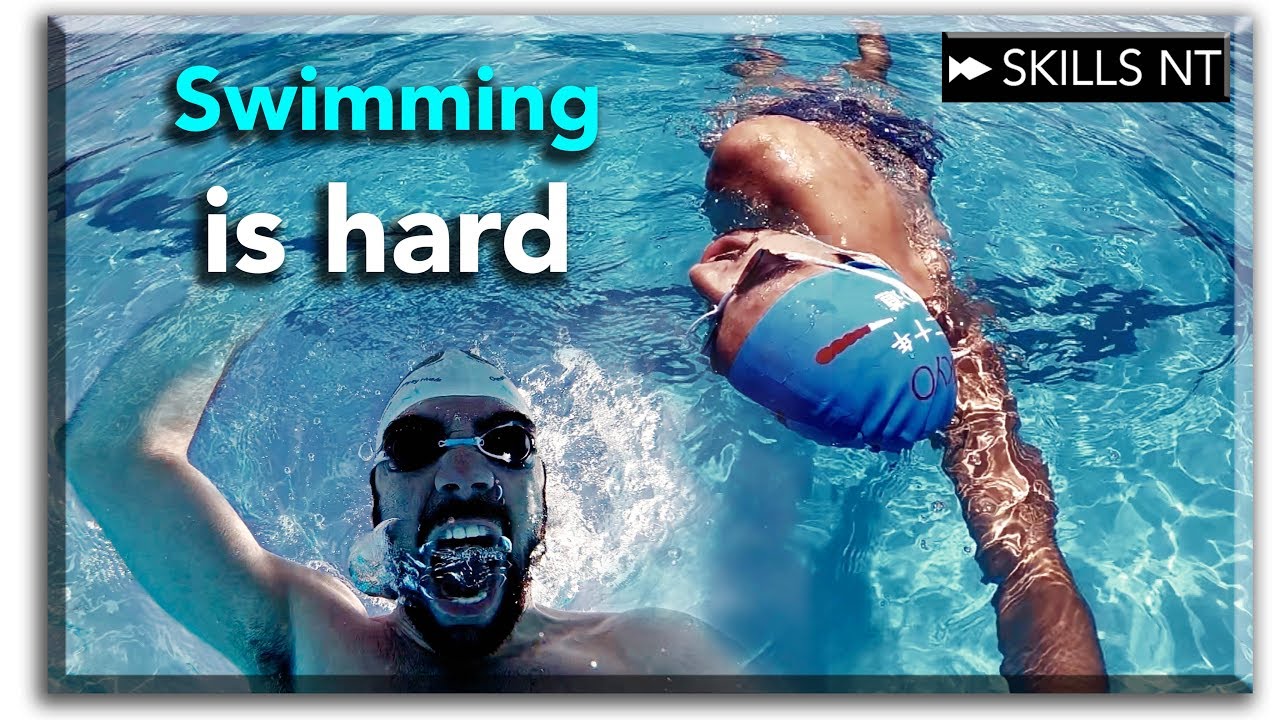
Learn to swim as an adult - Skills N' Talents
video description
Date: 2022-07-18
Related videos




Comments and reviews: 15
Jethro
I'm an adult male trying to learn to swim. I used to write a blog on a beginners swimming site called www. swimmunity. com. Unfortunately, after a long period of inactivity and creator neglect, it completely shut down, and all my entries were lost. I've decided to leave a comment here. My efforts to learn how to swim have had very little success. Sometimes I wonder if I should even keep trying, but for now, I am. Now and then on these videos, I'll comment on my hopes, fears, struggles, and hopefully, whatever small victories I have in trying to learn to swim. My goals at this point are very modest.
I've taken several adult swim classes at the Central YMCA since about 2013. I improved quite a bit. When I started I was terrified of the water. My anxiety has gone way down since then, but I'm far from fearless. I'm not sure how much further swim lessons would help me. I think I've tried the patience of all the teachers.
I can kickboard and do a few feet of of very crude and clumsy freestyle without a flotation belt, and about half a pool's length with one, but I tend to lose what little rhythm I have in these, start to panic, and crash.
Here are my main obstacles:
1. I can't float or tread water without a flotation belt. I've been told by different teachers that this is because I'm too lean and muscular. Others have told me my failure to float is mental. I continue to try, and one teacher told me I was doing a front float, but it felt to me like I'm pretty much submerged. I've been told by a few teachers and have read on the Net, that it's impossible to learn to swim if you can't tread water or float, but other teachers, mostly male, have told me they can't float either, yet they swim well. Maybe I need to learn their strategy, whatever it is.
2. Back float phobia. I have back swam with a float belt and a kickboard, even going down to the deep end that way, but being on my back gives me high anxiety and I have a tendency to feel out of control and impulsively struggle to get upright, which I don't do smoothly. I often feel like I'm going to tip over backward, headfirst. My teachers tell me this is an illusion and that it's impossible.
3. Deep end phobia. I have gone down to the deep end with a flotation belt, with and without a kickboard, but since I can't tread water or float, I wouldn't dare try that without one. In my practice, I carefully stay in the area I can stand in. I want to try to get down to the deep end more often too overcome my fear of it. I've done this, but when I go for long periods out of the pool, my confidence wears off.
I thought if I had somebody to prod, encourage, and coach me a little, I might move forward in my goals a little, and I might feel a little less self-conscious flailing around in the open swim pool all by myself. (I probably make the lifeguards nervous) I'm thinking maybe one day a week. I'm self-employed, so just about any time during open swim hours would work for me.
My long-term goal would be to freestyle the length of the pool and back, at least once, WITHOUT A FLOTATION BELT OR KICKBOARD, but if that's even possible, it'd be quite a ways down the road.
reply
I'm an adult male trying to learn to swim. I used to write a blog on a beginners swimming site called www. swimmunity. com. Unfortunately, after a long period of inactivity and creator neglect, it completely shut down, and all my entries were lost. I've decided to leave a comment here. My efforts to learn how to swim have had very little success. Sometimes I wonder if I should even keep trying, but for now, I am. Now and then on these videos, I'll comment on my hopes, fears, struggles, and hopefully, whatever small victories I have in trying to learn to swim. My goals at this point are very modest.
I've taken several adult swim classes at the Central YMCA since about 2013. I improved quite a bit. When I started I was terrified of the water. My anxiety has gone way down since then, but I'm far from fearless. I'm not sure how much further swim lessons would help me. I think I've tried the patience of all the teachers.
I can kickboard and do a few feet of of very crude and clumsy freestyle without a flotation belt, and about half a pool's length with one, but I tend to lose what little rhythm I have in these, start to panic, and crash.
Here are my main obstacles:
1. I can't float or tread water without a flotation belt. I've been told by different teachers that this is because I'm too lean and muscular. Others have told me my failure to float is mental. I continue to try, and one teacher told me I was doing a front float, but it felt to me like I'm pretty much submerged. I've been told by a few teachers and have read on the Net, that it's impossible to learn to swim if you can't tread water or float, but other teachers, mostly male, have told me they can't float either, yet they swim well. Maybe I need to learn their strategy, whatever it is.
2. Back float phobia. I have back swam with a float belt and a kickboard, even going down to the deep end that way, but being on my back gives me high anxiety and I have a tendency to feel out of control and impulsively struggle to get upright, which I don't do smoothly. I often feel like I'm going to tip over backward, headfirst. My teachers tell me this is an illusion and that it's impossible.
3. Deep end phobia. I have gone down to the deep end with a flotation belt, with and without a kickboard, but since I can't tread water or float, I wouldn't dare try that without one. In my practice, I carefully stay in the area I can stand in. I want to try to get down to the deep end more often too overcome my fear of it. I've done this, but when I go for long periods out of the pool, my confidence wears off.
I thought if I had somebody to prod, encourage, and coach me a little, I might move forward in my goals a little, and I might feel a little less self-conscious flailing around in the open swim pool all by myself. (I probably make the lifeguards nervous) I'm thinking maybe one day a week. I'm self-employed, so just about any time during open swim hours would work for me.
My long-term goal would be to freestyle the length of the pool and back, at least once, WITHOUT A FLOTATION BELT OR KICKBOARD, but if that's even possible, it'd be quite a ways down the road.
reply
Robin
All schools I attended had their own pools. We had swimming lessons every year right through summer, twice every week. We had extra lessons after school for slow learners such as myself. We had progress cards that marked off our achievements from being able to float on our back right through long distance swimming. I am now 59 and still can't swim. I can't even float. There are people who will never learn. They simply can't do it. I decided to face reality 30 years ago when I stopped wasting my time trying.
This video explains very clearly the difficulties faced. Well done.
reply
All schools I attended had their own pools. We had swimming lessons every year right through summer, twice every week. We had extra lessons after school for slow learners such as myself. We had progress cards that marked off our achievements from being able to float on our back right through long distance swimming. I am now 59 and still can't swim. I can't even float. There are people who will never learn. They simply can't do it. I decided to face reality 30 years ago when I stopped wasting my time trying.
This video explains very clearly the difficulties faced. Well done.
reply
Blue
Very informative video and learning a lot from it.
I took some swimming lessons about 3 years ago and I can swim all 3 strokes, that is front, back Crowl and breaststroke.
I go up to depth of the pool where I can feel the floor under my feet, I do go to the deep end as well but only if someone is watching me coz I get bit scared. Others tell me that I m doing really well but I still dont feel comfortable in the deep end.
What can I do to build my confidence in the deep end so I can enjoy my swimming to the Max.
Hope you reply and thanks in advance. x
reply
Very informative video and learning a lot from it.
I took some swimming lessons about 3 years ago and I can swim all 3 strokes, that is front, back Crowl and breaststroke.
I go up to depth of the pool where I can feel the floor under my feet, I do go to the deep end as well but only if someone is watching me coz I get bit scared. Others tell me that I m doing really well but I still dont feel comfortable in the deep end.
What can I do to build my confidence in the deep end so I can enjoy my swimming to the Max.
Hope you reply and thanks in advance. x
reply
robohippy
I have found you to be one of the better, as well as more entertaining swim instructors on You Tube. I think the first time I went to the pool, I was swimming, underwater, around age 2. I would say that being able to swim from one end of the pool to the other, generally isn't that difficult. Getting from one end to the other efficiently is. Efficiency is intelligent laziness. No idea who said that. I do have one problem with drills. I tend to fall asleep before I run the length of the pool and run into the wall.
reply
I have found you to be one of the better, as well as more entertaining swim instructors on You Tube. I think the first time I went to the pool, I was swimming, underwater, around age 2. I would say that being able to swim from one end of the pool to the other, generally isn't that difficult. Getting from one end to the other efficiently is. Efficiency is intelligent laziness. No idea who said that. I do have one problem with drills. I tend to fall asleep before I run the length of the pool and run into the wall.
reply
Van
This is a great, informative video. For years I couldn't swim well at all, then I joined my local YMCA and took swim lessons, I have the best instructor! Though she is no longer my instructor I still take hydro aerobics from her, twice a week. She will watched me practice my flutter kick and other techniques and give me instruction, encouragement, whatever I need. Swimming correctly takes a lot of, concentration, time and dedication but for me it's worth it, I love it! Keep the videos coming
reply
This is a great, informative video. For years I couldn't swim well at all, then I joined my local YMCA and took swim lessons, I have the best instructor! Though she is no longer my instructor I still take hydro aerobics from her, twice a week. She will watched me practice my flutter kick and other techniques and give me instruction, encouragement, whatever I need. Swimming correctly takes a lot of, concentration, time and dedication but for me it's worth it, I love it! Keep the videos coming
reply
Wahfreak
My learning curve looked like this. at 55 years old join the Y to take some swim lessons. Signed up for a sprit triathlon. Go to the open water race orientation where we simulated a mass start. Understand I know nothing about swimming. Race anyway. Inhale water during the race and get lung infection. Spend the next 9 months in the pool trying to get better/faster. Discover my sprint race was the fastest I had swam since I started.
reply
My learning curve looked like this. at 55 years old join the Y to take some swim lessons. Signed up for a sprit triathlon. Go to the open water race orientation where we simulated a mass start. Understand I know nothing about swimming. Race anyway. Inhale water during the race and get lung infection. Spend the next 9 months in the pool trying to get better/faster. Discover my sprint race was the fastest I had swam since I started.
reply
Clownish-Gambino
getting my freestyle stroke faster and more efficient is truly the difficult part, for me at least. I'll be swimming for a fairly good chunk of time, and then some fresh as daisy hot shot hops in the lain next to me and just effortlessly leaves me in the dust even while I increase my effort, but I've always been told increased effort does increase overall time
reply
getting my freestyle stroke faster and more efficient is truly the difficult part, for me at least. I'll be swimming for a fairly good chunk of time, and then some fresh as daisy hot shot hops in the lain next to me and just effortlessly leaves me in the dust even while I increase my effort, but I've always been told increased effort does increase overall time
reply
andypandywalters
As a 61 year old that is to all intents and purposes a non swimmer, I find it all so frustrating and give up trying and believing in myself. The last 'one on one' teacher I had was frankly disinterested, & more concerned with not getting her hair wet! I gave up and walked away. That was over ten years ago.
reply
As a 61 year old that is to all intents and purposes a non swimmer, I find it all so frustrating and give up trying and believing in myself. The last 'one on one' teacher I had was frankly disinterested, & more concerned with not getting her hair wet! I gave up and walked away. That was over ten years ago.
reply
E.
Everything you said is true. At 60 y. o, I decided to learn to swim. Now, at EXACTLY 2 yrs later (62) I finally got enough skills to swim from one end of the pool to the other. Boy, oh boy. many, many hours of practice & I still have a LONG, LONG way to go. but I'll get there. Peace
reply
Everything you said is true. At 60 y. o, I decided to learn to swim. Now, at EXACTLY 2 yrs later (62) I finally got enough skills to swim from one end of the pool to the other. Boy, oh boy. many, many hours of practice & I still have a LONG, LONG way to go. but I'll get there. Peace
reply
Yogesh
I followed the Total Immersion videos online and learned to swim at the age of 33. I don't think that it is difficult. getting the correct info that is the most important and also the most difficult thing after that it's simply practice. so no. I don't agree with you!
reply
I followed the Total Immersion videos online and learned to swim at the age of 33. I don't think that it is difficult. getting the correct info that is the most important and also the most difficult thing after that it's simply practice. so no. I don't agree with you!
reply
Surabhi
Thanks guys, everyday when I go for a swim, I somewhat lose patience with myself but watching the videos and the techniques you talk about I relate to a lot and makes me feel like I belong and shouldn't give it up so easily. Keep up the good work, have a good day: )
reply
Thanks guys, everyday when I go for a swim, I somewhat lose patience with myself but watching the videos and the techniques you talk about I relate to a lot and makes me feel like I belong and shouldn't give it up so easily. Keep up the good work, have a good day: )
reply
Athay
I was waiting for the swim fast hand actions at the end was ready to do it with you: ( lol. Yeah swimming is frustrating but i just remember when I started and how far I've progressed. So i just keep practicing those frustrating drills till something clicks.
reply
I was waiting for the swim fast hand actions at the end was ready to do it with you: ( lol. Yeah swimming is frustrating but i just remember when I started and how far I've progressed. So i just keep practicing those frustrating drills till something clicks.
reply
Sandeep
Beautifully explained, now why I said that bcoz this is what the same thing happening to me. Firstly I began with wrong coaching and after then started learning from you tube but patiently I am learning and improving. Thanks a lot.
reply
Beautifully explained, now why I said that bcoz this is what the same thing happening to me. Firstly I began with wrong coaching and after then started learning from you tube but patiently I am learning and improving. Thanks a lot.
reply
Rick
I have yet to find anyone who coaches swimming - I've golfed for years, played tennis, etc and coaches/instructors are readily available. But swimming - you have the basic learn to swim coaches, but not intermediate and higher.
reply
I have yet to find anyone who coaches swimming - I've golfed for years, played tennis, etc and coaches/instructors are readily available. But swimming - you have the basic learn to swim coaches, but not intermediate and higher.
reply
lyiengzheng
Since I was young, I really struggled to learn to swim. I have thick legs (genetic, and every time I move them underwater, my legs will be stiff. Until now, I still struggle. I hope its not the end for me.
reply
Since I was young, I really struggled to learn to swim. I have thick legs (genetic, and every time I move them underwater, my legs will be stiff. Until now, I still struggle. I hope its not the end for me.
reply
Add a review, comment
Other channel videos