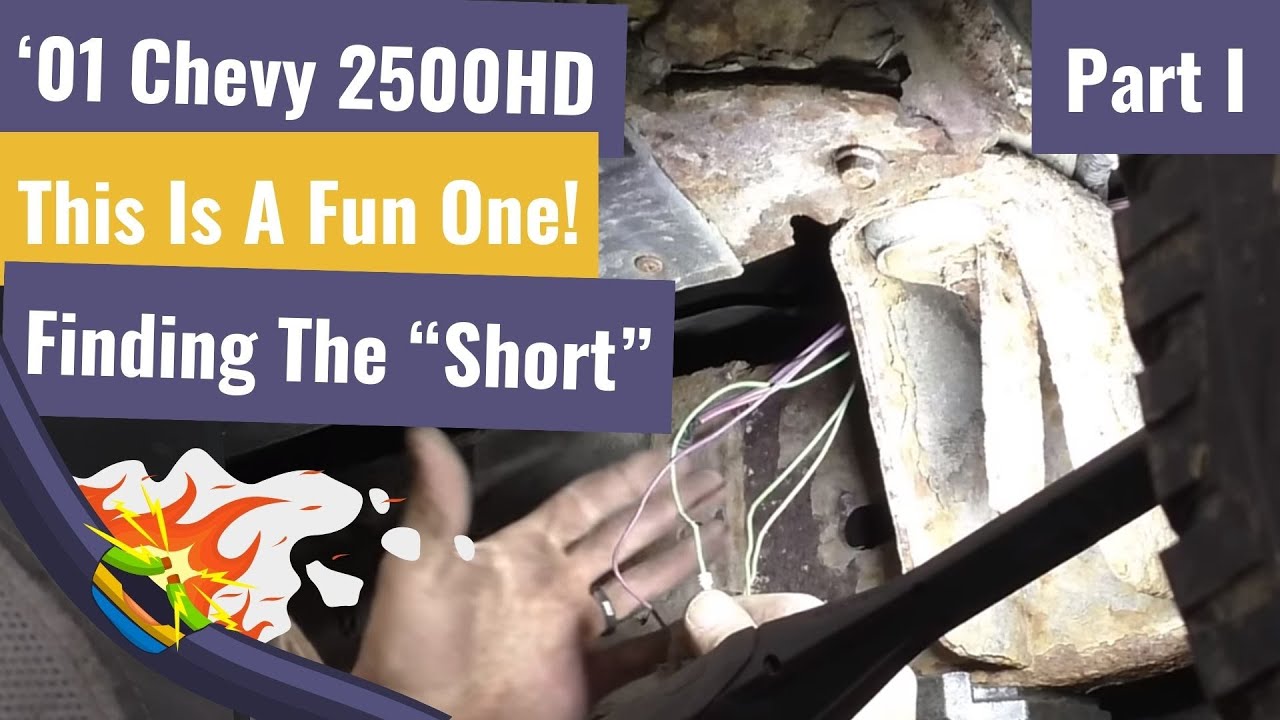
Chevy 2500HD With A Bizarre Running Issue
video description
Date: 2023-12-20
Related videos


Comments and reviews: 19
joshwilson849
I don t want anybody to take this comment the wrong way as I think extremely highly of Eric O and have learned an immense amount from him, and I can see why some of you are mind blown by this diagnosis. But this really wasn t a hard diagnosis. He knew right away from years of experience what was causing the issue with this truck. Focused on the o2 s and also knew from years of experience that when unplugged the scan tool should read the open circuit bias voltage. He seen a value that he knew wasn t right, eliminated the circuit at both ends and still had voltage, at that point the chase is on. Not that hard of a diagnosis for a guy like Eric or any really good diagnostician. This reminds me of a truck I worked on a few years ago, it was a freight-liner m2 as i am a heavy duty tech. Customer complaint of intermittently the engine would not shut off with the key off. It was the same result. Voltage carryover from a higher voltage circuit into the ignition switch circuit which was a non current carrying circuit, the module just looked for a certain voltage to determine if the key was on or off. I remember touching the red lead of my meter to the top of the plastic fuse box that had a film of road salt covering it and the top of the plastic fuse box measured 12 volts
reply
I don t want anybody to take this comment the wrong way as I think extremely highly of Eric O and have learned an immense amount from him, and I can see why some of you are mind blown by this diagnosis. But this really wasn t a hard diagnosis. He knew right away from years of experience what was causing the issue with this truck. Focused on the o2 s and also knew from years of experience that when unplugged the scan tool should read the open circuit bias voltage. He seen a value that he knew wasn t right, eliminated the circuit at both ends and still had voltage, at that point the chase is on. Not that hard of a diagnosis for a guy like Eric or any really good diagnostician. This reminds me of a truck I worked on a few years ago, it was a freight-liner m2 as i am a heavy duty tech. Customer complaint of intermittently the engine would not shut off with the key off. It was the same result. Voltage carryover from a higher voltage circuit into the ignition switch circuit which was a non current carrying circuit, the module just looked for a certain voltage to determine if the key was on or off. I remember touching the red lead of my meter to the top of the plastic fuse box that had a film of road salt covering it and the top of the plastic fuse box measured 12 volts
reply
spelunkerd
I never get tired of watching you do electronics diagnosis. O2 sensor circuits are a treat because the tiny voltage produced by the sensor cannot produce much current. So to accurately measure that voltage, a big resistor is present inside the PCM to effectively give a voltage divider circuit, with measurement done between the sensor and the big resistor. Likewise to screen for circuit integrity, bias voltage is applied through a really big resistor in the PCM and on to the sensor wire. That big resistor causes the measured voltage to change even if the short to voltage or ground goes through a high resistance pathway, such as through your wet finger to ground or through a salty track from external voltage along an adjacent wire. So the high impedance circuit design inside the PCM makes it more vulnerable to incorrect readings from short circuits. What I find surprising is the way you didn't get a trouble code for circuit integrity, short to voltage even though the measured bias voltage was obviously wrong. Good for you to pick it up even without the usual clues you'd expect to see.
reply
I never get tired of watching you do electronics diagnosis. O2 sensor circuits are a treat because the tiny voltage produced by the sensor cannot produce much current. So to accurately measure that voltage, a big resistor is present inside the PCM to effectively give a voltage divider circuit, with measurement done between the sensor and the big resistor. Likewise to screen for circuit integrity, bias voltage is applied through a really big resistor in the PCM and on to the sensor wire. That big resistor causes the measured voltage to change even if the short to voltage or ground goes through a high resistance pathway, such as through your wet finger to ground or through a salty track from external voltage along an adjacent wire. So the high impedance circuit design inside the PCM makes it more vulnerable to incorrect readings from short circuits. What I find surprising is the way you didn't get a trouble code for circuit integrity, short to voltage even though the measured bias voltage was obviously wrong. Good for you to pick it up even without the usual clues you'd expect to see.
reply
BigDaddy_MRI
I ve worked on MRI systems for 39 years. Analog to Digital circuits are genuinely complex. The A/D converter doesn t care that much about current. (Caveat: it does, but only to develop a voltage. Nano-amps of current when run through an RF filter and fed to an A/D converter will happily work just fine, and provide a digital representation of the voltage it senses. The same goes for a modern day DC digital voltmeter.
So just the salt deposit on both insulators acted as a very high input impedance short, and some tiny value of current flow was established. Maybe in the nano-amp range. The ECM A/D converter happily did the conversion and sent it to the digital computer side of the ECM and BOOM, the O2 sensor had an offset.
In other words, you nailed it, Mr. O! Perfect description and understanding of parasitic current flow on the outside of an insulator. Nicely done, and outstanding troubleshooting. And if you prick a wire, always seal it up with liquid electrical tape! Thanks, Mr. O!
reply
I ve worked on MRI systems for 39 years. Analog to Digital circuits are genuinely complex. The A/D converter doesn t care that much about current. (Caveat: it does, but only to develop a voltage. Nano-amps of current when run through an RF filter and fed to an A/D converter will happily work just fine, and provide a digital representation of the voltage it senses. The same goes for a modern day DC digital voltmeter.
So just the salt deposit on both insulators acted as a very high input impedance short, and some tiny value of current flow was established. Maybe in the nano-amp range. The ECM A/D converter happily did the conversion and sent it to the digital computer side of the ECM and BOOM, the O2 sensor had an offset.
In other words, you nailed it, Mr. O! Perfect description and understanding of parasitic current flow on the outside of an insulator. Nicely done, and outstanding troubleshooting. And if you prick a wire, always seal it up with liquid electrical tape! Thanks, Mr. O!
reply
f. k. burnham8491
Eric- Of interest to you might be an audio voltmeter. It will verbally give you a voltage. Often used by blind electronics techs. Also there is a tool called a Leak Seeker. Basically an audio milli-ohmmeter. It can trace tiny shorted PC traces down to within 1/4. Great for tracing leakage. I got mine about 20 years back. It is annoying though, as the unit is continuously is making an ever increasing audio tone/ squeal the closer you get to the short or leakage. But it really works great, and if the circuit even momentarily opens or shorts, you don't need to look at a meter, the tone instantly changes. I have seen them for sale at Ham Radio swap meets for as little as 35. 00- 90. 00. Also great for finding high resistance or leaky switches or relay contacts.
reply
Eric- Of interest to you might be an audio voltmeter. It will verbally give you a voltage. Often used by blind electronics techs. Also there is a tool called a Leak Seeker. Basically an audio milli-ohmmeter. It can trace tiny shorted PC traces down to within 1/4. Great for tracing leakage. I got mine about 20 years back. It is annoying though, as the unit is continuously is making an ever increasing audio tone/ squeal the closer you get to the short or leakage. But it really works great, and if the circuit even momentarily opens or shorts, you don't need to look at a meter, the tone instantly changes. I have seen them for sale at Ham Radio swap meets for as little as 35. 00- 90. 00. Also great for finding high resistance or leaky switches or relay contacts.
reply
JeRKII
Physically I've been out of the business for a decade mentally not so much.
I have to say you really are amazing.
I have put a word into a small extended warranty company that if you ever call just pay what ever you say needs to be done. ( pretty sure you won't as it on the other side of the U. S. but yea.
Thanks for taking us along only wonder what your start to real end time is on the diagnosis.
Merry Christmas to you, your family, friends, and anyone who reads this weither it be today, tomorrow, next week or next year as there will always be another one.
reply
Physically I've been out of the business for a decade mentally not so much.
I have to say you really are amazing.
I have put a word into a small extended warranty company that if you ever call just pay what ever you say needs to be done. ( pretty sure you won't as it on the other side of the U. S. but yea.
Thanks for taking us along only wonder what your start to real end time is on the diagnosis.
Merry Christmas to you, your family, friends, and anyone who reads this weither it be today, tomorrow, next week or next year as there will always be another one.
reply
seabulls69
Amazing troubleshooting, Mr. O. Gotta admit, this well seasoned electronics technician is impressed with your skill and determination. I've seen high voltage (several thousand volts) find some odd pathways across non-conductors but never anything with voltages this low. With HV, there's always the possibility of carbon tracks created as a result of arcing across contaminated insulators creating a high resistance pathway from point a to point b. How (presumably) vinyl insulation can become conductive like this is new to me. Bravo!
reply
Amazing troubleshooting, Mr. O. Gotta admit, this well seasoned electronics technician is impressed with your skill and determination. I've seen high voltage (several thousand volts) find some odd pathways across non-conductors but never anything with voltages this low. With HV, there's always the possibility of carbon tracks created as a result of arcing across contaminated insulators creating a high resistance pathway from point a to point b. How (presumably) vinyl insulation can become conductive like this is new to me. Bravo!
reply
dustcommander100
I think you nailed it. The salt itself is conducting, and is more than happy to reach the conductors thru any pinhole or other means available. Super bad environment up there in PRNY. If a good O2 sensor has a comparatively low impedance to the input of the ECM, having it unplugged (or a bad connection to it) would leave only the path thru the contaminants to determine the voltage - whereas when the O2 sensor is in the circuit, it would mainly be the determining factor. But what do I know? I'm a plumbah, for cryin' out loud!
reply
I think you nailed it. The salt itself is conducting, and is more than happy to reach the conductors thru any pinhole or other means available. Super bad environment up there in PRNY. If a good O2 sensor has a comparatively low impedance to the input of the ECM, having it unplugged (or a bad connection to it) would leave only the path thru the contaminants to determine the voltage - whereas when the O2 sensor is in the circuit, it would mainly be the determining factor. But what do I know? I'm a plumbah, for cryin' out loud!
reply
brentowen9480
I do my best not to poke a wire, sometimes time and access really require it. We (meaning people who have repaired fukt up wiring due to wire poking without repair) need to test in certain areas and you need to access what the wire has available. Great vid, Merry Christmas. My favorite repair for a wire poke I make if the Gorillar Glue with little brush. Liquid electrical tape is too goopy for tiny repairs.
reply
I do my best not to poke a wire, sometimes time and access really require it. We (meaning people who have repaired fukt up wiring due to wire poking without repair) need to test in certain areas and you need to access what the wire has available. Great vid, Merry Christmas. My favorite repair for a wire poke I make if the Gorillar Glue with little brush. Liquid electrical tape is too goopy for tiny repairs.
reply
goptools
Amazing! Salt is a very good enhancer of electrical conductivity. Up in the PRNY, you have your fair share of salt on the roads when things get slick. Electricity is like water, it will flow through any available opening. That tiny poke hole would be easy to overlook. It's also a good example of why you would back probe a connector instead of probing directly into a wire. Great job tracking that one down!
reply
Amazing! Salt is a very good enhancer of electrical conductivity. Up in the PRNY, you have your fair share of salt on the roads when things get slick. Electricity is like water, it will flow through any available opening. That tiny poke hole would be easy to overlook. It's also a good example of why you would back probe a connector instead of probing directly into a wire. Great job tracking that one down!
reply
cannbudo
Wow! That kinda blew my mind. Didn't think a short like that was a thing. Thanks for the video! To be clear the ECU sends a bias voltage through those wires so it can check for problems in the circuit. The bias voltage from the heater wire was traveling through salt, and debris outside the wire's insulation and into the pin hole. What a mind F. I hope you do a follow up video on this one.
reply
Wow! That kinda blew my mind. Didn't think a short like that was a thing. Thanks for the video! To be clear the ECU sends a bias voltage through those wires so it can check for problems in the circuit. The bias voltage from the heater wire was traveling through salt, and debris outside the wire's insulation and into the pin hole. What a mind F. I hope you do a follow up video on this one.
reply
941Earl
Unlike most of the industry, these are my favorite kinds of problems. Anyone can pad slap some brakes or ride the gravy train on BG services. This is what fixing cars in today's world is all about. It takes skill, experience, and intelligence to diagnose these kinds of problems. There is not an overabundance of that left in our trade, or new stock to replace the few left that do.
reply
Unlike most of the industry, these are my favorite kinds of problems. Anyone can pad slap some brakes or ride the gravy train on BG services. This is what fixing cars in today's world is all about. It takes skill, experience, and intelligence to diagnose these kinds of problems. There is not an overabundance of that left in our trade, or new stock to replace the few left that do.
reply
autorepair
99 Express 5. 7. 147, 000 miles. High idle/IAC count. Random sporadic readings. Checked VCM connections, no corrosion. Isolated a few circuits. Nada. Split VCM and found contamination. Seal failed and Fla salt air did it in. VCM is ordered. To be continued. 68 and still in the game. Just got it, going to be my hunting- fishing wagon.
Thanks for the motivation!
reply
99 Express 5. 7. 147, 000 miles. High idle/IAC count. Random sporadic readings. Checked VCM connections, no corrosion. Isolated a few circuits. Nada. Split VCM and found contamination. Seal failed and Fla salt air did it in. VCM is ordered. To be continued. 68 and still in the game. Just got it, going to be my hunting- fishing wagon.
Thanks for the motivation!
reply
mikeburdi3464
Very good, quick, easy to follow diagnosis. I know and appreciate that there are some super smart people in the comments section, but some of the questions and comments I have seen in the past make me question if some people should maybe not touch anything on their cars and hopefully, they aren't mechanics getting paid. But as always Eric does a great job!
reply
Very good, quick, easy to follow diagnosis. I know and appreciate that there are some super smart people in the comments section, but some of the questions and comments I have seen in the past make me question if some people should maybe not touch anything on their cars and hopefully, they aren't mechanics getting paid. But as always Eric does a great job!
reply
ianide2480
Not for the first time, I wish I lived somewhere half way close to your shop. I have an infuriating electrical problem with a car of mine and I would pay to just have it diagnosed. Problem is that I have trust issues (for a reason) with most mechanics. I see your diagnostic abilities and I am certain you would at least be able to tell me wth the issue is.
reply
Not for the first time, I wish I lived somewhere half way close to your shop. I have an infuriating electrical problem with a car of mine and I would pay to just have it diagnosed. Problem is that I have trust issues (for a reason) with most mechanics. I see your diagnostic abilities and I am certain you would at least be able to tell me wth the issue is.
reply
Speeddemon3
This is a true diagnostician at work! Mr O. Is the man when it comes to true diagnostics. Really a talent to admire. Wish you all and your all the best thru the Christmas season and all the best in the New Year! Thank you for sharing your talent and stay safe. Just a northern tech that admires your honesty and talent! Wish you and Mrs O. the very best!
reply
This is a true diagnostician at work! Mr O. Is the man when it comes to true diagnostics. Really a talent to admire. Wish you all and your all the best thru the Christmas season and all the best in the New Year! Thank you for sharing your talent and stay safe. Just a northern tech that admires your honesty and talent! Wish you and Mrs O. the very best!
reply
kal9906
So would cleaning the wiring and connector with isopropyl alcohol, repairing the pinhole with liquid tape or? then applying dielectric grease to the connector and the wiring work?
I am not seeing why the pigtail connector requires replacement ie. if the insulation on the signal wire is repaired and the conductive path from brine schmeg is removed.
reply
So would cleaning the wiring and connector with isopropyl alcohol, repairing the pinhole with liquid tape or? then applying dielectric grease to the connector and the wiring work?
I am not seeing why the pigtail connector requires replacement ie. if the insulation on the signal wire is repaired and the conductive path from brine schmeg is removed.
reply
jamiepatterson1214
Eric, your ability to explain a problem and diagnose it, and why it occurred, explains why others brings their vehicles to you to troubleshoot.
You demonstrate a working knowledge about how circuits work, thereby knowing the possible cause and what to look for.
You'd be an excellent teacher at a tech school or jr. College.
reply
Eric, your ability to explain a problem and diagnose it, and why it occurred, explains why others brings their vehicles to you to troubleshoot.
You demonstrate a working knowledge about how circuits work, thereby knowing the possible cause and what to look for.
You'd be an excellent teacher at a tech school or jr. College.
reply
FliesLikeABrick
This is a great practical demonstration of how sensitive high impedance circuits could be - great knowledge since there are a bunch of sensors on a vehicle that can be biased this way. Interesting to think how the behavior in the data would be impacted if this was a current-based measurement on the sensor circuit instead of voltage
reply
This is a great practical demonstration of how sensitive high impedance circuits could be - great knowledge since there are a bunch of sensors on a vehicle that can be biased this way. Interesting to think how the behavior in the data would be impacted if this was a current-based measurement on the sensor circuit instead of voltage
reply
pjimmbojimmbo1990
My 94 Buick ran great during warm-up, but as soon as it went into Closed Loop, rough running and lots of Black Smoke, and stink. After a few minutes, it suddenly ran a bit better(Limp Mode perhaps. A/C Controller in Diagnostic Mode, said Lean Codes on both Sides. 2 New O2 Sensors fixed it.
reply
My 94 Buick ran great during warm-up, but as soon as it went into Closed Loop, rough running and lots of Black Smoke, and stink. After a few minutes, it suddenly ran a bit better(Limp Mode perhaps. A/C Controller in Diagnostic Mode, said Lean Codes on both Sides. 2 New O2 Sensors fixed it.
reply
Add a review, comment
Other channel videos