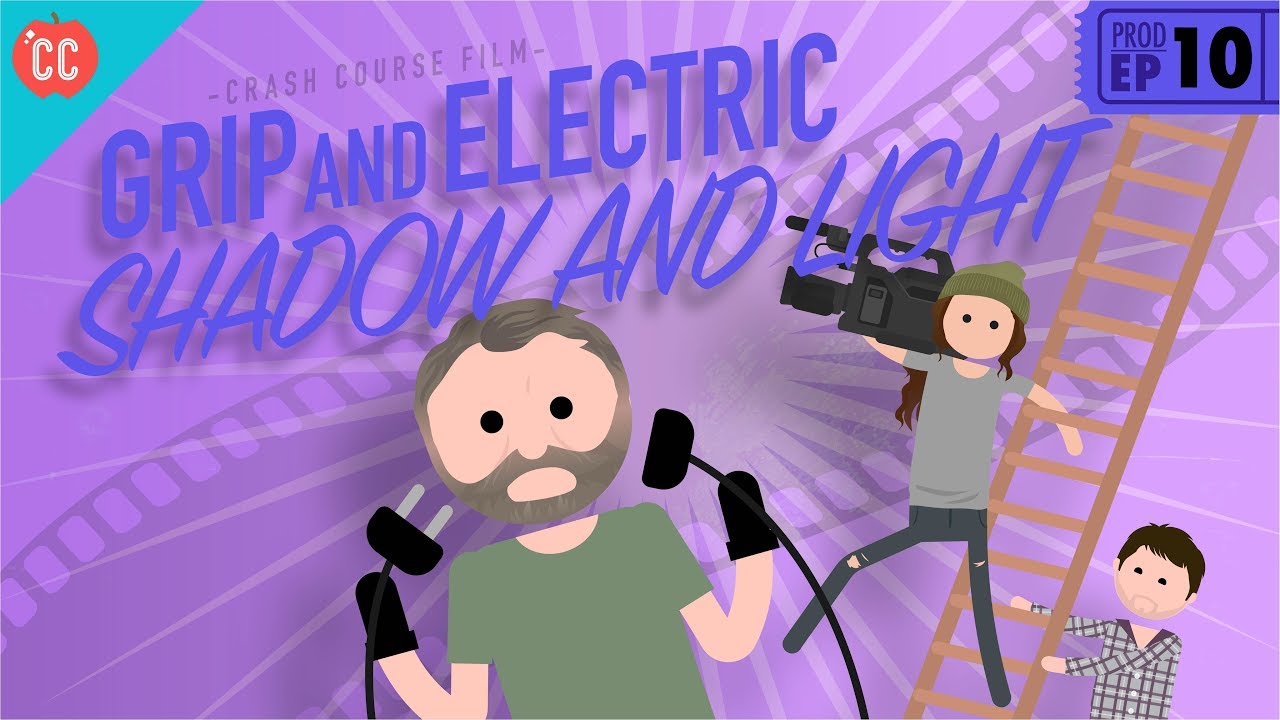
Grip and Electric: Crash Course Film Production #10
video description
Date: 2022-04-04
Related videos





Comments and reviews: 10
mad
Should be noted that as described this is the -American- or -hollywood- system not the -English- or -European-.
More and more internationally the -American- system dominates, but you will still find -English- system used in parts of Europe and Asia, its was common at the height of HK cinema for example.
-In traditional -English- system -Grips- really only deal with camera mounting and movement while the -Sparks- deal with both lights and flagging.
Having worked in both I-d have to say the -English- system actually makes more sense logically as much of the friction between departments is -Lighting- or -Electrics- having to get the -Grips- to flag our lights the way we need the Flagged rather than the way they -know- it should be done, allot of frustrations on set spring from this.
The -English - system means more responsibility for the lighting aka sparks but less hassle.
-Part of the reason why the -American- system might have been adopted in hollywood is perhaps because early film lights, carbon arcs, required an operator on each light to nearly continuously monitor it as it burnt.
-You had to adjust the -wick- or -trim the arc -. You can think of Carbon arcs as basically working by bringing two charged carbon welding rod together so they arc the resulting plasma producing light. As they arc-d this plasma ate away at rods so while one rod was could be advanced forward on a timed screw they didn-t burn completely consistently so the other had to manually adjusted to keep the light produced steady.
-This meant at least one -lamp op-, or two, per light and then, maybe to keep departments relatively same size, the grips became responsible for flagging as well as camera movement.
It also helps to concentrate the safety concerns of structural/mechanical rigging of hanging things over people heads separate from those of extremely hot sources of heat and electrical from large power sources.
In English system the -sparks- just did both.
As I said the American hollywood system has become increasingly common but will still find crews trained both ways if you travel.
reply
Should be noted that as described this is the -American- or -hollywood- system not the -English- or -European-.
More and more internationally the -American- system dominates, but you will still find -English- system used in parts of Europe and Asia, its was common at the height of HK cinema for example.
-In traditional -English- system -Grips- really only deal with camera mounting and movement while the -Sparks- deal with both lights and flagging.
Having worked in both I-d have to say the -English- system actually makes more sense logically as much of the friction between departments is -Lighting- or -Electrics- having to get the -Grips- to flag our lights the way we need the Flagged rather than the way they -know- it should be done, allot of frustrations on set spring from this.
The -English - system means more responsibility for the lighting aka sparks but less hassle.
-Part of the reason why the -American- system might have been adopted in hollywood is perhaps because early film lights, carbon arcs, required an operator on each light to nearly continuously monitor it as it burnt.
-You had to adjust the -wick- or -trim the arc -. You can think of Carbon arcs as basically working by bringing two charged carbon welding rod together so they arc the resulting plasma producing light. As they arc-d this plasma ate away at rods so while one rod was could be advanced forward on a timed screw they didn-t burn completely consistently so the other had to manually adjusted to keep the light produced steady.
-This meant at least one -lamp op-, or two, per light and then, maybe to keep departments relatively same size, the grips became responsible for flagging as well as camera movement.
It also helps to concentrate the safety concerns of structural/mechanical rigging of hanging things over people heads separate from those of extremely hot sources of heat and electrical from large power sources.
In English system the -sparks- just did both.
As I said the American hollywood system has become increasingly common but will still find crews trained both ways if you travel.
reply
Guilherme
I'm loving this series immensely, and with every episode I get comforted in the fact that I don't feel any urge to do cinema, because HOT DANG that is a huge world of skills and professions and therefore _potential problems_ whose brilliant solutions I'm super happy to enjoy at a safe distance.
It's sooooo much easier to be a composer, I mean, really.
reply
I'm loving this series immensely, and with every episode I get comforted in the fact that I don't feel any urge to do cinema, because HOT DANG that is a huge world of skills and professions and therefore _potential problems_ whose brilliant solutions I'm super happy to enjoy at a safe distance.
It's sooooo much easier to be a composer, I mean, really.
reply
AnnoyingMoose
Considering how jargon-filled this episode was I'm glad that when I directed my first independent movie that I hired a DP with his own crew. All I had to do to was tell the DP in 2 or 3 sentences how I wanted the next shot to look then he organised all the technical details while I ran around putting out other fires.
reply
Considering how jargon-filled this episode was I'm glad that when I directed my first independent movie that I hired a DP with his own crew. All I had to do to was tell the DP in 2 or 3 sentences how I wanted the next shot to look then he organised all the technical details while I ran around putting out other fires.
reply
Aestarte
There is no such thing as -safety-. I would rather be free than suffer under the illusion of safety. For example, risks can be managed although this is less likely with media driven mass hysteria. Time for you kids to grow a spine and cut it out with the unhealthy obsession with -safety-.
reply
There is no such thing as -safety-. I would rather be free than suffer under the illusion of safety. For example, risks can be managed although this is less likely with media driven mass hysteria. Time for you kids to grow a spine and cut it out with the unhealthy obsession with -safety-.
reply
Muda
Very informative and clears out some lack of information, however, what I think might be missing is more hands on equipment. I worked as a PA, and some of the functions are still a bit unknown to me, even though you mentioned and explained them in the video.
Thanks.
reply
Very informative and clears out some lack of information, however, what I think might be missing is more hands on equipment. I worked as a PA, and some of the functions are still a bit unknown to me, even though you mentioned and explained them in the video.
Thanks.
reply
Ahmad
Crash course on acting please! I want to be a director and I hear every source about learning how to be a director telling me that I should learn about acting, at least the principles. So please make a crash course about acting as soon as possible.
reply
Crash course on acting please! I want to be a director and I hear every source about learning how to be a director telling me that I should learn about acting, at least the principles. So please make a crash course about acting as soon as possible.
reply
Christopher
A backlight is not the weakest light. A scrum doesnt change the intensity of the light. And nowadays its not required for grips to set sticks. Its a courtesy and is dependent on how old school your dp is.
reply
A backlight is not the weakest light. A scrum doesnt change the intensity of the light. And nowadays its not required for grips to set sticks. Its a courtesy and is dependent on how old school your dp is.
reply
Daisy
Great video due to the information but who did the sound for this? It is awful. Sorry but what mics, boom, lavs? did they use? It is so distracting. But the I learned a lot yay just sound mixer tisk tisk.
reply
Great video due to the information but who did the sound for this? It is awful. Sorry but what mics, boom, lavs? did they use? It is so distracting. But the I learned a lot yay just sound mixer tisk tisk.
reply
crash_course
Unrelated: just saw Lily in Off the Rails at the Oregon Shakespeare Festival and she did so great! I kept wondering while watching where I had seen her before, and this show is it!
reply
Unrelated: just saw Lily in Off the Rails at the Oregon Shakespeare Festival and she did so great! I kept wondering while watching where I had seen her before, and this show is it!
reply
MakeMeThinkAgain
I thought you would say something about shooting day scenes at night with special lights. I assume they do that to get better control as well as to avoid daytime crowds.
reply
I thought you would say something about shooting day scenes at night with special lights. I assume they do that to get better control as well as to avoid daytime crowds.
reply
Add a review, comment
Other channel videos