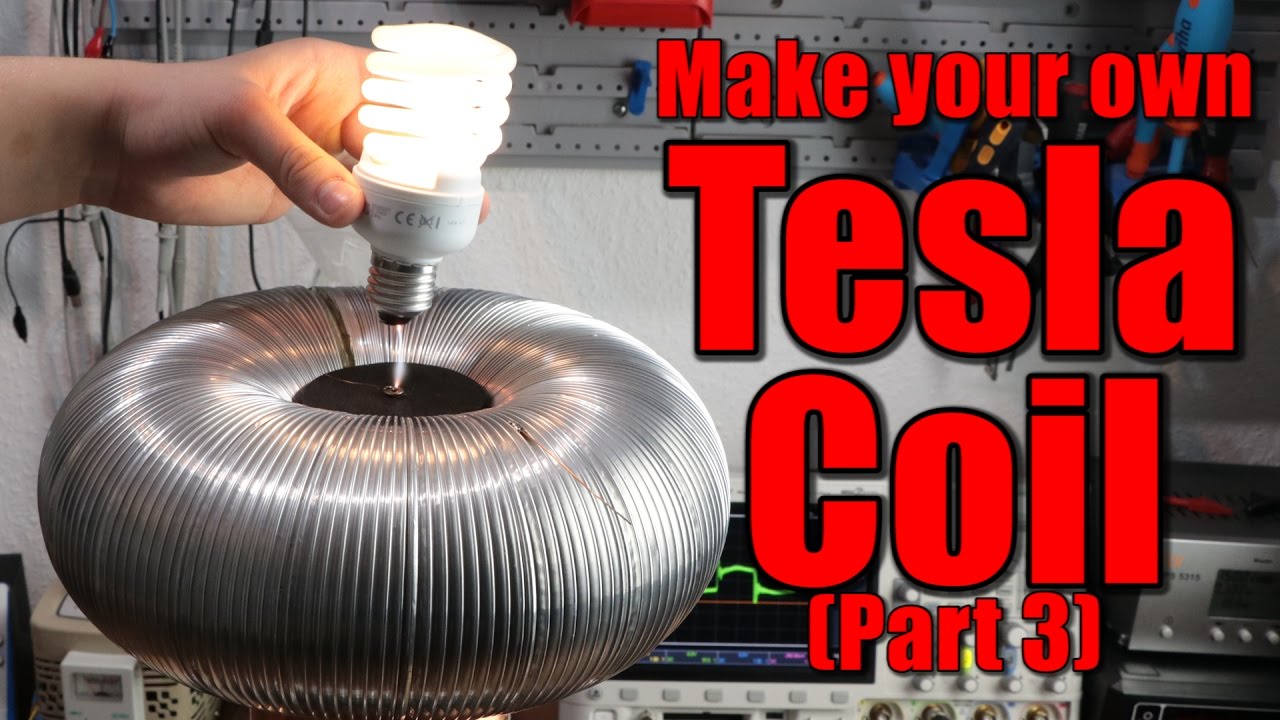
Make your own Tesla Coil (Part 3) Playing Music, Feedback, DRSSTC
video description
The next coil (the series resonant, impulsed from both ends) has on its ends 2 equal series tuning caps, that connect parallel over to the H Bridge coil.
the 3rd coil, is the secondary, tuned to the 5th or 7th harmonic, depending on the phase coupling of the coils.
The impulses generated by L1 are fed to series resonant L2. L2 longitudinally kicks L3 into magneto dielectric resonance.
L3 is coupled back to L1. this is positive feedback, made posible by the phase shift between L2 and L3, and also phase shifted between L1 and L2 (done by reversing the L1 coil, causing counter rotation)
All coils are distanced (loose coupled) bifilar pancake coils (equal mass.
Date: 2020-09-05
Related videos




Comments and reviews: 9
Roman
Hey scott, first: i love your videos and they are very inspiering and aloe me to get rid of anny doubt i have,
Second: i beleve that the wooden spaar youplaced in the center of the Tesla coil is whats avoiding a higher output (i think) Because i have built a much more simpympler one with the same construction principal, a wooden spar from a Broken brommstick hanble, turnes out after testing i notest 2 things. 1 the output power was way less then before and 2 the wooden spar was getting warm. Just a sudgestion, you could try removing the wooden spar and i belive that would give a bit more power to the output. Once again love your videos, take care and keep Up the great work: )
reply
Hey scott, first: i love your videos and they are very inspiering and aloe me to get rid of anny doubt i have,
Second: i beleve that the wooden spaar youplaced in the center of the Tesla coil is whats avoiding a higher output (i think) Because i have built a much more simpympler one with the same construction principal, a wooden spar from a Broken brommstick hanble, turnes out after testing i notest 2 things. 1 the output power was way less then before and 2 the wooden spar was getting warm. Just a sudgestion, you could try removing the wooden spar and i belive that would give a bit more power to the output. Once again love your videos, take care and keep Up the great work: )
reply
ondra511cz
Your project is very helpful! I have learned a lot from watching few of your videos. Only thing I am wondering about is the output. I have built a very simple SSTC and, when using Interrupter, I get quite visible corona at around 15v input voltage, it goes down to about 6v, when interrupter frequencies are higher, because of my limited possibilities in power supply part of the circuit. So my question is do you get no corona at all or is the corona less visible because of surrounding lights?
reply
Your project is very helpful! I have learned a lot from watching few of your videos. Only thing I am wondering about is the output. I have built a very simple SSTC and, when using Interrupter, I get quite visible corona at around 15v input voltage, it goes down to about 6v, when interrupter frequencies are higher, because of my limited possibilities in power supply part of the circuit. So my question is do you get no corona at all or is the corona less visible because of surrounding lights?
reply
Heads
weird. my real spark gap coil has its sparks go the other way!
that is, if i bring a metal object near.
the corona first appears on the metal. not the coil.
and i have the other end grounded on a copper pipe hammered into the ground and doused with salt water.
polarity doesnt matter, im running a neon sign transformer.
if i hold a fluoro tube by ether end and bring the center close to the coil. the center goes dark!
i better tune it in though.
reply
weird. my real spark gap coil has its sparks go the other way!
that is, if i bring a metal object near.
the corona first appears on the metal. not the coil.
and i have the other end grounded on a copper pipe hammered into the ground and doused with salt water.
polarity doesnt matter, im running a neon sign transformer.
if i hold a fluoro tube by ether end and bring the center close to the coil. the center goes dark!
i better tune it in though.
reply
RoboT
Hi GreatScott! I was wondering why you left this project at such a low output. I recently made a 25cm long coil and it has longer arcs than your coil, while being so much smaller and less powerful. If I were you, I would definitely try your circuit out using rectified mains. It just doesn't make sense to wind such a huge coil and then run it at such a low voltage. I think that's a waste of both time & resources. Cheers from neighbour country - Poland!
reply
Hi GreatScott! I was wondering why you left this project at such a low output. I recently made a 25cm long coil and it has longer arcs than your coil, while being so much smaller and less powerful. If I were you, I would definitely try your circuit out using rectified mains. It just doesn't make sense to wind such a huge coil and then run it at such a low voltage. I think that's a waste of both time & resources. Cheers from neighbour country - Poland!
reply
Jesse
Really cool and interesting. I hope someday to acquire the knowledge base to do projects like this. Thank you. I learned what an IGBT is not long ago when something at work blew it's varidrive. Disassembly found the IGBTs went boom due to arcing through dust on the 600v DC bus. Now I get to take the new varidrive apart every 6 months and clean it.
reply
Really cool and interesting. I hope someday to acquire the knowledge base to do projects like this. Thank you. I learned what an IGBT is not long ago when something at work blew it's varidrive. Disassembly found the IGBTs went boom due to arcing through dust on the 600v DC bus. Now I get to take the new varidrive apart every 6 months and clean it.
reply
prabhat
Why not just use some power transformer like of 20-30 volts ( which I think you have because you said you have quite a lot of transformers from salvaged bench power supplies ) and use a simple volatge doubler. That would definitely make the arcs quite big compared to now. We want to see it for a future video!
reply
Why not just use some power transformer like of 20-30 volts ( which I think you have because you said you have quite a lot of transformers from salvaged bench power supplies ) and use a simple volatge doubler. That would definitely make the arcs quite big compared to now. We want to see it for a future video!
reply
Stephen
How safe is this? I've read how it can cause burns even when far away and how burns can happen even without pain? Can you also creat a discussion on safety? I wish to create a project like this but safety concerns stop me from doing projects like this
reply
How safe is this? I've read how it can cause burns even when far away and how burns can happen even without pain? Can you also creat a discussion on safety? I wish to create a project like this but safety concerns stop me from doing projects like this
reply
PinkySuavo
no i didnt get motivated, i struggle with doing a simple transformer and checking if I have some output voltage and you do programming, soldering, cutting, projecting, calculating and 13201 different things that I would have no idea how to do.
reply
no i didnt get motivated, i struggle with doing a simple transformer and checking if I have some output voltage and you do programming, soldering, cutting, projecting, calculating and 13201 different things that I would have no idea how to do.
reply
joecheagaray
Thank you Scott, you explained everything, I learned a lot. Actually, I'm surprised how easy you applied maths to facts and solve problems. I'll build mine and share the results later.
reply
Thank you Scott, you explained everything, I learned a lot. Actually, I'm surprised how easy you applied maths to facts and solve problems. I'll build mine and share the results later.
reply
Add a review, comment
Other channel videos