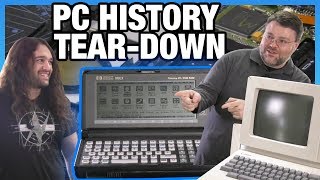
Computer from 1993 Test Drive & Tear-Down, ft. Level1Techs Wendell
video description
Date: 2020-05-06
Related videos


Comments and reviews: 10
Sam
13: 17 GPD pocket! not the GPD win (in the video. I own the pocket and pocket 2 and provided the first teardown photos of both. I use the pocket 2 every day in class as a second monitor to pull up notes and textbooks and suchlike. More than just a portable monitor though, I also use it on airplanes to play games, It's much smaller than an xbox controller! Anyway, Wendell is right, the keyboards on the GPD pockets aren't great. They key-spacing is pretty narrow and even worse: on the pocket 2, it's got different spacing on different rows. Makes it hard to type. Also the pocket 1 has a better pointing stick than the optical trackpad on the pocket 2. Overall these devices are awesome! I get a full day of battery out of mine easily! I charge it once a week or so. they're great conversation starters. When I have to do serious typing I'll use my other device or a portable keyboard. The pocket 1 has had the cooling system upgraded pretty heavily (it can now run the CPU full bore for 3. 5 hours until it runs out of battery without it ever downclocking. The pocket 2 cooling system is much better and didn't require modification. Turning the fan off on the pocket 2 increases battery life a little, because it will cause the CPU to downclock sooner. I love little miniature computers like these. This one has some really cool things going on! I love how the battery wires are clipped to the PCB> I think they do that for vibration resistance. There's 5 inductors over where the batteries come in, so I'm sure those are VRMs for all the devices. Maxim IC appears to drive that serial port, but I wonder if it's just a level shifter and the SoC does all the work? There's a lot more action going on on the other side of the board. We have the controllers for the VRMs on the other side (MAX 717 and 722. Both of which are specifically designed for palmtops, it says so in the datasheet) and, we have some 74-series logic (one quad NAND gate is on the same side as the SoC) I'm going to find teardown pictures online and see more! I'm always happy to see Wendell guest star. Keep it up!
reply
13: 17 GPD pocket! not the GPD win (in the video. I own the pocket and pocket 2 and provided the first teardown photos of both. I use the pocket 2 every day in class as a second monitor to pull up notes and textbooks and suchlike. More than just a portable monitor though, I also use it on airplanes to play games, It's much smaller than an xbox controller! Anyway, Wendell is right, the keyboards on the GPD pockets aren't great. They key-spacing is pretty narrow and even worse: on the pocket 2, it's got different spacing on different rows. Makes it hard to type. Also the pocket 1 has a better pointing stick than the optical trackpad on the pocket 2. Overall these devices are awesome! I get a full day of battery out of mine easily! I charge it once a week or so. they're great conversation starters. When I have to do serious typing I'll use my other device or a portable keyboard. The pocket 1 has had the cooling system upgraded pretty heavily (it can now run the CPU full bore for 3. 5 hours until it runs out of battery without it ever downclocking. The pocket 2 cooling system is much better and didn't require modification. Turning the fan off on the pocket 2 increases battery life a little, because it will cause the CPU to downclock sooner. I love little miniature computers like these. This one has some really cool things going on! I love how the battery wires are clipped to the PCB> I think they do that for vibration resistance. There's 5 inductors over where the batteries come in, so I'm sure those are VRMs for all the devices. Maxim IC appears to drive that serial port, but I wonder if it's just a level shifter and the SoC does all the work? There's a lot more action going on on the other side of the board. We have the controllers for the VRMs on the other side (MAX 717 and 722. Both of which are specifically designed for palmtops, it says so in the datasheet) and, we have some 74-series logic (one quad NAND gate is on the same side as the SoC) I'm going to find teardown pictures online and see more! I'm always happy to see Wendell guest star. Keep it up!
reply
Demorthus
I love Wendell so much. In a way he reminds me to one of our IT instructors from vocational school. He'd have so many stories & cool devices from back in the day, despite what some other students may have felt bored about; to me it was a joy almost every single day. You never really know what interesting details would come about even if the goal of that day was to cover a chapter (or several) of things like cpu sockets (their types, implementations, iterations, etc. Memory (self explanatory, I won't make this extra long by expressing what would be in several pages of a textbook lol. Back to Wendell, I'm not much of a software guy but I can appreciate his patience & ability to elaborate on things that may have otherwise simply been overlooked. Hardware-wise, have to love the fact this man made mods & overclocked such tiny hand held devices, as Steve mentioned the word Enthusiast I don't think you can come any closer to a real example of an OG like Wendell! :) (really just a fancy way of saying an accelerated course/program for CNST. With the intent that you also graduate along getting your A+ certification. But after that ofc you will undoubtedly find your niche that you wish to specialize in IF you truly love the world of IT and don't just do it for a paycheck)
reply
I love Wendell so much. In a way he reminds me to one of our IT instructors from vocational school. He'd have so many stories & cool devices from back in the day, despite what some other students may have felt bored about; to me it was a joy almost every single day. You never really know what interesting details would come about even if the goal of that day was to cover a chapter (or several) of things like cpu sockets (their types, implementations, iterations, etc. Memory (self explanatory, I won't make this extra long by expressing what would be in several pages of a textbook lol. Back to Wendell, I'm not much of a software guy but I can appreciate his patience & ability to elaborate on things that may have otherwise simply been overlooked. Hardware-wise, have to love the fact this man made mods & overclocked such tiny hand held devices, as Steve mentioned the word Enthusiast I don't think you can come any closer to a real example of an OG like Wendell! :) (really just a fancy way of saying an accelerated course/program for CNST. With the intent that you also graduate along getting your A+ certification. But after that ofc you will undoubtedly find your niche that you wish to specialize in IF you truly love the world of IT and don't just do it for a paycheck)
reply
Clive
Hey there. The. HP200lx was conceptualised by a team of engineers in Singapore and later used for the firing solution calculation of FH155mm artillery howitzers in the field. It was made exclusively in Singapore. The stock clock speed was 7MHz and it clocked to 21Mhz. Autoroute UK, EVP (Envision Publisher) desktop publishing with serial mouse support via DOS driver, connecting to a Bulletin Board Service (BBS) with a PCMCIA modem, dialling up unprotected infrastructure computers around the world, searchable databases, DOS games (Pac-Man, Tetris, Prince of Persia, Montezuma s revenge, Quicken, Lotus 123, BASIC programming with QBasic, IR control of the TV and more. Printing to a laser printer via RS232 serial or infrared. And YES, Windows, albeit Windows 2. 0. The best task manager (multi-tasking) was probably Software Carousel. I could type all my notes while at campus and collate them into a text file (with RTF) and then upload it to a desktop PC for finalising. And the IR port also allowed conjugating with other people with the HP95 or HP100. Regards
reply
Hey there. The. HP200lx was conceptualised by a team of engineers in Singapore and later used for the firing solution calculation of FH155mm artillery howitzers in the field. It was made exclusively in Singapore. The stock clock speed was 7MHz and it clocked to 21Mhz. Autoroute UK, EVP (Envision Publisher) desktop publishing with serial mouse support via DOS driver, connecting to a Bulletin Board Service (BBS) with a PCMCIA modem, dialling up unprotected infrastructure computers around the world, searchable databases, DOS games (Pac-Man, Tetris, Prince of Persia, Montezuma s revenge, Quicken, Lotus 123, BASIC programming with QBasic, IR control of the TV and more. Printing to a laser printer via RS232 serial or infrared. And YES, Windows, albeit Windows 2. 0. The best task manager (multi-tasking) was probably Software Carousel. I could type all my notes while at campus and collate them into a text file (with RTF) and then upload it to a desktop PC for finalising. And the IR port also allowed conjugating with other people with the HP95 or HP100. Regards
reply
Chris
Great video. I m one of those die-hard HP200LX users. Used mine daily until about 2004. It was souped-up, double-clocked and 32MB RAM upgrade. I even sent it into Thaddeus computing in the early 2000s to get the keyboard replaced. I still have it, but alas I threw away a bunch of the accessories over the years - things like a double-slot PCMCIA expander, an Ethernet card and a modem card. I even had one of those suction cup acoustic telephone modems for emergency use while traveling. I wrote tons of C programs on this machine, including an utility to interface the phone book with a Rex-3. Great memories, now I gotta go dust it off and see if I can still boot it.
reply
Great video. I m one of those die-hard HP200LX users. Used mine daily until about 2004. It was souped-up, double-clocked and 32MB RAM upgrade. I even sent it into Thaddeus computing in the early 2000s to get the keyboard replaced. I still have it, but alas I threw away a bunch of the accessories over the years - things like a double-slot PCMCIA expander, an Ethernet card and a modem card. I even had one of those suction cup acoustic telephone modems for emergency use while traveling. I wrote tons of C programs on this machine, including an utility to interface the phone book with a Rex-3. Great memories, now I gotta go dust it off and see if I can still boot it.
reply
Macartan
My first computer was a Sinclair spectrum 48 k a hole 48 killabite and a 4 track tape player you could buy games on 4 track cassettes. But the first computer i worked at could not fit onto Steve's bench it might not fit into Steve's place and you could not lift it's data storage was on 2 foot diameter 2 inch wide magnetic tape it punched holes in punch cards lol. that was long before you were born Steve lol in 1970
reply
My first computer was a Sinclair spectrum 48 k a hole 48 killabite and a 4 track tape player you could buy games on 4 track cassettes. But the first computer i worked at could not fit onto Steve's bench it might not fit into Steve's place and you could not lift it's data storage was on 2 foot diameter 2 inch wide magnetic tape it punched holes in punch cards lol. that was long before you were born Steve lol in 1970
reply
Krydolph
When I see that RGB SSD, I keep thinking about the first RGB SSD's that overheated and was absolutely terrible. Is it safe to assume that, that is no longer an issue since you are now shilling for this? Or did you take the money without testing it first? (I have a hard time imagining the last option from you guys) Could you please address this, since I have seen nothing about this besides sponsor spots!
reply
When I see that RGB SSD, I keep thinking about the first RGB SSD's that overheated and was absolutely terrible. Is it safe to assume that, that is no longer an issue since you are now shilling for this? Or did you take the money without testing it first? (I have a hard time imagining the last option from you guys) Could you please address this, since I have seen nothing about this besides sponsor spots!
reply
Piers
I attended prep and boarding school (in England) with students from China and Japan, and every single one of them had devices like these for (what mostly seemed to be) translation. But my favourite one was a student from Japan who had a colour Sharp device (form factor of the HP one in this video but colour screen. Edit: This was in 1996-99 for prep school so quite early for a colour touch screen.
reply
I attended prep and boarding school (in England) with students from China and Japan, and every single one of them had devices like these for (what mostly seemed to be) translation. But my favourite one was a student from Japan who had a colour Sharp device (form factor of the HP one in this video but colour screen. Edit: This was in 1996-99 for prep school so quite early for a colour touch screen.
reply
Chip
A friend had one of the HP handhelds; I wrote an option calculator for him. The cut down version of Lotus-123 didn't have a Log Normal Distribution function so I had to use a numerical approximation with as few float operations as possible. I miss the days of squeezing performance out of hardware - I have to play with microcontrollers to get the same buzz today.
reply
A friend had one of the HP handhelds; I wrote an option calculator for him. The cut down version of Lotus-123 didn't have a Log Normal Distribution function so I had to use a numerical approximation with as few float operations as possible. I miss the days of squeezing performance out of hardware - I have to play with microcontrollers to get the same buzz today.
reply
G3
i feel like im waay to young to be here lol, im 18 yet i kinda like old stuff, i have my father game & watch and 2 palm Vx still alive with the cradle, modded it to receive micro usb power input lol speaking of sharp, it seems like they are one of those companies that tried to push tech, untill foxconn bought them atleast
reply
i feel like im waay to young to be here lol, im 18 yet i kinda like old stuff, i have my father game & watch and 2 palm Vx still alive with the cradle, modded it to receive micro usb power input lol speaking of sharp, it seems like they are one of those companies that tried to push tech, untill foxconn bought them atleast
reply
Dave
13: 33 Slide out keyboards on PDA's and smartphones is something i miss to this day. There is not an on-screen keyboard that actually works properly 16: 08 My very first computer had a copy of Rogue on it. I was only 8 when I got and never did really understand what to do in Rogue (i never did get a manual for it)
reply
13: 33 Slide out keyboards on PDA's and smartphones is something i miss to this day. There is not an on-screen keyboard that actually works properly 16: 08 My very first computer had a copy of Rogue on it. I was only 8 when I got and never did really understand what to do in Rogue (i never did get a manual for it)
reply
Add a review, comment
Other channel videos