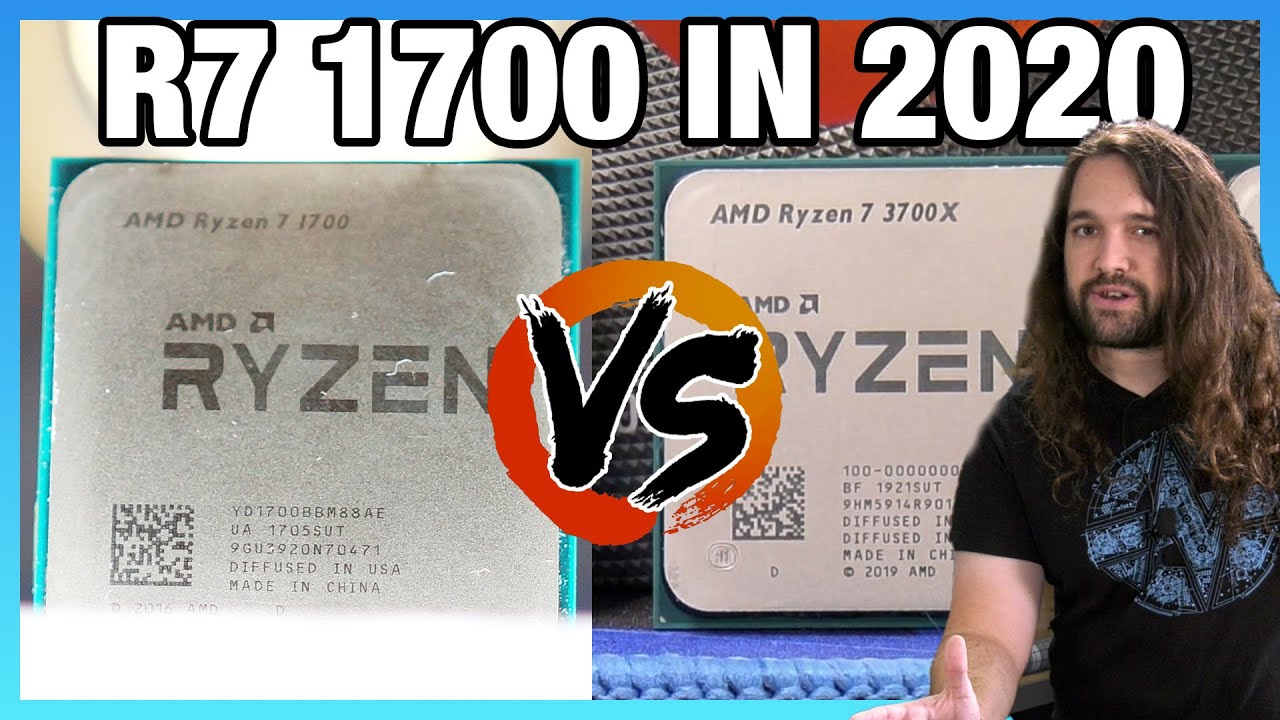
AMD Ryzen 7 1700 in 2020: Benchmark vs. 3700X, 3900X, 10600K, & More
video description
Date: 2020-06-12
Related videos


Comments and reviews: 10
SvD
I'll chime in with a mini-review of the R7 1700 from a consumers POV.
I picked up a Ryzen 7 1700 at the end of March '17 for about 400 AUD ( 305 USD at the time). For me, it was a no-brainer; the i7-7700K was faster in games, but the R7 1700 performed more like one of Intel's Broadwell-E HEDT processors in production tasks while being less expensive than an i7-7700K. For reference, I was upgrading from an i7-3770.
My personal rig does a lot of stuff - gaming, streaming, code compilation, video rendering, virtualisation, etc., and the balance of performance and price offered by the Ryzen 7 1700 made it the clear pick of what was available at the time. Intel's higher performance in games hasn't been a draw for me as I'm still using an R9 290X 4GB GPU at 1080p/75Hz, so the bottleneck is pretty much always on the GPU when gaming (outside of select titles). I've got mine overclocked to 3.8 GHz at 1.285V (SET) and it chugs along quite nicely. I play and stream games like World of Warcraft, CoD: Modern Warfare, Satisfactory, and the combination of R7 1700 and R9 290X serves me very well.
So that's the good, what about the bad? Well, I picked the ASUS ROG CROSSHAIR VI HERO as my board of choice - the only options available to me at the time were the C6H, MSI's X370 Xpower Gaming Titanium (which Buildzoid and many others rightfully called out as not being very good), ASRock's X370 Taichi, and Gigabyte's AX370 Gaming K7. Having to take the plunge on a flagship motherboard hurt a bit, but none of the other X370 or B350 boards had become available at the time, and I knew AM4 was a brand new platform meaning the flagship boards would get the best support (in theory).
The board itself has been great - I'm running BIOS 6401 (AGESA PinnaclePi 1.0.0.6) as I haven't needed to upgrade to support Zen 2. What hasn't been so great is memory support. 1st gen Ryzen is a picky, picky architecture. My kit of Corsair Vengeance LPX (CMK16GX4M2B3200C16) is rated for 3200 C16, but it uses Hynix AFR ICs and my early production run CPU _hates_ the stuff. I had it running at 2666 AUTO for the better part of three years simply because I couldn't be bothered testing and retesting to try and find a stable set of timings. More recently I used the DRAM calculator to try 3200 C16 (crashes in Windows) and 2933 C14 (seemed to work for a while but I started getting hard crashes), so I'm back to 2666 at 14-16-16-36-54-1T (I haven't adjusted timings since backing off from 2933 to 2666).
My particular unit is also vulnerable to the old kill Ryzen Linux compilation bug that causes segmentation faults when executing certain instructions, given it was manufactured very early on in 2017, so that's not so great.
All in all though, I'm very pleased with my purchase. The march of progress means that at best I'm looking at Ryzen 3 3100 or Ryzen 3 3300X performance in games (if I were to upgrade my GPU), but gaming is just one part of what I do. I'm in two minds about upgrading to a Ryzen 9 3900X when Ryzen 4000 comes out, or just waiting for DDR5, but it's nice to have options.
reply
I'll chime in with a mini-review of the R7 1700 from a consumers POV.
I picked up a Ryzen 7 1700 at the end of March '17 for about 400 AUD ( 305 USD at the time). For me, it was a no-brainer; the i7-7700K was faster in games, but the R7 1700 performed more like one of Intel's Broadwell-E HEDT processors in production tasks while being less expensive than an i7-7700K. For reference, I was upgrading from an i7-3770.
My personal rig does a lot of stuff - gaming, streaming, code compilation, video rendering, virtualisation, etc., and the balance of performance and price offered by the Ryzen 7 1700 made it the clear pick of what was available at the time. Intel's higher performance in games hasn't been a draw for me as I'm still using an R9 290X 4GB GPU at 1080p/75Hz, so the bottleneck is pretty much always on the GPU when gaming (outside of select titles). I've got mine overclocked to 3.8 GHz at 1.285V (SET) and it chugs along quite nicely. I play and stream games like World of Warcraft, CoD: Modern Warfare, Satisfactory, and the combination of R7 1700 and R9 290X serves me very well.
So that's the good, what about the bad? Well, I picked the ASUS ROG CROSSHAIR VI HERO as my board of choice - the only options available to me at the time were the C6H, MSI's X370 Xpower Gaming Titanium (which Buildzoid and many others rightfully called out as not being very good), ASRock's X370 Taichi, and Gigabyte's AX370 Gaming K7. Having to take the plunge on a flagship motherboard hurt a bit, but none of the other X370 or B350 boards had become available at the time, and I knew AM4 was a brand new platform meaning the flagship boards would get the best support (in theory).
The board itself has been great - I'm running BIOS 6401 (AGESA PinnaclePi 1.0.0.6) as I haven't needed to upgrade to support Zen 2. What hasn't been so great is memory support. 1st gen Ryzen is a picky, picky architecture. My kit of Corsair Vengeance LPX (CMK16GX4M2B3200C16) is rated for 3200 C16, but it uses Hynix AFR ICs and my early production run CPU _hates_ the stuff. I had it running at 2666 AUTO for the better part of three years simply because I couldn't be bothered testing and retesting to try and find a stable set of timings. More recently I used the DRAM calculator to try 3200 C16 (crashes in Windows) and 2933 C14 (seemed to work for a while but I started getting hard crashes), so I'm back to 2666 at 14-16-16-36-54-1T (I haven't adjusted timings since backing off from 2933 to 2666).
My particular unit is also vulnerable to the old kill Ryzen Linux compilation bug that causes segmentation faults when executing certain instructions, given it was manufactured very early on in 2017, so that's not so great.
All in all though, I'm very pleased with my purchase. The march of progress means that at best I'm looking at Ryzen 3 3100 or Ryzen 3 3300X performance in games (if I were to upgrade my GPU), but gaming is just one part of what I do. I'm in two minds about upgrading to a Ryzen 9 3900X when Ryzen 4000 comes out, or just waiting for DDR5, but it's nice to have options.
reply
wishus
When Zen first launched... I looked at it like.. Well, its not bad, its good enough for good competition . And it was certainly hell of an increase over bulldozer. It couldn't beat intel from my impressions but it was certainly worth considering if at least to go back to the brand that I loved so much in the past. I still held off and clung to my 2600K as my gamer as then Zen+ launched, and then Zen2. Threadripper on zen and zen+ never interested me in the slightest, and I was doing workloads where I would really need it. As I had an old used dual socket 6 core westmere workstation I was using for that stuff as I got busy with my work already since about the time I bought my 2600K. Then when I saw Zen2 delidded and space for that extra chiplet... I gasped... And waited... Zen2's numbers were fantastic, and truly competitive both in performance and price, and then the 3950X launched and I finally opened my wallet and came back home to AMD after a very long absence... And hopefully wont be looking back for a long time to come. No regrets.
A friend of mine hung onto his 1100T hex core and replaced it with a ryzen 1700 shortly after its launch, and has been on AMD since his very first computer.. A 386 DX40. He has never once had an Intel. And this video today will be aimed squarely at him. He several times was forced to cling to a machine far longer than was ideal in anticipation of AMD coming out with a winner. And several times he didn't regret those choices, with the Athlon 550, the Athlon 64, and any time AMD was able to leap over everyone else.... And then his 1700. It has made him a very proud fanboy.
reply
When Zen first launched... I looked at it like.. Well, its not bad, its good enough for good competition . And it was certainly hell of an increase over bulldozer. It couldn't beat intel from my impressions but it was certainly worth considering if at least to go back to the brand that I loved so much in the past. I still held off and clung to my 2600K as my gamer as then Zen+ launched, and then Zen2. Threadripper on zen and zen+ never interested me in the slightest, and I was doing workloads where I would really need it. As I had an old used dual socket 6 core westmere workstation I was using for that stuff as I got busy with my work already since about the time I bought my 2600K. Then when I saw Zen2 delidded and space for that extra chiplet... I gasped... And waited... Zen2's numbers were fantastic, and truly competitive both in performance and price, and then the 3950X launched and I finally opened my wallet and came back home to AMD after a very long absence... And hopefully wont be looking back for a long time to come. No regrets.
A friend of mine hung onto his 1100T hex core and replaced it with a ryzen 1700 shortly after its launch, and has been on AMD since his very first computer.. A 386 DX40. He has never once had an Intel. And this video today will be aimed squarely at him. He several times was forced to cling to a machine far longer than was ideal in anticipation of AMD coming out with a winner. And several times he didn't regret those choices, with the Athlon 550, the Athlon 64, and any time AMD was able to leap over everyone else.... And then his 1700. It has made him a very proud fanboy.
reply
Joseph
Thanks for the Ryzen 1700 2020 update Steve. I think you absolutely gave solid advice recommending the 1700 over the 1800x back in 2017. And you also gave solid advice recommending the 7700k/8700k over the first gen Ryzen parts, if one was exclusively gaming as well. The 7700k and 8700k have aged incredibly well.
But I think most first gen Ryzen owners can upgrade to an 3700x if coming from an 1700/1700x/1800x and most 1600 owners can likewise upgrade to an 3600 or 3700x for a large performance uplift. But it is a shame that 300 chipset AM4 owners won't be getting Ryzen 4000 support, I really do think an upgrade to 4000 from 1000 would be an even more substantial upgrade over 3000 series.
But 3000 series is still a very large upgrade over 1000 series, and is absolutely an viable upgrade path for more gaming and productivity performance. My advice would be that if anyone on 1st gen Ryzen who wants to upgrade to 3000 series, and doesn't want to upgrade the entire platform to 4000 series, just wait for 4000 launch and pick up an 3000 CPU for an much cheaper price compared to current pricing.
Thanks for the update Steve, very informative and highly enjoyable.
reply
Thanks for the Ryzen 1700 2020 update Steve. I think you absolutely gave solid advice recommending the 1700 over the 1800x back in 2017. And you also gave solid advice recommending the 7700k/8700k over the first gen Ryzen parts, if one was exclusively gaming as well. The 7700k and 8700k have aged incredibly well.
But I think most first gen Ryzen owners can upgrade to an 3700x if coming from an 1700/1700x/1800x and most 1600 owners can likewise upgrade to an 3600 or 3700x for a large performance uplift. But it is a shame that 300 chipset AM4 owners won't be getting Ryzen 4000 support, I really do think an upgrade to 4000 from 1000 would be an even more substantial upgrade over 3000 series.
But 3000 series is still a very large upgrade over 1000 series, and is absolutely an viable upgrade path for more gaming and productivity performance. My advice would be that if anyone on 1st gen Ryzen who wants to upgrade to 3000 series, and doesn't want to upgrade the entire platform to 4000 series, just wait for 4000 launch and pick up an 3000 CPU for an much cheaper price compared to current pricing.
Thanks for the update Steve, very informative and highly enjoyable.
reply
Jared
I've been on the 1700 since shortly after launch. It's on an Asrock B350 Gaming K4 and paired with a GTX 1070.
I got it for my coding and gaming. It has treated me great since then.
I bent a pin on my CPU when installing, which I fixed with a craft knife, so it's possible my overclocking results were impacted.
I'm not great with overclocking, so the best I've managed is a 3600MHz all-core overclock and my memory, 2x8GB G.Skill Fortis 2400C15, couldn't get past 2666MHz. Any tweaking of timings outside of XMP default failed to boot. Though that's probably my choice of memory.
I made attempts to push higher but immediately struggled with crashes and weird application issues.
I chose a Noctua NH-U12S, which seems to be doing well to keep my CPU cool during heavy use, so maybe I could push further on the CPU if I knew better how to tune.
Moving to Gen 3 Ryzen and better memory is on my mind, eventually followed by a GPU and motherboard upgrade down the road.
Given this was my first attempt at building my own PC, how do you think I did?
reply
I've been on the 1700 since shortly after launch. It's on an Asrock B350 Gaming K4 and paired with a GTX 1070.
I got it for my coding and gaming. It has treated me great since then.
I bent a pin on my CPU when installing, which I fixed with a craft knife, so it's possible my overclocking results were impacted.
I'm not great with overclocking, so the best I've managed is a 3600MHz all-core overclock and my memory, 2x8GB G.Skill Fortis 2400C15, couldn't get past 2666MHz. Any tweaking of timings outside of XMP default failed to boot. Though that's probably my choice of memory.
I made attempts to push higher but immediately struggled with crashes and weird application issues.
I chose a Noctua NH-U12S, which seems to be doing well to keep my CPU cool during heavy use, so maybe I could push further on the CPU if I knew better how to tune.
Moving to Gen 3 Ryzen and better memory is on my mind, eventually followed by a GPU and motherboard upgrade down the road.
Given this was my first attempt at building my own PC, how do you think I did?
reply
Steve
I've got a 3900x that no longer works - and Amazon won't do anything about it. And now while waiting for Cosumper Protection to get back to me I'm waiting on AMD. And I had 2 x570 Taichi that stopped working. You can't just go into a shop to buy replacements. I'm now also waiting for a not rubbish x570 motherboard to be able to actually buy it and have it delivered rather than get another email saying that they now have no more stock.
Customer service seems to have disappeared in Australia - people don't answer phones, they don't respond to emails, they're charging me 100 to send my CPU by DHL (per AMD request) to Singapore. DHL added 18 to my bill in case I couldn't pay - doesn't make sense & they didn't say beforehand. DHL told me to have the parcel ready to go when it was picked up, then they said make sure it's all open for inspection when they pick it up - go figure.
So it looks like I'm in the market for a 1600AF and a B450 Tomahawk with 16gb 3200-16.
reply
I've got a 3900x that no longer works - and Amazon won't do anything about it. And now while waiting for Cosumper Protection to get back to me I'm waiting on AMD. And I had 2 x570 Taichi that stopped working. You can't just go into a shop to buy replacements. I'm now also waiting for a not rubbish x570 motherboard to be able to actually buy it and have it delivered rather than get another email saying that they now have no more stock.
Customer service seems to have disappeared in Australia - people don't answer phones, they don't respond to emails, they're charging me 100 to send my CPU by DHL (per AMD request) to Singapore. DHL added 18 to my bill in case I couldn't pay - doesn't make sense & they didn't say beforehand. DHL told me to have the parcel ready to go when it was picked up, then they said make sure it's all open for inspection when they pick it up - go figure.
So it looks like I'm in the market for a 1600AF and a B450 Tomahawk with 16gb 3200-16.
reply
advil000
So because of price/performance/availability etc. What happens when you pit a 3900x with 3600 DDR4 and fclk at 1800mhz or 1900mhz against the 10600k and 10900k? My 3900x has been a total monster with affordable 180 trident neo 32gb 3600 CL16 and it's solid at 1900fclk. (ASUS TUF X570 Gaming non-wifi) This is with no extra OC control, little LLC and a negative voltage offset all specifically to keep volts and temps in a reasonable range. Based on all the earlier complex discussions when the 3900x and 3950x came out the push was to run 3600 RAM and at least 1800fclk 1:1:1 which has turned out to be pretty straightforward in the end since nothing ELSE we do to the CPUs really makes them clock any higher. But a lot of the gaming gap gets closed if the system is set up this way... and why wouldn't you? It costs about 20 extra for the ram and the fclk stability is just down to getting the RAM and motherboard set right.
reply
So because of price/performance/availability etc. What happens when you pit a 3900x with 3600 DDR4 and fclk at 1800mhz or 1900mhz against the 10600k and 10900k? My 3900x has been a total monster with affordable 180 trident neo 32gb 3600 CL16 and it's solid at 1900fclk. (ASUS TUF X570 Gaming non-wifi) This is with no extra OC control, little LLC and a negative voltage offset all specifically to keep volts and temps in a reasonable range. Based on all the earlier complex discussions when the 3900x and 3950x came out the push was to run 3600 RAM and at least 1800fclk 1:1:1 which has turned out to be pretty straightforward in the end since nothing ELSE we do to the CPUs really makes them clock any higher. But a lot of the gaming gap gets closed if the system is set up this way... and why wouldn't you? It costs about 20 extra for the ram and the fclk stability is just down to getting the RAM and motherboard set right.
reply
ShikiKaze
My R7-1700 still rocking. Great for CAD work, light-medium computational workload, and decent in gaming, just what I needed. O.C'd it's fantastic at 4.2Ghz stable on 3 cores but across all core stable at 4.0Ghz. I probably will skip the 3000-Series till I see any need for stable architectural necessity that benefits my work. I definitely need to get rid of this Sapphire RX580 which keeps black screening on me even after all the updates. Adrenalin used for controlling/monitoring the GPU with built in Ryzen Master for CPU, intermittently crashes and black screens if there's multiple windows opens + dual screen. which is quite frankly annoying when I want to game or do light multitasking. Waiting on Jensen/Nvidia to unleash the 3k Series card and techtuber's card performance reviews to upgrade entirely later.
reply
My R7-1700 still rocking. Great for CAD work, light-medium computational workload, and decent in gaming, just what I needed. O.C'd it's fantastic at 4.2Ghz stable on 3 cores but across all core stable at 4.0Ghz. I probably will skip the 3000-Series till I see any need for stable architectural necessity that benefits my work. I definitely need to get rid of this Sapphire RX580 which keeps black screening on me even after all the updates. Adrenalin used for controlling/monitoring the GPU with built in Ryzen Master for CPU, intermittently crashes and black screens if there's multiple windows opens + dual screen. which is quite frankly annoying when I want to game or do light multitasking. Waiting on Jensen/Nvidia to unleash the 3k Series card and techtuber's card performance reviews to upgrade entirely later.
reply
Chase
I have a 1700 3.8 and have been wondering with the latest cpu updates if its still even worth a new chip since I game at 1440p with a gtx 1080 so any new ryzen chip won't really be worth it imo, would be interesting to see more testing at 1440p with settings people actually play on to see what percentage of improvement can be made with a drop in upgrade not just trying to get as much difference as possible between all the chips because that's not how people realistically play games. If you have a lower end gaming cpu you might as well make the gpu the limiting factor and crank all the settings that way the difference between a 1700 and a 10600k or a 3700x become smaller and smaller
reply
I have a 1700 3.8 and have been wondering with the latest cpu updates if its still even worth a new chip since I game at 1440p with a gtx 1080 so any new ryzen chip won't really be worth it imo, would be interesting to see more testing at 1440p with settings people actually play on to see what percentage of improvement can be made with a drop in upgrade not just trying to get as much difference as possible between all the chips because that's not how people realistically play games. If you have a lower end gaming cpu you might as well make the gpu the limiting factor and crank all the settings that way the difference between a 1700 and a 10600k or a 3700x become smaller and smaller
reply
SpeedProg
I can get 3.9 on my 1700X without even increasing any voltages, never tried how far I would get with voltage changes. Through I really don't care actually using it at stock speed and downvolted, mostly it doesn't need it anyway only thing really stressing it is when I compile stuff. (or when I used to multibox 13 eve clients) Only thing bad about it was, that the first one I got had the bug were it randomly segfaulted during compiles, which really wasn't funny when running gentoo. But man was it nice to get 8 cores for an affordable price back then.
reply
I can get 3.9 on my 1700X without even increasing any voltages, never tried how far I would get with voltage changes. Through I really don't care actually using it at stock speed and downvolted, mostly it doesn't need it anyway only thing really stressing it is when I compile stuff. (or when I used to multibox 13 eve clients) Only thing bad about it was, that the first one I got had the bug were it randomly segfaulted during compiles, which really wasn't funny when running gentoo. But man was it nice to get 8 cores for an affordable price back then.
reply
Alexandru
I have this 3.8 GHz, +0.1375 V & LLC Mode 4 (MSI board, it reaches 1,33V when needed), and I'm very satisfied with it. Paid like 270-280 USD I think when Intel just released their 8700 SKUs. I agree it isn't the best gaming CPU, but I have it with a midrange graphics card and I think it's decent. Plus, I like its productivity capabilities, I run servers on my machine, I use Handbrake frequently, and it is great for that. All in all I think it's a good all-rounder. I'll wait for Ryzen 4000 series to see if the 4700X will stomp on my 1700.
reply
I have this 3.8 GHz, +0.1375 V & LLC Mode 4 (MSI board, it reaches 1,33V when needed), and I'm very satisfied with it. Paid like 270-280 USD I think when Intel just released their 8700 SKUs. I agree it isn't the best gaming CPU, but I have it with a midrange graphics card and I think it's decent. Plus, I like its productivity capabilities, I run servers on my machine, I use Handbrake frequently, and it is great for that. All in all I think it's a good all-rounder. I'll wait for Ryzen 4000 series to see if the 4700X will stomp on my 1700.
reply
Add a review, comment
Other channel videos