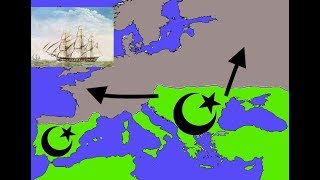
What if Ireland United in the 11th Century?
video description
In any case we'd probably still have an English Civil War as the Divine Right of Kings was spreading through Europe, which would raise uncomfortable questions about the relationship between Parliament and the Crown. I could imagine the Irish and the Scots propping up one side or the other to weaken England and prolong the war, but I don't know if this would tip the scales in favor of the Crown or not.
Date: 2022-07-15
Related videos



Comments and reviews: 9
Kelnx
I would say that it is impossible to imagine what Ireland would become had it stayed united. Ireland and the Irish people we know of today, including the many of us that share Irish ancestry, are so alien to Ireland and it's people before centuries of dominance by England. But had the nation stayed somehow intact, I do not see any reason they would not have industrialized and most likely would have been at least a moderate maritime power. Assuming a unified Ireland could avoid being invaded or breaking up at some point, I suppose the only real factor would have been competency of its system of government, and without a strong model to look at there is no way to predict it. There really is no fully developed, purely Gaelic society in our timeline to compare to, not even the Scots, who were massively influenced by England and France.
Regardless of modern Irish efforts to reintroduce Gaelic language, the culture died out for good by the 17th century, and we have no group or cultural politics or behavior to compare to.
reply
james
The real reason England excluded Ireland was a small revolt against
Henry VII.
Henry VII was haunted by the two princes killed by King Richard. These princes had a better claim to the throne then Henry VII.
In the County Cork a man claimed to be one of these princes, and wanted to reclaim the throne from Henry VII.
There was a small revolt which threatened Henry VII. It was resolved that the man claiming to be the rightful King was an imposter.
But this revolt had a profound effect on Henry VII's son, who became Henry VIII.
It was Henry VIII, who excluded the Irish from the English Court.
See the Irish Nobles didn't care whether their King was in Dublin or London.
It was Henry VIII, who made the Irish into the surfs of the British Isles.
Also it was wise for the English to excluded the Irish from the English Court. Because the Celtic Irish are better politicians than the English.
reply
Contact
semi-nomadic? Farming has been present in Ireland since the Neolithic farmers arrived 6, 500 years ago. Pre-viking Ireland was centered around the clan with dominant noble families ruling over the surrounding area. It had the most advanced centers of education in Europe at the time with English and French nobility sending their children to be taught in the monasteries. I don't think it was the pre-agricultural backwater that you depict.
Celtic fringe, under-developed and potato-obsessed. These are all ideas floated by the English over the years in order to justify genocide and land-grabbing. The English sometimes dismiss Irish objections to these terms as jealousy or as a chip on the shoulder but these ideas are dehumanising and they have been used as a cover for the genocide of Irish people so it's very insulting to use these terms when addressing Irish people.
reply
MrHistory
I feel like Ireland would loose its empire around the 17th or 18th centuries in my opinion the 14-1600s were the time where vast majority of the European Kingdoms had a a shot of empire and after the 7 years war and Napoleon only a select few European Kingdoms had an empire think about it before the 1700s There were Swedish Dutch Scottish Portuguese and the Spanish French and English and after the 7 years war and Napoleon the only empire that were still standing were the British and French everyone else was gone no Spanish empire the Dutch on the decline and Portugal was loosing everything that only left the British to colonize and the French got there act together a couple decades after I think Ireland would loose its grip along with the Spanish and Dutch however i am most likely wrong thats just what I think would happen
reply
Thomas
One of the differences was that Scotland couldn't be prevented from industrialization by English fiat. Ireland, which wasn't in the best resource situation would have probably industrialized after Scotland and England anyway. This was because of fewer resources like coal. But when Ireland showed signs or what was taken as signs of industrialization, the British Parliament shut them down hard because of the traditional dislike of competition among the merchants etc. If you look at how the British East India Company closed down pre-existing industries in India to eliminate competition for British manufactures, you'll see it's the same process.
reply
Jakub
6: 45 many Poles actually converted to protestantism, but due to religious tolerance in Poland it didn't have a bigger impact on the country. The situation changed when Swedish came. Their barbarian acts in some way worse than Germans in WWII (seriously) connected with their fanatism made many Poles dislike protestants (not only Swedes were ones but also most of them supported the attackers) and two years later all protestants had to either convert, or be banished from the Commowealth
yeah, I bet so many people will read this after 2 years
reply
Contact
For someone you is a fan of Norman history, you should know that Ireland was conquered by the French not English in the 12th century. Diarmuid McMurrough invited king Henry II into Ireland. King Henry II was King of England but he held court in Acquitaine. The Normans that proceeded to conquer Ireland ruled over Ireland for the next 400 years. They spoke French and both Ireland and England's parliament conducted business and wrote laws in French until the arrival of the Tudors.
reply
MCFC
Ireland were united under high kings other than Brian Boru.
They were high kings of Ireland although it acted as a kind
Holy Roman Empire with all the smaller tribes still fighting under the high king.
From the mid 400s AD to late 600s AD, Ireland had a high king while no one other than the Irish tribes were in Ireland, and the entire west side of Scotland was conquered by the Irish and the Isle Of Mann belonged to Ireland.
That was the biggest Ireland ever was.
reply
Seaghn
Great to see an Irish alternate history! Unfortunately you didn't seem to do much research. Ireland wasn't tribal or anarchic before the English conquest, that is a myth propagated by the English. Also it is just wrong to say the Irish were semi-nomadic cattle herders prior to the English invasion, you can look at annalistic evidence as well as palynological evidence to see that tillage farming was widespread in Ireland centuries before England invaded.
reply
Add a review, comment
Other channel videos