My 11 Favorite History Books.
video description
Rudyard L. rated it it was amazing
Shelves: history-books
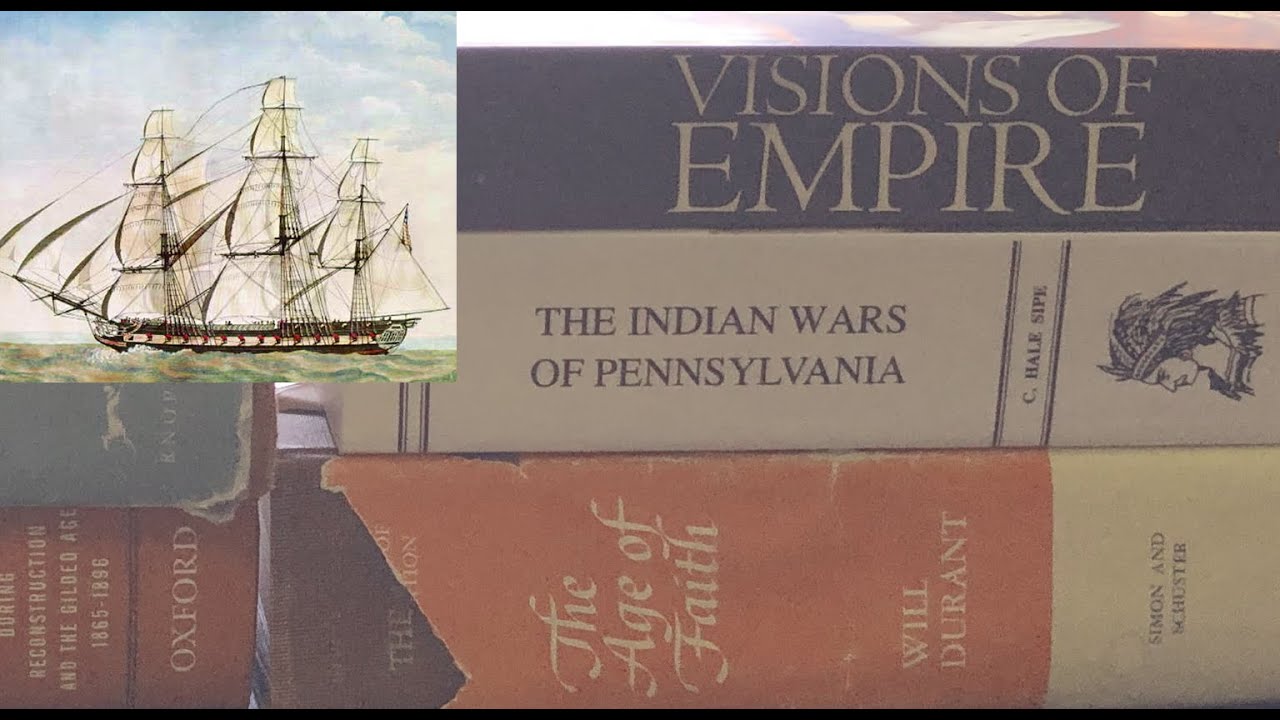
It's not impossible I'm the only person in the world to have read this book since 1950 at least. I bought this book at a used bookstore in a middle of no-where town in Pennsylvania (the author's home state. I had to create the Goodreads entry for it and it is barely even on Amazon. This book was written in the midst of World War 2, during paper rationing. This results in pages so thin that when I took this book through airport security, it set off the alarm systems for being so dense. Also, this book was written in a style about 40 years out of date at the time and would be considered borderline heretical in a few decades. This slated this book to be endlessly forgotten. Thus, as the only person recorded to have ever read this, I feel a sense of duty to write the book review.
That being said, this book is a masterpiece. It is easily one of my favorite history books of all time. I'm a pretty hard core history buff, so that title does not come easily. This book summarized in a single sentence is Why is America rich and Mexico poor? Baldwin studies the history of the Americas from Christopher Columbus to the Second World War. The main focus is What impact did European settlement and civilization have on separate parts of the Americas. Each nation is viewed as a separate attempt by a European country to impart its society, often emphasizing completely different characteristics and taking in different levels of native culture. Paraguay and Mexico were both colonized by Spain, but Paraguay became a communist Catholic theocracy while Mexico was a feudal caste slave economy. This shows why the nations in the Americas are so different and explains their complex relationships today.
The main focus of this book is the colonization and settlement itself. This will result in strange choices. For example, the American Civil War will receive almost no page time, but the 18th century Canada-Santa Fe trade route receives 10 pages. Leland Dewitt Baldwin is a fabulous writer. He really should have been a novelist rather than a historian. It feels as if Errol Flynn is reading these lines to inspire his pirate crew in some Swashbuckling film of the age. Stories of incredible adventure and drama are told and will have you on the edge of your seat for hundreds of pages.
However, my favorite part of the book is Baldwin's bizarre knowledge and deep erudition. I learned an insane amount from this book. I feel cheated by the history I learned in school that they missed out on all this incredible material.
For Example:
1. It's quite possible that the English and Portuguese knew about America before Columbus and were just keeping it secret.
2. The Pacific North-West was settled by Scottish fur trappers who created a feudal society that peacefully surrendered power to the American pioneers.
3. Paraguay was a once a communist theocracy that successfully fought a war of independence against Spain while it was the main world power.
4. The state of South Carolina once fought a personal war against the nations of Spain and France---AND WON.
5. There were bands of Brazilian roving thugs called the Paulistas that roved across almost the entire South American continent in the 17th century, enslaving entire whole regions.
This book hasn't aged well in all the right ways. It has a classic style that is really out of fashion and the deep historical knowledge that went with it. Histories of today tend to focus on small, nearly insignificant regions of the past. They also tend to forget that history was mainly done by a bunch of scared and hungry teenagers trying the best they could in insane circumstances, and occasionally succeeding brilliantly. In any histories of this era, you tend to run into things that would today be considered politically incorrect. This really isn't an issue here. Baldwin freely admits that the Europeans were often terrible scumbags and the natives many times had the moral high ground. He makes some pretty insensitive comments against Africans, but he actually makes a very stirring argument for the equality of the races, an end to segregation and for racial integration multiple times.
In summary, this book is an incredible masterpiece that deserves more attention.
Date: 2022-07-15
Related videos




Comments and reviews: 9
Patrick
Dude. you spoke more truth about history books in the first minute of this video than I was even prepared for. Howard Zinns book? It really is the Marxist Single-Factor-Explanation of History, through and through. As though all American history is just about property owners oppressing and exploiting the working class, or the white man oppressing everyone else. As though America needs a Socialist revolution, instead of recognizing American life was, and still is, in the history of the world, a revolution _in and of itself. _ Gibbons work influenced two of my favorite authors so much (D. Boorstin and B. Tuchman, but youre right, hes clunky to read in this era of television and incompetence in public schooling.
reply
Dude. you spoke more truth about history books in the first minute of this video than I was even prepared for. Howard Zinns book? It really is the Marxist Single-Factor-Explanation of History, through and through. As though all American history is just about property owners oppressing and exploiting the working class, or the white man oppressing everyone else. As though America needs a Socialist revolution, instead of recognizing American life was, and still is, in the history of the world, a revolution _in and of itself. _ Gibbons work influenced two of my favorite authors so much (D. Boorstin and B. Tuchman, but youre right, hes clunky to read in this era of television and incompetence in public schooling.
reply
The
How could you have Quigley on your list but not also include Spengler and Toynbee!
I mean, The Evolution of Civilizations is great and all - I actually just reread it myself - but its thesis is far more streamlined, narrow, and specifically-focused, whereas the theses of A Study of History and Der Untergang Das Abendlands cover a far wider array of topics and ideas. I adore Quigley, and think that he is one of the greatest historians of the 20th century, and perhaps one of the greatest American historians to have ever lived, but, next to those of Spengler and Toynbee, his ideas & ultimate conclusions are rather dull, regardless of how empirically correct they are.
reply
How could you have Quigley on your list but not also include Spengler and Toynbee!
I mean, The Evolution of Civilizations is great and all - I actually just reread it myself - but its thesis is far more streamlined, narrow, and specifically-focused, whereas the theses of A Study of History and Der Untergang Das Abendlands cover a far wider array of topics and ideas. I adore Quigley, and think that he is one of the greatest historians of the 20th century, and perhaps one of the greatest American historians to have ever lived, but, next to those of Spengler and Toynbee, his ideas & ultimate conclusions are rather dull, regardless of how empirically correct they are.
reply
tracerpose
I've got to say, as someone who lurks and never comments, you though deserve the knowledge that you have helped me understand the world, history, and society much more effectively. I have been watching your videos for years. Yet although every model of analyzing the world may be partly flawed somehow, mine has improved due to your consistent show of eclectic yet effective knowledge!
Thank you for stimulating interest, enjoyment, curiosity and intellectual growth, and I am happy to see some of your own teachers on display here as well, perhaps I shall check these out!
Finally, again, thank you Whatifalthist!
reply
I've got to say, as someone who lurks and never comments, you though deserve the knowledge that you have helped me understand the world, history, and society much more effectively. I have been watching your videos for years. Yet although every model of analyzing the world may be partly flawed somehow, mine has improved due to your consistent show of eclectic yet effective knowledge!
Thank you for stimulating interest, enjoyment, curiosity and intellectual growth, and I am happy to see some of your own teachers on display here as well, perhaps I shall check these out!
Finally, again, thank you Whatifalthist!
reply
Richard
Barbara Tuchman is witheringly American in her slight marginalisation of England. That America is obviously just that little bit better, which probably why they wrecked the free world twice in the space of about 100 years and thereby caused a world war, socialism and the post-world war political consensus and then the greed is good, crash and then the rise of far-left politics once again! All achieved without a privileged aristocracy.
reply
Barbara Tuchman is witheringly American in her slight marginalisation of England. That America is obviously just that little bit better, which probably why they wrecked the free world twice in the space of about 100 years and thereby caused a world war, socialism and the post-world war political consensus and then the greed is good, crash and then the rise of far-left politics once again! All achieved without a privileged aristocracy.
reply
Goose
Its a bloody shame that Howard Zinn exposes U. S history for what it is, a giant centuries long tale of theft, genocide, murder, and expropriation. He should have done more like bourgeois historians and focused on what leg George Washington lifted when he farted or ideological jibber-jabber about freedom and liberty in a society of slavery and Jim Crow.
reply
Its a bloody shame that Howard Zinn exposes U. S history for what it is, a giant centuries long tale of theft, genocide, murder, and expropriation. He should have done more like bourgeois historians and focused on what leg George Washington lifted when he farted or ideological jibber-jabber about freedom and liberty in a society of slavery and Jim Crow.
reply
Undefind
Howard Zinn can best be described using the phrase: Assassin of Joy.
If you replaced every historical event from his book with its opposite, Zinn would look upon it just as unfavorably.
A people's History of the United States was a supplementary text used in AP US history. Hated every reading assignment in it!
reply
Howard Zinn can best be described using the phrase: Assassin of Joy.
If you replaced every historical event from his book with its opposite, Zinn would look upon it just as unfavorably.
A people's History of the United States was a supplementary text used in AP US history. Hated every reading assignment in it!
reply
Motionless
Inglourious Empire by Tharoor.
maybe do a little historiography? Many think that this book coincides with his party's(INC) downturn, written to revive interest and faith in the INC as the party that helped end British colonial rule. He's also being investigated for murdering his wife I'm pretty sure.
reply
Inglourious Empire by Tharoor.
maybe do a little historiography? Many think that this book coincides with his party's(INC) downturn, written to revive interest and faith in the INC as the party that helped end British colonial rule. He's also being investigated for murdering his wife I'm pretty sure.
reply
T.
At 12: 35 the map shows how Turkey caused the creation of Australia and New Zealand. Can anyone explain this? The only thing that I can think of is how Australian and Kiwi soldiers fought the Ottomans at Gallipoli in WW1, but if that's the case, how did it change the 2 island countries?
reply
At 12: 35 the map shows how Turkey caused the creation of Australia and New Zealand. Can anyone explain this? The only thing that I can think of is how Australian and Kiwi soldiers fought the Ottomans at Gallipoli in WW1, but if that's the case, how did it change the 2 island countries?
reply
Co
My favourite history books:
1. Guns, Germs and Steel (Jared Diamond)
2. Centuries of Change: Which Century Saw The Most Change? (Ian Mortimer)
3. A Study of History (Arnold Toynbee)
4. Jerusalem (Simon Sebag Montefiore)
5. The Rise and Fall of Great Powers (Paul Kennedy)
reply
My favourite history books:
1. Guns, Germs and Steel (Jared Diamond)
2. Centuries of Change: Which Century Saw The Most Change? (Ian Mortimer)
3. A Study of History (Arnold Toynbee)
4. Jerusalem (Simon Sebag Montefiore)
5. The Rise and Fall of Great Powers (Paul Kennedy)
reply
Add a review, comment
Other channel videos