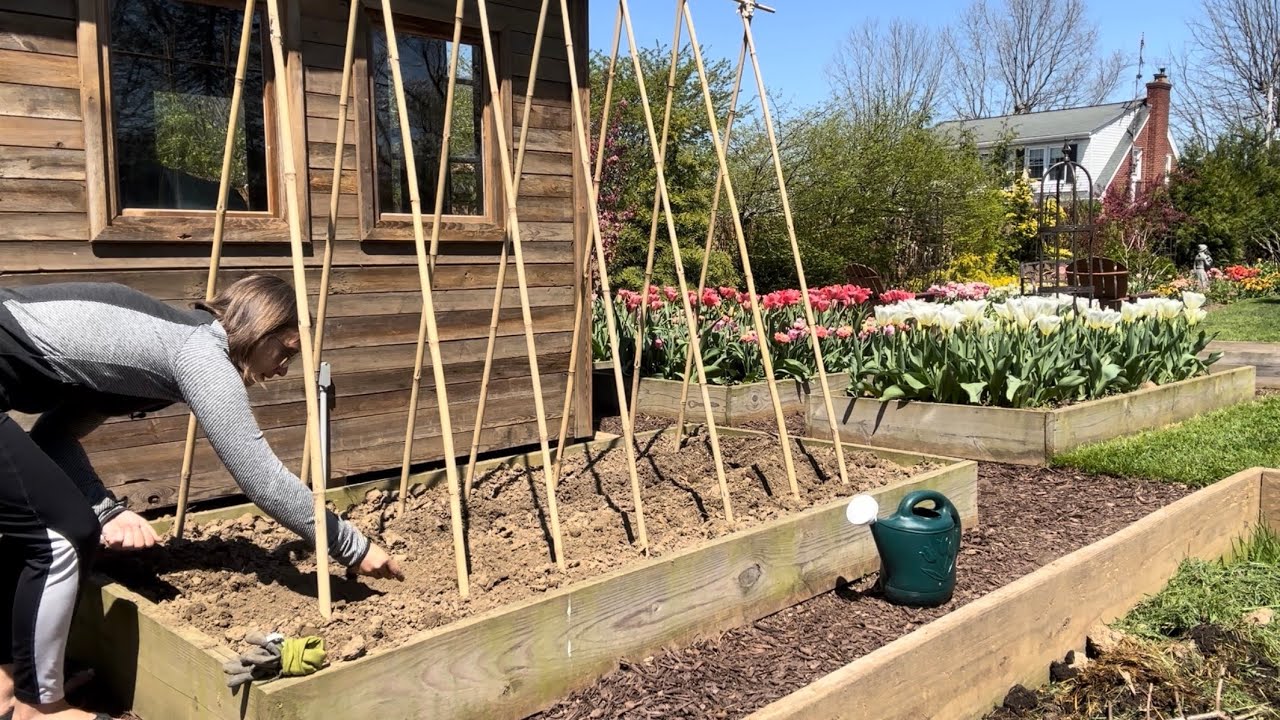
Fixing a BIG Garden Problem with a BASIC Plant, Healing Compacted Soil with Hyacinth Bean & Radishes
video description
Date: 2024-04-18
Related videos





Comments and reviews: 20
northlawn_flower_farm
Hi Danielle, I had inherited that same hard compacted clay soil. I have tried multiple things in different places (depending on situation like sun or shade and near a path etceterea. For the garden near the conifer hedge, it looks like part sun and also as quite a large area, so my suggestion is geranium macrorrizhome. And then let the worms work their magic. After a couple of years it will have gotten enough organic matter from the leaves that it will improve without you ever having to do maintenance. And it can be removed relatively easily after those years of improvement if you then want to plant up that area differently. Plant with augers, a slide of a small clay spade, even a drill if you have to. And plant relatively densely. Better to plant more dense than to plant huge plants far apart. And, same as you do in the these back crop beds, treat it as too-well draining soil so help the plants the first months with water more than you would in the rest of your garden where the soil quality is much better. If I think of more tips, I’ll post them later. Good luck
reply
Hi Danielle, I had inherited that same hard compacted clay soil. I have tried multiple things in different places (depending on situation like sun or shade and near a path etceterea. For the garden near the conifer hedge, it looks like part sun and also as quite a large area, so my suggestion is geranium macrorrizhome. And then let the worms work their magic. After a couple of years it will have gotten enough organic matter from the leaves that it will improve without you ever having to do maintenance. And it can be removed relatively easily after those years of improvement if you then want to plant up that area differently. Plant with augers, a slide of a small clay spade, even a drill if you have to. And plant relatively densely. Better to plant more dense than to plant huge plants far apart. And, same as you do in the these back crop beds, treat it as too-well draining soil so help the plants the first months with water more than you would in the rest of your garden where the soil quality is much better. If I think of more tips, I’ll post them later. Good luck
reply
meluvsquki
I'm quite housebroke, seeing that I moved into my property a couple years ago. My biggest money saving tip is to get a chipdrop if it's available in your area or befriend an arborist. We had an entire truck load of fresh wood chips dumped on our driveway, and spread it all around my beds with some help from friends. I have to say the benefits have been so amazing. The fresh wood chips deprive the top layer of soil of nitrogen so weed pressure is so much less. And the soil underneath the chips I laid last fall is swarming with worms and lush dark soil. I've got long ways to go with my heavy clay, but the chips have helped a lot. It also has aided in exploding the resident spider population and I've yet to see a single aphid in sight which is a stark contrast to last year.
reply
I'm quite housebroke, seeing that I moved into my property a couple years ago. My biggest money saving tip is to get a chipdrop if it's available in your area or befriend an arborist. We had an entire truck load of fresh wood chips dumped on our driveway, and spread it all around my beds with some help from friends. I have to say the benefits have been so amazing. The fresh wood chips deprive the top layer of soil of nitrogen so weed pressure is so much less. And the soil underneath the chips I laid last fall is swarming with worms and lush dark soil. I've got long ways to go with my heavy clay, but the chips have helped a lot. It also has aided in exploding the resident spider population and I've yet to see a single aphid in sight which is a stark contrast to last year.
reply
maryferguson6586
I’ve used composted cow manure for years. I top dress each spring. For the last 2-3 years I’ve put shredded leaves on my beds in the fall. I just leave them and compost over them each spring. My soil is pretty good now, after many years of living with clay soil in Michigan. I’m an 81 year old gardener, who until this year, has gardened with no help. Due to some surgery this winter I’ve hired my granddaughter to help me. I’m hoping she gets bitten by the bug and enjoys gardening as much as I do. I go mainly flowers but a few vegetables also. As I recuperated from my surgery I watched many of your previous videos, they were good for my healing!
reply
I’ve used composted cow manure for years. I top dress each spring. For the last 2-3 years I’ve put shredded leaves on my beds in the fall. I just leave them and compost over them each spring. My soil is pretty good now, after many years of living with clay soil in Michigan. I’m an 81 year old gardener, who until this year, has gardened with no help. Due to some surgery this winter I’ve hired my granddaughter to help me. I’m hoping she gets bitten by the bug and enjoys gardening as much as I do. I go mainly flowers but a few vegetables also. As I recuperated from my surgery I watched many of your previous videos, they were good for my healing!
reply
amyh3619
Leaf mould has been very helpful in my garden beds. Like another commenter, we bought a leaf shredder (ours is from Worx. In the Fall, we shred all our leaves, and also many bags from our neighbors. The first year, I put the shredded leaves directly onto the garden beds in the Fall. We had a very snowy winter which helped them break down a bit. It was okay. But the next year, I shredded them in the Fall and let them compost in a bin over the winter. Turned it once or twice with a fork. By the next Spring, it was garden gold! And free
reply
Leaf mould has been very helpful in my garden beds. Like another commenter, we bought a leaf shredder (ours is from Worx. In the Fall, we shred all our leaves, and also many bags from our neighbors. The first year, I put the shredded leaves directly onto the garden beds in the Fall. We had a very snowy winter which helped them break down a bit. It was okay. But the next year, I shredded them in the Fall and let them compost in a bin over the winter. Turned it once or twice with a fork. By the next Spring, it was garden gold! And free
reply
vickywood8354
Our soil in the mountains is red clay. Every fall we find a place to pile the leaves we rake. It takes time but after a few seasons you have the most beautiful Leaf mold. Also I’ve heard adding gypsum to garden soil helps break up hard soil. I also add dried leaves to the garden each fall and top the leaves with blood meal. Fall is also a great time to top dress with manure. You can also grow red clover in late summer then turn under about a month before you plant in the spring to compost and rot. Adds nitrogen. Good luck
reply
Our soil in the mountains is red clay. Every fall we find a place to pile the leaves we rake. It takes time but after a few seasons you have the most beautiful Leaf mold. Also I’ve heard adding gypsum to garden soil helps break up hard soil. I also add dried leaves to the garden each fall and top the leaves with blood meal. Fall is also a great time to top dress with manure. You can also grow red clover in late summer then turn under about a month before you plant in the spring to compost and rot. Adds nitrogen. Good luck
reply
northlawn_flower_farm
Do a new house and wanted to plant a vegetable garden, right where an old boat used to be parked all the time. The ground was as hard as concrete, and there hadn’t been in the soil in probably 20 or 30 years. I wrote the entire section adding sand and compost. I gave it an entire season to settle with no walking on it. I’m on year two in the soil has never been better. There are earthworms everywhere. It just takes time and patience to reclaim what once was. You’re doing an amazing job lunch so much.
reply
Do a new house and wanted to plant a vegetable garden, right where an old boat used to be parked all the time. The ground was as hard as concrete, and there hadn’t been in the soil in probably 20 or 30 years. I wrote the entire section adding sand and compost. I gave it an entire season to settle with no walking on it. I’m on year two in the soil has never been better. There are earthworms everywhere. It just takes time and patience to reclaim what once was. You’re doing an amazing job lunch so much.
reply
madambutterfly5343
I had to resort to ordering soil mix from a local garden center. They have a special mix of soil that contains compost and organic matter. I ordered the mix to be mixed 50/50. 50% top soil with 50% their mix. I buy it by the yard, they deliver it in a truck. It’s pricey, but it’s quick. I just use a Wheelbarrow to fill my raised beds. I used this mix last year with added organic fertilizer. Some of my dahlias grew over 8 foot tall. I’m putting in more raised beds this year.
reply
I had to resort to ordering soil mix from a local garden center. They have a special mix of soil that contains compost and organic matter. I ordered the mix to be mixed 50/50. 50% top soil with 50% their mix. I buy it by the yard, they deliver it in a truck. It’s pricey, but it’s quick. I just use a Wheelbarrow to fill my raised beds. I used this mix last year with added organic fertilizer. Some of my dahlias grew over 8 foot tall. I’m putting in more raised beds this year.
reply
marymurphy4825
hi Danielle, My brother-in-law in New Hampshire uses Daikon radish to loosen up the soil underneath his trees, it produces very large radishes with deep roots and works great to loosen up and enrich the soil. You can leave them to decompose or pull them up and bake them or boil them in stews and soups, or just slice and eat in a salad. Hope this helps, thanks for the tips and good luck with the hyacinth bean on the trellis. it will be so pretty
reply
hi Danielle, My brother-in-law in New Hampshire uses Daikon radish to loosen up the soil underneath his trees, it produces very large radishes with deep roots and works great to loosen up and enrich the soil. You can leave them to decompose or pull them up and bake them or boil them in stews and soups, or just slice and eat in a salad. Hope this helps, thanks for the tips and good luck with the hyacinth bean on the trellis. it will be so pretty
reply
lissapowell967
I have that same compacted soil here in Indiana. In her early home garden days, Laura from garden answer, has successfully used gypsum. It is another purchase, unfortunately, but can be purchased at your local lumber store. I have not tried it but am considering it. I use alfalfa pellets in the early spring to break down and increase nitrogen levels in the soil. I can make a $ 15 bag last 2 or 3 years. Thanks for the radish tip.
reply
I have that same compacted soil here in Indiana. In her early home garden days, Laura from garden answer, has successfully used gypsum. It is another purchase, unfortunately, but can be purchased at your local lumber store. I have not tried it but am considering it. I use alfalfa pellets in the early spring to break down and increase nitrogen levels in the soil. I can make a $ 15 bag last 2 or 3 years. Thanks for the radish tip.
reply
MicheleLHarvey
If you roast or pan fry radishes they taste like potatoes! As to amending soil, we have local arborists (road crew) drop wood chip loads for us. We use for the garden path, then scatter when it breaks down. A neighboring dairy farmer lets us dig rotted manure from where he dumps it. Perhaps one of your Amish friends could let you have some bucketfuls. Of course, never use 'hot', but can apply in fall & let rot/mellow over winter.
reply
If you roast or pan fry radishes they taste like potatoes! As to amending soil, we have local arborists (road crew) drop wood chip loads for us. We use for the garden path, then scatter when it breaks down. A neighboring dairy farmer lets us dig rotted manure from where he dumps it. Perhaps one of your Amish friends could let you have some bucketfuls. Of course, never use 'hot', but can apply in fall & let rot/mellow over winter.
reply
aalejardin
Danielle, you have an amazing community here. Your videos are great and the comments today are so helpful. I am dealing with the clay/rock/gravel mixture that was used as fill when our property was developed. By weight my biggest crop is surely rocks, which I am resigned to removing as I go along, at least the larger specimens. In the meantime I am going to try some cover crops and always more leaves, mulch and wood chips.
reply
Danielle, you have an amazing community here. Your videos are great and the comments today are so helpful. I am dealing with the clay/rock/gravel mixture that was used as fill when our property was developed. By weight my biggest crop is surely rocks, which I am resigned to removing as I go along, at least the larger specimens. In the meantime I am going to try some cover crops and always more leaves, mulch and wood chips.
reply
philodendron3736
I have grey clay soil and we left a large circle cut wood stump laying flat in the middle of the lawn for a full season. We moved the wood cut stump to plant a tree. And the soil was the mostly crumbly easy soil I ever dug into vs the rest of yard. So I’m currently experimenting with having more logs sitting on the ground with drilled holes for the mason bees just sitting in spots I want to plant in for next year.
reply
I have grey clay soil and we left a large circle cut wood stump laying flat in the middle of the lawn for a full season. We moved the wood cut stump to plant a tree. And the soil was the mostly crumbly easy soil I ever dug into vs the rest of yard. So I’m currently experimenting with having more logs sitting on the ground with drilled holes for the mason bees just sitting in spots I want to plant in for next year.
reply
kristenp8472
I think using the problem areas for composting would work well. And then after a period of time, tilling the compost into the soil. I also have a small tiller that seems to do a great job of getting some movement into the earth. I think it's from the greenworks series Also, I know moving the library was an unexpected change and pain in the butt, but I think its new location actually works better in your landscape!
reply
I think using the problem areas for composting would work well. And then after a period of time, tilling the compost into the soil. I also have a small tiller that seems to do a great job of getting some movement into the earth. I think it's from the greenworks series Also, I know moving the library was an unexpected change and pain in the butt, but I think its new location actually works better in your landscape!
reply
wbflowersvt
I have heard daikon radish as a cover crop is great at breaking up compacted soil. Maybe a broadfork would be helpful Could test with a garden fork, maybe Just stick it in and rock back and forth But not if you can't even get an implement into the soil! Might watering the spot first make a difference or would you just have a big puddle Whatever the solution is, I believe you'll find it!
reply
I have heard daikon radish as a cover crop is great at breaking up compacted soil. Maybe a broadfork would be helpful Could test with a garden fork, maybe Just stick it in and rock back and forth But not if you can't even get an implement into the soil! Might watering the spot first make a difference or would you just have a big puddle Whatever the solution is, I believe you'll find it!
reply
valeriestewart467
Big sunflowers! I heard from others that thickly planted sunflowers can break up compacted soil and improve it. Make a mound to sprout them on top of soil to sprout them. Also burying food scraps in the soilhowever if you cannot dig it then burying food scraps might be impossible. You need big roots to break up that compaction. Gracie lost in thoughts of bones and flowers.
reply
Big sunflowers! I heard from others that thickly planted sunflowers can break up compacted soil and improve it. Make a mound to sprout them on top of soil to sprout them. Also burying food scraps in the soilhowever if you cannot dig it then burying food scraps might be impossible. You need big roots to break up that compaction. Gracie lost in thoughts of bones and flowers.
reply
cathymccall9846
Great plan. I know one year I wanted to fix as it were, my back yard compacted SC clay soil and used a cover crop mix from True Leaf. It is a bit of extra work in terms of timing each spring when it needs to be terminated as there is such a mixture of grass, daikon radish, hairy vetch, etc. But ultimately It worked and as I mow in succession it shows it has worked.
reply
Great plan. I know one year I wanted to fix as it were, my back yard compacted SC clay soil and used a cover crop mix from True Leaf. It is a bit of extra work in terms of timing each spring when it needs to be terminated as there is such a mixture of grass, daikon radish, hairy vetch, etc. But ultimately It worked and as I mow in succession it shows it has worked.
reply
marianhintz9981
When we built our house I use compost that is free from the city I live in. I put that in every year for multiple years. Our city yard waist from our yards and then gives it away for free. You have to have a truck to pick it up. It’s a lot of work to shovel it out of the truck but so worth it. The soil is beautiful and full of earth worms and very rich looking!
reply
When we built our house I use compost that is free from the city I live in. I put that in every year for multiple years. Our city yard waist from our yards and then gives it away for free. You have to have a truck to pick it up. It’s a lot of work to shovel it out of the truck but so worth it. The soil is beautiful and full of earth worms and very rich looking!
reply
dianepuskas6362
Hello, the garden is springing to life before our eyes! Such a wonderful time of year. For your soil, I have grown lots of green beans and left the roots in afterwards. They have the nodules on their roots to help fix the soil. Dandelions, like daikon radish, has long tap roots that also help break up the soil. PSA-Don't forget to wear your sunscreen: -)
reply
Hello, the garden is springing to life before our eyes! Such a wonderful time of year. For your soil, I have grown lots of green beans and left the roots in afterwards. They have the nodules on their roots to help fix the soil. Dandelions, like daikon radish, has long tap roots that also help break up the soil. PSA-Don't forget to wear your sunscreen: -)
reply
carolmcintyre8485
Free grass clippings as a much. It keeps the soil moist and the worms with use it for food. They are full of nitrogen so when it rains they feed your plants. And of course, all the leaves you can get in the fall topped with more grass clipping. I've used this method for years, it works. Keep the soil covered, right
reply
Free grass clippings as a much. It keeps the soil moist and the worms with use it for food. They are full of nitrogen so when it rains they feed your plants. And of course, all the leaves you can get in the fall topped with more grass clipping. I've used this method for years, it works. Keep the soil covered, right
reply
kathleenvadney6217
It might be really helpful to sprinkle Espoma Biotone over the top of the soil and water in since it contains some microrhiza(spelling. It wouldn’t take much. It has been really helpful for me where the soil was like concrete and so hard to work. Good luck. I’m still working to add mulch every chance I get.
reply
It might be really helpful to sprinkle Espoma Biotone over the top of the soil and water in since it contains some microrhiza(spelling. It wouldn’t take much. It has been really helpful for me where the soil was like concrete and so hard to work. Good luck. I’m still working to add mulch every chance I get.
reply
Add a review, comment
Other channel videos