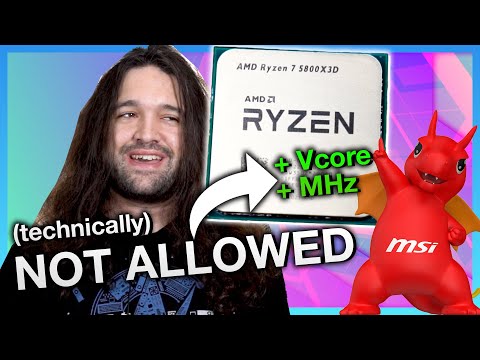
Breaking AMD's Rules: Overclocking the Ryzen 7 5800X3D (Kombo Strike)
video description
Date: 2022-07-06
Related videos





Comments and reviews: 9
EvoBeard
I wonder if MSI has indeed some sort of slight tweaking method, and the VCore/Freq are simply incorrect with eachother?
IE lvl1 has VCore bumped the most and whatever they do to increase Clocks. But in this case, that's going to lvl3 by mistake and vice versa?
I'm curious, and I know Steve stated 'theoretically' but whether lvl2 actually was an improvement over both lvl1 and lvl3 afterall due to it having an increase in VCore AND Freq magic applied in this situation?
Could be wrong, but I only ask as they may have not tested lvl2 due it being in the middle and deemed pointless?
Could be absolutely wrong of course, but am curious, especially given there have been ways to manipulate the Freq and MSI have have implemented that on a BIOS level.
reply
I wonder if MSI has indeed some sort of slight tweaking method, and the VCore/Freq are simply incorrect with eachother?
IE lvl1 has VCore bumped the most and whatever they do to increase Clocks. But in this case, that's going to lvl3 by mistake and vice versa?
I'm curious, and I know Steve stated 'theoretically' but whether lvl2 actually was an improvement over both lvl1 and lvl3 afterall due to it having an increase in VCore AND Freq magic applied in this situation?
Could be wrong, but I only ask as they may have not tested lvl2 due it being in the middle and deemed pointless?
Could be absolutely wrong of course, but am curious, especially given there have been ways to manipulate the Freq and MSI have have implemented that on a BIOS level.
reply
MY
I am surprised that PBO2/Curve Optimizer is not mentioned at all in this video, because that's basically what Kombo Strike is (a dumbed down version at least). Basically it applies a more aggressive voltage/frequency curve to undervolt the CPU, running at lower voltages at the same frequency or higher frequency at the same voltage (while still allowing the CPU boost algorithm to do its job). Level 1-3 seem to be three different curves with 3 being more aggressive in the undervolt department.
On the X3D you can do that in other boards using PBO2 tuner. Curve Optimizer is officially available on other Zen 3 CPUs and can be accessed via BIOS or Ryzen Master.
reply
I am surprised that PBO2/Curve Optimizer is not mentioned at all in this video, because that's basically what Kombo Strike is (a dumbed down version at least). Basically it applies a more aggressive voltage/frequency curve to undervolt the CPU, running at lower voltages at the same frequency or higher frequency at the same voltage (while still allowing the CPU boost algorithm to do its job). Level 1-3 seem to be three different curves with 3 being more aggressive in the undervolt department.
On the X3D you can do that in other boards using PBO2 tuner. Curve Optimizer is officially available on other Zen 3 CPUs and can be accessed via BIOS or Ryzen Master.
reply
Hans
I tested this myself on my MEG B550 UNIFY and found a significant lower power consumption and temperatures with same performance in gaming only my Cinebench R23 score improved. My average temperature dropped by 9 from 81.3 to 72.3 at Kombo Strike level 3 and my average power consumption dropped 14W from 112.2W to 98.2W. This is pretty weird. I'm keeping it on level 3 for now because I see no downside. I'm getting the same performance with lower temperatures and with less power. I posted my results on /r/hardware a couple of days ago but it looks like I can't post the link.
reply
I tested this myself on my MEG B550 UNIFY and found a significant lower power consumption and temperatures with same performance in gaming only my Cinebench R23 score improved. My average temperature dropped by 9 from 81.3 to 72.3 at Kombo Strike level 3 and my average power consumption dropped 14W from 112.2W to 98.2W. This is pretty weird. I'm keeping it on level 3 for now because I see no downside. I'm getting the same performance with lower temperatures and with less power. I posted my results on /r/hardware a couple of days ago but it looks like I can't post the link.
reply
TheSteelRodent
I do find it peculiar that the 5800X acts the way it does, or maybe there's just something about it I don't understand. The 3800X on stock settings auto-boosts to higher clockspeeds the more you cool it (at least mine went from 4.3 GHz to 4.55 GHz just by swapping out the stock cooler for a Hyper 212), but the 5800X seem to have a very limited frequency range it's willing to run at no matter what you do to it, and yet it uses less power and runs cooler than 3800X.
reply
I do find it peculiar that the 5800X acts the way it does, or maybe there's just something about it I don't understand. The 3800X on stock settings auto-boosts to higher clockspeeds the more you cool it (at least mine went from 4.3 GHz to 4.55 GHz just by swapping out the stock cooler for a Hyper 212), but the 5800X seem to have a very limited frequency range it's willing to run at no matter what you do to it, and yet it uses less power and runs cooler than 3800X.
reply
bluedragon219123
HardWare Bot's Over Clocking challenge sounds great...until people try to OC on hardware they shouldn't. OC parts yes but using barely better than stock Coolers and Motherboards that don't have great VRMs and putting in numbers into the BIOs, or other application, that shouldn't be done even on higher end systems and cooling. Lots of dead components are going to come from this and blessedly HardWare Bot won't take any of the blame. :)
reply
HardWare Bot's Over Clocking challenge sounds great...until people try to OC on hardware they shouldn't. OC parts yes but using barely better than stock Coolers and Motherboards that don't have great VRMs and putting in numbers into the BIOs, or other application, that shouldn't be done even on higher end systems and cooling. Lots of dead components are going to come from this and blessedly HardWare Bot won't take any of the blame. :)
reply
Sorappoli
You guys should do a build using the smallest pc case you can possibly get your hands on and use a Zen 4 APU only when it comes out and see if it's actually something good to use as is. It would probably be a pain but it would be interesting to see how small you can go for a decent enough gaming system without a dGPU. I personally find this a really interesting way of doing things. See what you can make to possibly rival Intel's NUC stuff.
reply
You guys should do a build using the smallest pc case you can possibly get your hands on and use a Zen 4 APU only when it comes out and see if it's actually something good to use as is. It would probably be a pain but it would be interesting to see how small you can go for a decent enough gaming system without a dGPU. I personally find this a really interesting way of doing things. See what you can make to possibly rival Intel's NUC stuff.
reply
John
I don't want to support this type of content. I'll watch it, but I won't support it. I run an ad-blocker as well, so Gamers Nexus won't even get ad revenue. How do you like them apples, Steve? Now run along, computer boy --- and make me more content --- serve it to me on a silver platter with a smile.
Edit: Just disliked the video as well, for good measure. I'm just the worst type of person there is!
reply
I don't want to support this type of content. I'll watch it, but I won't support it. I run an ad-blocker as well, so Gamers Nexus won't even get ad revenue. How do you like them apples, Steve? Now run along, computer boy --- and make me more content --- serve it to me on a silver platter with a smile.
Edit: Just disliked the video as well, for good measure. I'm just the worst type of person there is!
reply
remainsdefeated
wasnt this a big thing a few years back? where boards from different manufacturers were shown to be doing a behind-the-scenes overclock without the user knowing? i remember reading an article on it. is that maybe why the gigabyte board is better stock to stock? of course i guess it could just also be a better product, but the stock voltage interested me and reminded me of that.
reply
wasnt this a big thing a few years back? where boards from different manufacturers were shown to be doing a behind-the-scenes overclock without the user knowing? i remember reading an article on it. is that maybe why the gigabyte board is better stock to stock? of course i guess it could just also be a better product, but the stock voltage interested me and reminded me of that.
reply
Robert
It appears that Kombo lv 3 settings on the GN MSI test motherboard provides about the same performance, frequencies, temps, Vcores and power consumption as your Gigabyte standard bench mobo does out of the box, hence the similarities in all numbers.
As for the name Kombo I suspect it's derived from something like KO Mother Board Overclock . Just guessing here though.
reply
It appears that Kombo lv 3 settings on the GN MSI test motherboard provides about the same performance, frequencies, temps, Vcores and power consumption as your Gigabyte standard bench mobo does out of the box, hence the similarities in all numbers.
As for the name Kombo I suspect it's derived from something like KO Mother Board Overclock . Just guessing here though.
reply
Add a review, comment
Other channel videos