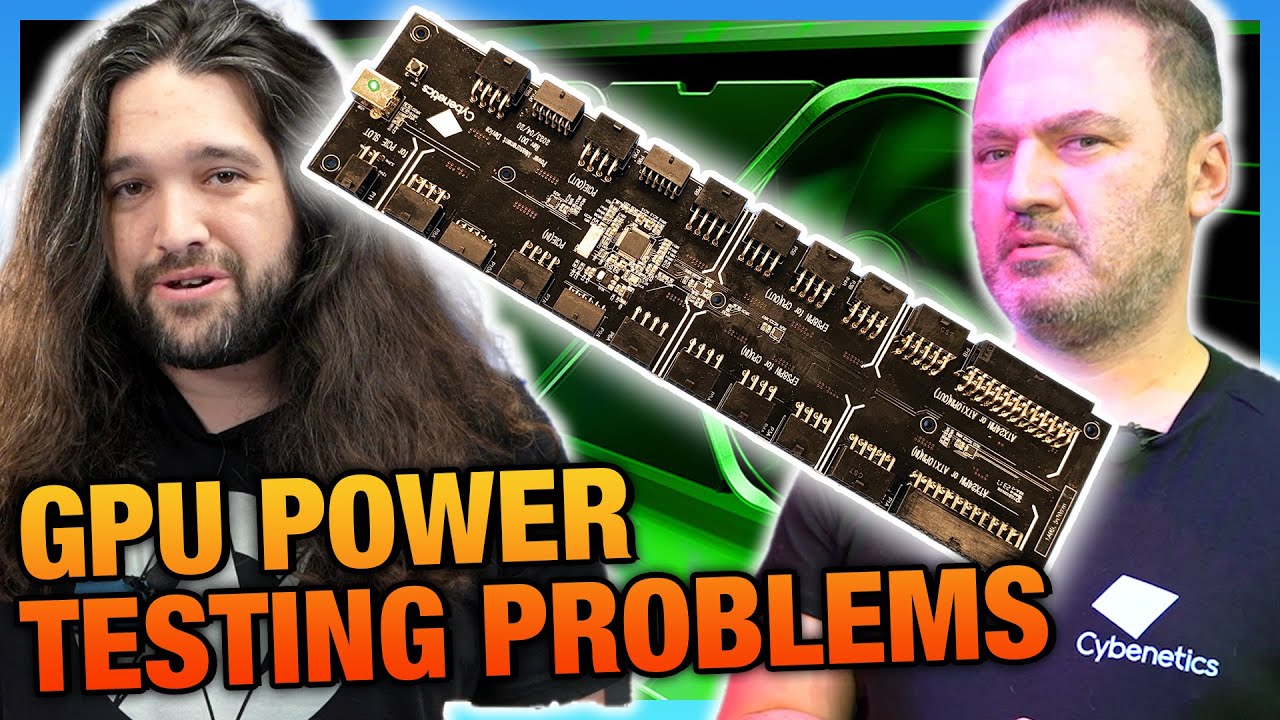
GPU & CPU Power Testing Needs an Overhaul Discussion ft. Aris of Cybenetics
video description
Date: 2023-06-22
Related videos


Comments and reviews: 19
44R0Ndin
I do like the ASUS idea of the high power connectors specifically for high power PCI-e cards.
But like you and Aris said, It needs to be an industry standard or nobody else is going to adopt it .
Like you said, you would need to get PCI-SIG on board with it, but because it's a motherboard power connector, IMO you would be doing the industry a disservice if you put the standard in place without consulting the ATX PSU standards people as well, because let's face it, if the power connector for the GPU is integrated into the motherboard , you should probably get the motherboard power connector people to give their thoughts and/or design detail suggestions.
Right now I'd be calling the standard PCIe High Power Extension or something along those lines, to make it clear from the name alone that this is an optional EXTENSION to the PCIe standard, that has additional connectors that provide HIGH POWER tailored to the needs of higher power draw cards such as GPUs, but it's not JUST GPUs that could make use of this standard!
For a prime non-GPU example of something that could draw more than what a PCIe slot can supply, well, let's put it this way, have you ever wanted to charge your USB-C laptop from your PC while you synch files between them?
For that you usually end up needing a high power USB Host Bus Adapter, that spits out at least one USB-C port that supports USB-C Power Delivery. Even in it's basic form, USB-C PD is rated to supply up to 100 watts to a device (using cables that are electronically marked to indicate that they're rated to carry the 20 volts at 5 amps that the 100w is supplied as), and last I checked a PCIe slot is already limited to a maximum electrical power supply of 100W or less... so it doesn't look good for the PCIe slot if that USB HBA spits out even 2 USB-C PD compatible ports (doesn't matter internal or external either, they're present and that creates a potential problem of too much power draw from the PCIe slot that needs to be addressed).
And with most things switching over to USB-3.0 C or A, the USB-A ports are going to need to start supporting PD 3.0 as well.
Now, granted a standard PCIe 4.0 and earlier 6 or 8 pin PSU connector would do that job, but I don't think that connector is going to be supported forever.
Instead, we could be plugging more EPS12v connectors into the motherboard (where we have the real estate to not be worried about size and therefore aren't forced to use the +12vHPWR connector, which IMO is a good thing because it seems that where that connector is (outside of data centers), fires and/or melted connectors follow far more frequently than is tolerable (for myself at least). And as for getting the power the last mile from the motherboard to the PCIe slot, that's where the PCIe High Power Extension standard comes in to play.
Of course, we already know we're going to need nice wide traces on the PCB to handle these higher currents (600w at 12v is up to 50A, and that's a LOT, even for tinned traces), but I'm thinking we're going to go a step further and specify a thicker copper layer on the PCB as well. Now yes, that's more expensive, but it does something useful, namely it makes the cross-sectional area of the trace larger. It does so at a faster rate than just making the trace wider will, and board real estate for power traces is limited by the need for so many other kinds of traces on the PCB already (as well as the real estate used for all the different kinds of vias and connectors and pins and the like, and that's not even mentioning the things like the southbridge chip, and sockets for things like CPU and RAM).
reply
I do like the ASUS idea of the high power connectors specifically for high power PCI-e cards.
But like you and Aris said, It needs to be an industry standard or nobody else is going to adopt it .
Like you said, you would need to get PCI-SIG on board with it, but because it's a motherboard power connector, IMO you would be doing the industry a disservice if you put the standard in place without consulting the ATX PSU standards people as well, because let's face it, if the power connector for the GPU is integrated into the motherboard , you should probably get the motherboard power connector people to give their thoughts and/or design detail suggestions.
Right now I'd be calling the standard PCIe High Power Extension or something along those lines, to make it clear from the name alone that this is an optional EXTENSION to the PCIe standard, that has additional connectors that provide HIGH POWER tailored to the needs of higher power draw cards such as GPUs, but it's not JUST GPUs that could make use of this standard!
For a prime non-GPU example of something that could draw more than what a PCIe slot can supply, well, let's put it this way, have you ever wanted to charge your USB-C laptop from your PC while you synch files between them?
For that you usually end up needing a high power USB Host Bus Adapter, that spits out at least one USB-C port that supports USB-C Power Delivery. Even in it's basic form, USB-C PD is rated to supply up to 100 watts to a device (using cables that are electronically marked to indicate that they're rated to carry the 20 volts at 5 amps that the 100w is supplied as), and last I checked a PCIe slot is already limited to a maximum electrical power supply of 100W or less... so it doesn't look good for the PCIe slot if that USB HBA spits out even 2 USB-C PD compatible ports (doesn't matter internal or external either, they're present and that creates a potential problem of too much power draw from the PCIe slot that needs to be addressed).
And with most things switching over to USB-3.0 C or A, the USB-A ports are going to need to start supporting PD 3.0 as well.
Now, granted a standard PCIe 4.0 and earlier 6 or 8 pin PSU connector would do that job, but I don't think that connector is going to be supported forever.
Instead, we could be plugging more EPS12v connectors into the motherboard (where we have the real estate to not be worried about size and therefore aren't forced to use the +12vHPWR connector, which IMO is a good thing because it seems that where that connector is (outside of data centers), fires and/or melted connectors follow far more frequently than is tolerable (for myself at least). And as for getting the power the last mile from the motherboard to the PCIe slot, that's where the PCIe High Power Extension standard comes in to play.
Of course, we already know we're going to need nice wide traces on the PCB to handle these higher currents (600w at 12v is up to 50A, and that's a LOT, even for tinned traces), but I'm thinking we're going to go a step further and specify a thicker copper layer on the PCB as well. Now yes, that's more expensive, but it does something useful, namely it makes the cross-sectional area of the trace larger. It does so at a faster rate than just making the trace wider will, and board real estate for power traces is limited by the need for so many other kinds of traces on the PCB already (as well as the real estate used for all the different kinds of vias and connectors and pins and the like, and that's not even mentioning the things like the southbridge chip, and sockets for things like CPU and RAM).
reply
LeitoAE
GPU power connector on motherboard:
One of the point was shorter cables - less voltage drop and higher efficiency. I think that we already can shorten the cables using today's connector. Simply move the connector to the other side of PCB. For long GPUs you will need the cut out in case, for shorter GPUs where connector would end up in motherboard area - mount power connector on the shorter side of PCB - like few manufacturers do. Mounting GPU power connector on motherboard is not a good idea. Not in the way that prototype does it. You simply add one more set of connectors that may fail and is a point of voltage drop.
Connector in motherboard makes sense only when we switch to only 12V PSUs, where all other voltages are being handled by motherboard. In this case you have one set of powerfull connectors that supply motherboard with 12V and a portion of that goes to GPU.
Still this solution generates another problem. What if Today I build a system with mid range CPU and GPU and then I upgrade CPU and after that I wanna upgrade a GPU to a more powerfull. My motherboard's GPU power connector can handle only 300W GPU and I have 500W GPU. To not burn out motherboard we are going to need a set of data connectors that handle power negotiations between motherboard and GPU. So you can end up in a situation when your CPU is powerfull enaugh to run with new GPU, your power supply is powerfull enaugh to power your GPU, but... Your motherboard connector can not handle more power and you end up with bottleneck... We should simplify the connection, not complicate it.
reply
GPU power connector on motherboard:
One of the point was shorter cables - less voltage drop and higher efficiency. I think that we already can shorten the cables using today's connector. Simply move the connector to the other side of PCB. For long GPUs you will need the cut out in case, for shorter GPUs where connector would end up in motherboard area - mount power connector on the shorter side of PCB - like few manufacturers do. Mounting GPU power connector on motherboard is not a good idea. Not in the way that prototype does it. You simply add one more set of connectors that may fail and is a point of voltage drop.
Connector in motherboard makes sense only when we switch to only 12V PSUs, where all other voltages are being handled by motherboard. In this case you have one set of powerfull connectors that supply motherboard with 12V and a portion of that goes to GPU.
Still this solution generates another problem. What if Today I build a system with mid range CPU and GPU and then I upgrade CPU and after that I wanna upgrade a GPU to a more powerfull. My motherboard's GPU power connector can handle only 300W GPU and I have 500W GPU. To not burn out motherboard we are going to need a set of data connectors that handle power negotiations between motherboard and GPU. So you can end up in a situation when your CPU is powerfull enaugh to run with new GPU, your power supply is powerfull enaugh to power your GPU, but... Your motherboard connector can not handle more power and you end up with bottleneck... We should simplify the connection, not complicate it.
reply
Blahorga
As a PC tech who was around long before 80+ was introduced it's sometimes hard to remember that not everyone knows what the standard means, and what is tested. When he says it has some weak spots that's framing it mildly. Remember that it only is concerned with power efficiency at a few select loads. It says nothing about the quality of the power, other than make sure it meats minimum ATX spec. That's all. It has nothing to do with quality of the PSU, though in the early years it took a lot of work to meet even the basic 80+ standard, so those PSU's tended to be of at least decent quality. Today that's well known tech and even the cheapest and shoddily made PSU can be built to 80+ spec. Gold was relatively safe to assume that they wouldn't be terrible for a few years, and then Platinum. Titanium grade is the new hotness, and yet there's no guarantee that the power they provide is clean and stable, or at least that it's not better than ATX spec.
Having said that the latest Titanium grade PSU's are still likely to be of at least decent quality. Likely but not guaranteed.
So yea, a new and improved standard would be a good thing. I'm not envious of him though. Trying to get PSU manufacturers to agree to follow a standard that actually risk pointing out less well performing PSU's in their line up will have to be like herding cats!
reply
As a PC tech who was around long before 80+ was introduced it's sometimes hard to remember that not everyone knows what the standard means, and what is tested. When he says it has some weak spots that's framing it mildly. Remember that it only is concerned with power efficiency at a few select loads. It says nothing about the quality of the power, other than make sure it meats minimum ATX spec. That's all. It has nothing to do with quality of the PSU, though in the early years it took a lot of work to meet even the basic 80+ standard, so those PSU's tended to be of at least decent quality. Today that's well known tech and even the cheapest and shoddily made PSU can be built to 80+ spec. Gold was relatively safe to assume that they wouldn't be terrible for a few years, and then Platinum. Titanium grade is the new hotness, and yet there's no guarantee that the power they provide is clean and stable, or at least that it's not better than ATX spec.
Having said that the latest Titanium grade PSU's are still likely to be of at least decent quality. Likely but not guaranteed.
So yea, a new and improved standard would be a good thing. I'm not envious of him though. Trying to get PSU manufacturers to agree to follow a standard that actually risk pointing out less well performing PSU's in their line up will have to be like herding cats!
reply
Ken
I think people fundamentally misunderstand the 80+ standard and who it is primarily meant for.
It is an efficiency standard. It is just about how efficiently the PSU converts the AC it draws from the supply into DC. For the average home user the difference between an 80+ certified and 80+ Titanium PSU will amount to a dollar or two in operating costs per year, at most.
For a data center operator with hundreds to thousands of PSU's all drawing 1200+ W the differences just between 80+ Platinum and 80+ Titanium PSU's can have a marked effect on the monthly electric bill.
It is true that PSU manufacturers started marketing the standard to main stream consumers with the implicit argument that the higher the efficiency rating the better the physical quality of the PSU must be. For many manufacturers that is the case and it is a reliable marker for quality for brands like Silverstone. The problem is that is relatively easy to just concentrate on the efficiency and ignore the safety features etc. qualify for the rating and produce a low quality PSU for less reputable brands.
reply
I think people fundamentally misunderstand the 80+ standard and who it is primarily meant for.
It is an efficiency standard. It is just about how efficiently the PSU converts the AC it draws from the supply into DC. For the average home user the difference between an 80+ certified and 80+ Titanium PSU will amount to a dollar or two in operating costs per year, at most.
For a data center operator with hundreds to thousands of PSU's all drawing 1200+ W the differences just between 80+ Platinum and 80+ Titanium PSU's can have a marked effect on the monthly electric bill.
It is true that PSU manufacturers started marketing the standard to main stream consumers with the implicit argument that the higher the efficiency rating the better the physical quality of the PSU must be. For many manufacturers that is the case and it is a reliable marker for quality for brands like Silverstone. The problem is that is relatively easy to just concentrate on the efficiency and ignore the safety features etc. qualify for the rating and produce a low quality PSU for less reputable brands.
reply
Sam
16:34 how many PCB layers you need to carry the power through the board This should be a non-issue, they require the same number of PCB power and ground planes to carry the power from the PCIE connectors as they would need to carry it from the new power foot.
Next regarding the power handling capabilities of the power foot, I did some looking and that part seems to be the HD Plus card edge power connector from TE connectivity, and is designed for data center equipment. They rate it for 25A per power connector, and this unit has eight. Molex has ones that will do 40A per contact. (although that's with a 30C temp rise, Keeping the temp under +10c, you have 15A per contact, which is still a lot more than they are pushing through this.
Even the smaller PCIe connector can handle 3a per contact (in some of the more premium versions) and these are wider than normal signal connectors.
So 600A should be easily doable. Of course you will want to measure it.
reply
16:34 how many PCB layers you need to carry the power through the board This should be a non-issue, they require the same number of PCB power and ground planes to carry the power from the PCIE connectors as they would need to carry it from the new power foot.
Next regarding the power handling capabilities of the power foot, I did some looking and that part seems to be the HD Plus card edge power connector from TE connectivity, and is designed for data center equipment. They rate it for 25A per power connector, and this unit has eight. Molex has ones that will do 40A per contact. (although that's with a 30C temp rise, Keeping the temp under +10c, you have 15A per contact, which is still a lot more than they are pushing through this.
Even the smaller PCIe connector can handle 3a per contact (in some of the more premium versions) and these are wider than normal signal connectors.
So 600A should be easily doable. Of course you will want to measure it.
reply
Der
I've been in test & measurement for a long, long time, and have worked with the best in the business , and any time that you put something between the power supply and a DUT, it is, as they say, non-trivial , and measurements need to be taken over all of the operational envelope, and as many sets of modes as possible, and, keep looking for the rogue wave ... itps not just a measurement, it's probabilities, and the ability to trigger on, and capture, the most elusive events...this requires, for tough measurements, and robust results, oscilloscopes that cost well more than 1,000, more like beginning at 10k, and, then, probing..... great fun, but not for the faint of heart. Look up Picotest, Rohde&Schwarz, Keysight, Tektronix, Teledyne LeCroy... have a look at the Signal Integrity mailing list.
Great to see you guys taking it to a level that some people are not happy with ;-)
reply
I've been in test & measurement for a long, long time, and have worked with the best in the business , and any time that you put something between the power supply and a DUT, it is, as they say, non-trivial , and measurements need to be taken over all of the operational envelope, and as many sets of modes as possible, and, keep looking for the rogue wave ... itps not just a measurement, it's probabilities, and the ability to trigger on, and capture, the most elusive events...this requires, for tough measurements, and robust results, oscilloscopes that cost well more than 1,000, more like beginning at 10k, and, then, probing..... great fun, but not for the faint of heart. Look up Picotest, Rohde&Schwarz, Keysight, Tektronix, Teledyne LeCroy... have a look at the Signal Integrity mailing list.
Great to see you guys taking it to a level that some people are not happy with ;-)
reply
Durahl
Concerning the last bit with the Motherboard Power Connector - Personally, the biggest mystery to me regarding the whole Connector Debacle ( you know... them melting and stuff ) is why they're not using something like the XT90 from the RC Model Industry that have a 90A / 500V rating... Proper High Strand Silicone Cables while certainly not as flexible as those flimsy ones currently in use would still flexible enough to be routed everywhere even inside the tiniest Case Formfactors and - IMHO - would greatly add to the aesthetics due to less but thicker cables being visible at a time.
reply
Concerning the last bit with the Motherboard Power Connector - Personally, the biggest mystery to me regarding the whole Connector Debacle ( you know... them melting and stuff ) is why they're not using something like the XT90 from the RC Model Industry that have a 90A / 500V rating... Proper High Strand Silicone Cables while certainly not as flexible as those flimsy ones currently in use would still flexible enough to be routed everywhere even inside the tiniest Case Formfactors and - IMHO - would greatly add to the aesthetics due to less but thicker cables being visible at a time.
reply
Ronny
Good then one can actually test Sea sonic PSU's since everyone (including you) say they are perfect superior and all that. and i DISAGREE with that.
Since my last sea sonic 650W got way to HOT powering my 5900x and 5700XT it was a platinum version
Replaced that (crap) with an Delta one (go look it up noobs they are older then you) 650w platinum one. can game ALL day and gets slightly warm.
That temperature comes from somewhere in that Sea Sonic power supply and it aint that efficiency label that's on it.........
reply
Good then one can actually test Sea sonic PSU's since everyone (including you) say they are perfect superior and all that. and i DISAGREE with that.
Since my last sea sonic 650W got way to HOT powering my 5900x and 5700XT it was a platinum version
Replaced that (crap) with an Delta one (go look it up noobs they are older then you) 650w platinum one. can game ALL day and gets slightly warm.
That temperature comes from somewhere in that Sea Sonic power supply and it aint that efficiency label that's on it.........
reply
TT
Can't get enough of these videos where Steve talks to others in the industry, especially those he has a rapport with.
I was aware that Aris was from HW Busters, but did not know about him being the man behind Cybenetiks. I just bought a ATX 3.0 PSU on the strength of its review on both the HW Busters and Cybenetiks websites, so it was reassuring to get an impression of the strong sense of ethics and dedication to quality Aris has.
reply
Can't get enough of these videos where Steve talks to others in the industry, especially those he has a rapport with.
I was aware that Aris was from HW Busters, but did not know about him being the man behind Cybenetiks. I just bought a ATX 3.0 PSU on the strength of its review on both the HW Busters and Cybenetiks websites, so it was reassuring to get an impression of the strong sense of ethics and dedication to quality Aris has.
reply
iRdMoose
I used to work at Intel as a contractor doing power and performance measurement. I know Aris' product isn't meant for a consumer solution, but I would LOVE something like this to act as a distribution board in my gaming desktop that also performed power measurement. Also, if Aris is looking for people to help support this awesome product who have this experience in their background, I'd love to send in my CV.
reply
I used to work at Intel as a contractor doing power and performance measurement. I know Aris' product isn't meant for a consumer solution, but I would LOVE something like this to act as a distribution board in my gaming desktop that also performed power measurement. Also, if Aris is looking for people to help support this awesome product who have this experience in their background, I'd love to send in my CV.
reply
Robert
The VRMs are unlikely to start fires. But one of the many flaws in the 1920 vintage circuit is that if a single FET shorts, the voltage delivered to the CPU or GPU is 12 V. Louis Rossmann states that this is the number one failure mode for the 13 MacBook Pro. Full voltage goes to the SSD and totally fries it. Destroying all information on the SSD. With fried memory chips, data recovery is NOT possible.
reply
The VRMs are unlikely to start fires. But one of the many flaws in the 1920 vintage circuit is that if a single FET shorts, the voltage delivered to the CPU or GPU is 12 V. Louis Rossmann states that this is the number one failure mode for the 13 MacBook Pro. Full voltage goes to the SSD and totally fries it. Destroying all information on the SSD. With fried memory chips, data recovery is NOT possible.
reply
vegeta
In Re using CPU as a dummy load: You can change PL1 at runtime. On linux the interface is in /sys/class/powercap/. Then use PI controller to adjust PL1 so that the externally measured input power is what you want, to correct for error in the CPU's own measurement. (But be aware there will be error due to VRM losses, which will vary between motherboards and with temperature.)
reply
In Re using CPU as a dummy load: You can change PL1 at runtime. On linux the interface is in /sys/class/powercap/. Then use PI controller to adjust PL1 so that the externally measured input power is what you want, to correct for error in the CPU's own measurement. (But be aware there will be error due to VRM losses, which will vary between motherboards and with temperature.)
reply
nauroticdax
funny thing just yesterday I was talking to the mrs while ordering a new psu about how happy I am cybenetics lists a lot of the things I wanted to know at a glance (efficiency, average noise etc) but I was blown away when I looked at one of the full reports it lists EVERYTHING you could ever need to know the man's doing the lords work and I love it
reply
funny thing just yesterday I was talking to the mrs while ordering a new psu about how happy I am cybenetics lists a lot of the things I wanted to know at a glance (efficiency, average noise etc) but I was blown away when I looked at one of the full reports it lists EVERYTHING you could ever need to know the man's doing the lords work and I love it
reply
Demorthus
Edit: My god the way his mind works during the conversation was so exciting! Intellectually stimulating, awesome!
Loved his story about the interaction with NVIDIA, very consistent (poor, that is to say) lol. But, clearly he's passionate, and an all around great mind - I love the whole PSU/Cybernetics system vs. Antiquated 80 Plus certification
reply
Edit: My god the way his mind works during the conversation was so exciting! Intellectually stimulating, awesome!
Loved his story about the interaction with NVIDIA, very consistent (poor, that is to say) lol. But, clearly he's passionate, and an all around great mind - I love the whole PSU/Cybernetics system vs. Antiquated 80 Plus certification
reply
Linus
I saw just some days ago that the seasonic Prime 700w fanless was rated as cybernetics titanium, while also earning a pretty poor review by aris. I became pretty curious about what was not considered in the cybernetics score that Arise saw in the review. I believe it was the response times but i am not sure.
reply
I saw just some days ago that the seasonic Prime 700w fanless was rated as cybernetics titanium, while also earning a pretty poor review by aris. I became pretty curious about what was not considered in the cybernetics score that Arise saw in the review. I believe it was the response times but i am not sure.
reply
sharadeth
CLI is great for automation and scripting, but it may be easier for cybernetics to simply push the data out as udp packets that an automation tool can ingest. I personally find parsing packets easier than getting awk commands to get what I need out of CLI perfect, but that is probably just m
reply
CLI is great for automation and scripting, but it may be easier for cybernetics to simply push the data out as udp packets that an automation tool can ingest. I personally find parsing packets easier than getting awk commands to get what I need out of CLI perfect, but that is probably just m
reply
TheStayHomeDad
I love these videos not only for the fact that I'm learning but Steve/GN you guys just mesh so well with others. It's so nice to see the sharing and learning trade back and forth with others when industries and companies are like No, it's mine and I'm keeping it to myself .
reply
I love these videos not only for the fact that I'm learning but Steve/GN you guys just mesh so well with others. It's so nice to see the sharing and learning trade back and forth with others when industries and companies are like No, it's mine and I'm keeping it to myself .
reply
Robert
Please blame the failures on the bad 1920 circuit design, not on cheap components or faulty construction.
The latest innovation in the 12 V only PSU is simply eliminating the regulators for the other voltages. Since when is eliminating features innovation ?
reply
Please blame the failures on the bad 1920 circuit design, not on cheap components or faulty construction.
The latest innovation in the 12 V only PSU is simply eliminating the regulators for the other voltages. Since when is eliminating features innovation ?
reply
afelias
A guy who's doing power electronics logging that needs some software support? Damn, I wonder if we can pull the open-source-repo + APIs with docu kinda route. Not just for the automation stuff GN mentioned, but all sorts of pipelines for like, data analysis.
reply
A guy who's doing power electronics logging that needs some software support? Damn, I wonder if we can pull the open-source-repo + APIs with docu kinda route. Not just for the automation stuff GN mentioned, but all sorts of pipelines for like, data analysis.
reply
Add a review, comment
Other channel videos