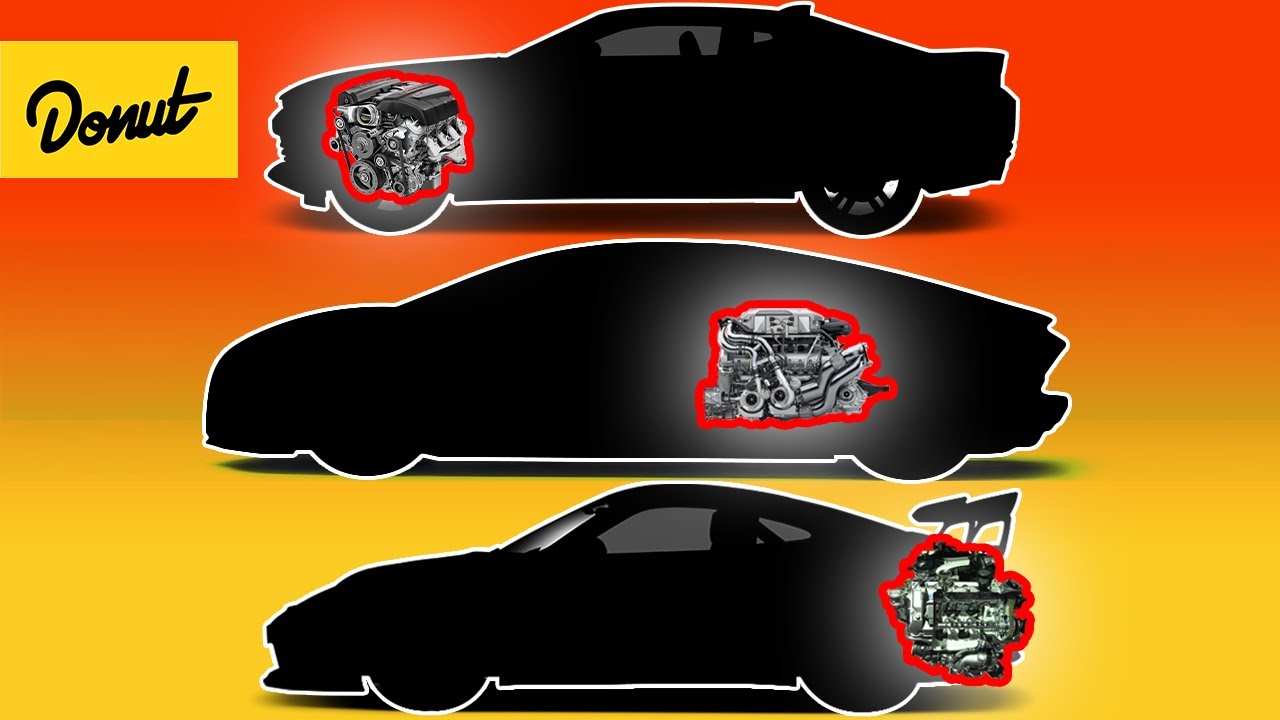
Engine Placement EXPLAINED
video description
Date: 2020-04-07
Related videos


Comments and reviews: 10
Andrew
Donut, I'm extremely happy to see you covering vehicle dynamics. I really appreciate this entire episode for discussing the way engine position and derivations affect vehicle dynamics. However, I have a small but important qualm with the wording or implication of rear engined cars have more rear end traction. It's only partially true. It's not fully correct to blindly say that rear-engined cars have more traction in the rear. That's only true of propulsion-system grip. It doesn't work that way with inertia, like when cornering. You touched on the topic, but your wording leaves a little to be desired. It's not that the rear-engined cars handle like drag cars (which are purpose built to be as steady as possible in a straight line) but rather more that they handle like a dog with its back paws wet, on a tile floor. The inertia of the engine means that the front tires will bite off more than the rear can chew, frankly. Full explanation below. That polar inertia of moment thing becomes a big deal in motorsports and racing, but is almost never talked about by enthusiasts. Also, there is theoretically no limit to how fast a car can go around a corner, except its weight and lack of downforce, almost regardless of engine placement. If you get a car that weighs only 2 pounds, with 335mm wide tires, and 10, 000 pounds of downforce, it would theoretically be almost able to corner at full throttle at top speed without sliding (no under- nor over-steer at all) The more you turn the wheel, the more you turn. Kinda like your Need for Speed/Ridge Racer physics, how you never really have to hit the brakes. You still always want a lightweight car. Implying that rear-engined cars have more grip inherently due to the design is kinda misleading. It's true at a standstill, for sure. But, as soon as you start to get into vehicle dynamics and study weight transfer at high speed, you start to realize that putting the engine behind the rear wheels increases the polar moment of the rear of the car enough to make it almost undriveable without certain design sacrifices. And, cars will always handle better in corners with less weight, unless the weight reduction screws with the weight distribution or polar inertial moment. That's what my little rant about the 2 pound car with 10, 000 pounds of downforce is trying to get across. However, and despite the theoretical limitless grip car, snap back to reality and think about your engine as a fish tank full of water. Pretty heavy, right? 200-800 pounds, usually. Now, imagine that engine on some wooden block wheels, with the front tires being rubber still. When the front tires start to turn, the rear of the car naturally wants to slide out because of Newton's law of the conservation of movement. An object in motion (the engine block) will always want to continue in that direction (perfectly straight ahead) unless acted upon by an outside force (the front tires trying to turn the car. The tires' job is to rotate the car and keep the car from spinning. The weight of the car wants to keep going straight. The heavier the car, the more it resists turning, and the more tire/grip you need to get it to rotate. Or, in the case of a rear-engined car with wooden blocks for rear tires and rubber tires for front tires, to stop rotating. Upon its own axis. Into a tree. Or house. Or whatever it looks at. That's the power of inertia in the world of motorsports and performance driving; it will be the thing that really causes every spin. Reducing the polar moment of inertia works well to make cars handle well, but that can be done in everything from my friend's Subaru rally car (with Group N engine mounts that move the engine back behind the front axle by moving it within the engine bay) to RX-8s having the engine at the very back of the engine bay, to my old Alfa Romeo 75QV which had the 3. 2 V6 in the back of the front engine bay and a [possibly-Ferrari-F40 sourced? ] transaxle at the back. Yes, really. In a truly ideal world, the engine would be in the exact center point of the car, like an LMP1 car, with very little weight, like an F1 car, and huge downforce like the Porsche 919 Evo had. It would be low to the ground like an LMP1 car, including the low roofline, and the engine mounted as low as possible in the chassis. Basically, the most ideal car is an LMP1 car from a design standpoint, but with a Porsche flat 6 in the middle to keep the center of gravity low. Maybe like a higher downforce version of the Porsche 911 GT1 with more power?
reply
Donut, I'm extremely happy to see you covering vehicle dynamics. I really appreciate this entire episode for discussing the way engine position and derivations affect vehicle dynamics. However, I have a small but important qualm with the wording or implication of rear engined cars have more rear end traction. It's only partially true. It's not fully correct to blindly say that rear-engined cars have more traction in the rear. That's only true of propulsion-system grip. It doesn't work that way with inertia, like when cornering. You touched on the topic, but your wording leaves a little to be desired. It's not that the rear-engined cars handle like drag cars (which are purpose built to be as steady as possible in a straight line) but rather more that they handle like a dog with its back paws wet, on a tile floor. The inertia of the engine means that the front tires will bite off more than the rear can chew, frankly. Full explanation below. That polar inertia of moment thing becomes a big deal in motorsports and racing, but is almost never talked about by enthusiasts. Also, there is theoretically no limit to how fast a car can go around a corner, except its weight and lack of downforce, almost regardless of engine placement. If you get a car that weighs only 2 pounds, with 335mm wide tires, and 10, 000 pounds of downforce, it would theoretically be almost able to corner at full throttle at top speed without sliding (no under- nor over-steer at all) The more you turn the wheel, the more you turn. Kinda like your Need for Speed/Ridge Racer physics, how you never really have to hit the brakes. You still always want a lightweight car. Implying that rear-engined cars have more grip inherently due to the design is kinda misleading. It's true at a standstill, for sure. But, as soon as you start to get into vehicle dynamics and study weight transfer at high speed, you start to realize that putting the engine behind the rear wheels increases the polar moment of the rear of the car enough to make it almost undriveable without certain design sacrifices. And, cars will always handle better in corners with less weight, unless the weight reduction screws with the weight distribution or polar inertial moment. That's what my little rant about the 2 pound car with 10, 000 pounds of downforce is trying to get across. However, and despite the theoretical limitless grip car, snap back to reality and think about your engine as a fish tank full of water. Pretty heavy, right? 200-800 pounds, usually. Now, imagine that engine on some wooden block wheels, with the front tires being rubber still. When the front tires start to turn, the rear of the car naturally wants to slide out because of Newton's law of the conservation of movement. An object in motion (the engine block) will always want to continue in that direction (perfectly straight ahead) unless acted upon by an outside force (the front tires trying to turn the car. The tires' job is to rotate the car and keep the car from spinning. The weight of the car wants to keep going straight. The heavier the car, the more it resists turning, and the more tire/grip you need to get it to rotate. Or, in the case of a rear-engined car with wooden blocks for rear tires and rubber tires for front tires, to stop rotating. Upon its own axis. Into a tree. Or house. Or whatever it looks at. That's the power of inertia in the world of motorsports and performance driving; it will be the thing that really causes every spin. Reducing the polar moment of inertia works well to make cars handle well, but that can be done in everything from my friend's Subaru rally car (with Group N engine mounts that move the engine back behind the front axle by moving it within the engine bay) to RX-8s having the engine at the very back of the engine bay, to my old Alfa Romeo 75QV which had the 3. 2 V6 in the back of the front engine bay and a [possibly-Ferrari-F40 sourced? ] transaxle at the back. Yes, really. In a truly ideal world, the engine would be in the exact center point of the car, like an LMP1 car, with very little weight, like an F1 car, and huge downforce like the Porsche 919 Evo had. It would be low to the ground like an LMP1 car, including the low roofline, and the engine mounted as low as possible in the chassis. Basically, the most ideal car is an LMP1 car from a design standpoint, but with a Porsche flat 6 in the middle to keep the center of gravity low. Maybe like a higher downforce version of the Porsche 911 GT1 with more power?
reply
Flyingby
Just a little science intervention here. Yes a rear mid engine layout will improve braking compared to any type of front engine layout. However it doesnt achieve equal loading of the brakes, the front ones still do the heavy lifting. This is where rear engined cars like the 911s start to shine. They can actually approach having equal breaking loads on all four tires. Do you want to know why? Im sorry but Im to lazy to explain. There are some very informative articles about this that you can find in the internet. Edit: All things being equal a mid engine will still outperform the rear engine by a bit, even though a rear engine car has the advantage in braking. The handling benefits of the mid engine more than make up for that.
reply
Just a little science intervention here. Yes a rear mid engine layout will improve braking compared to any type of front engine layout. However it doesnt achieve equal loading of the brakes, the front ones still do the heavy lifting. This is where rear engined cars like the 911s start to shine. They can actually approach having equal breaking loads on all four tires. Do you want to know why? Im sorry but Im to lazy to explain. There are some very informative articles about this that you can find in the internet. Edit: All things being equal a mid engine will still outperform the rear engine by a bit, even though a rear engine car has the advantage in braking. The handling benefits of the mid engine more than make up for that.
reply
Swordz
You do realise Fron/Rear allows perfect 50/50 from to rear weight distribution. Almost all mid engine cars have 55% or more weight to the rear. This difference is why midship cars rotate better. The weight is closer to even, but rear biased. Braking balances the car or even allows front biased weight, whereas in an F/R braking pushes higher weight percentage over the front, acceleration pushes that bias rearward. FR oversteers on corner exit. Mid rear oversteers on corner entry, with improved traction on exit because of rear biased weight. Long winded, apologies. Just felt I had to explain the difference
reply
You do realise Fron/Rear allows perfect 50/50 from to rear weight distribution. Almost all mid engine cars have 55% or more weight to the rear. This difference is why midship cars rotate better. The weight is closer to even, but rear biased. Braking balances the car or even allows front biased weight, whereas in an F/R braking pushes higher weight percentage over the front, acceleration pushes that bias rearward. FR oversteers on corner exit. Mid rear oversteers on corner entry, with improved traction on exit because of rear biased weight. Long winded, apologies. Just felt I had to explain the difference
reply
Gameboy
Front engine does not give you better traction. Traction is connected to load put on tyres. When you accelerate, you get more load on rear tyres. With engine in the back, your rear wheels hve ALL the traction of the world. Engine in the front makes your car unfersteer. That means less front GRIP. When you are braking while turning you have more traction than in rear engined car, but you have less grip since your engine is being pushed forward/outside of the turn by inertia.
reply
Front engine does not give you better traction. Traction is connected to load put on tyres. When you accelerate, you get more load on rear tyres. With engine in the back, your rear wheels hve ALL the traction of the world. Engine in the front makes your car unfersteer. That means less front GRIP. When you are braking while turning you have more traction than in rear engined car, but you have less grip since your engine is being pushed forward/outside of the turn by inertia.
reply
CannedBullets
Shorter wheelbases allow for a reduced moment of inertia because it decreases the resistance to angular acceleration which is the acceleration of a spinning object. The shorter the wheelbase, the less resistance to angular acceleration it has which means a short wheelbase car will be easier to rotate than a long wheelbase car which is why sports cars are usually designed with shorter wheelbases.
reply
Shorter wheelbases allow for a reduced moment of inertia because it decreases the resistance to angular acceleration which is the acceleration of a spinning object. The shorter the wheelbase, the less resistance to angular acceleration it has which means a short wheelbase car will be easier to rotate than a long wheelbase car which is why sports cars are usually designed with shorter wheelbases.
reply
LDN
Porker, Vobble Wagen engine hanging behind the axle is very wrong. Mid engine, ideally the best but really unessential. Front engine, rear transaxle quite good and passengers fitFront engine, ideally behind the front axle, can be just as good. Build the car around the weight. With attention you can move enough weight back to be 50/50Front engine ion front of front axle, BAD. AudiFront drive, very bad.
reply
Porker, Vobble Wagen engine hanging behind the axle is very wrong. Mid engine, ideally the best but really unessential. Front engine, rear transaxle quite good and passengers fitFront engine, ideally behind the front axle, can be just as good. Build the car around the weight. With attention you can move enough weight back to be 50/50Front engine ion front of front axle, BAD. AudiFront drive, very bad.
reply
tom
you missed many of the small 4cyl cars that are front engine front wheel drive with the engine in front of the front wheels. like my '88 honda civic. not quite between the wheels but in front of them, about as much as my '64 ford falcon's 260 v8 is only slightly behind the front wheels. unlike the '65 mustang where the engine is directly between the front wheels.
reply
you missed many of the small 4cyl cars that are front engine front wheel drive with the engine in front of the front wheels. like my '88 honda civic. not quite between the wheels but in front of them, about as much as my '64 ford falcon's 260 v8 is only slightly behind the front wheels. unlike the '65 mustang where the engine is directly between the front wheels.
reply
darquille
I hate that panic has been the death of several cool GM cars. The Corvair, Fiero and the Cobalt all died because of their early years had flaws. I still want a Corvair, but unfortunately the logic of old car expensive because rare and nostalgia still stands regardless of bad reputation
reply
I hate that panic has been the death of several cool GM cars. The Corvair, Fiero and the Cobalt all died because of their early years had flaws. I still want a Corvair, but unfortunately the logic of old car expensive because rare and nostalgia still stands regardless of bad reputation
reply
-Solivagant-
This guy is way too cooler than the other host. The fat blondie (soo cringey. Idk why they used to paint this one as the geeky anti-cool dude. his jokes are funny and overall personality cool despite his looks. Hope to see more of him in this character in the future
reply
This guy is way too cooler than the other host. The fat blondie (soo cringey. Idk why they used to paint this one as the geeky anti-cool dude. his jokes are funny and overall personality cool despite his looks. Hope to see more of him in this character in the future
reply
Shubham
VW headquarters: -Boardroom: - Member 1): - Sir how are we going to deal with the lawsuit from Czech company against our beetle design. Member 2): - It's easy just let our leader invade Czechoslovakia and problem solved. Everyone: - Give this man a promotion.
reply
VW headquarters: -Boardroom: - Member 1): - Sir how are we going to deal with the lawsuit from Czech company against our beetle design. Member 2): - It's easy just let our leader invade Czechoslovakia and problem solved. Everyone: - Give this man a promotion.
reply
Add a review, comment
Other channel videos